Irrefutable legal arguments supporting the right of secession

In EVERY state, the South seceded because it feared for the institution of slavery. Some say that poor whites were fooled by the elites who owned most of the slaves, which btw were the biggest single asset in the US at the time, but I don't buy that. The poor whites feared hordes of free blacks swarming the countryside.

The North, however, did not invade the South over slaves. It invaded to prevent secession from succeeding.
"Poor whites" weren't duped, they heard an invading army was approaching and took to arms. I would have done the same if Obama was marching an army on Idaho, I don't care what the issues were.

Most people aren't that intelligent or politically sophisticated. Their passions and loyalties follow simple codes. Men in Virginia thought of themselves as Virginians before anything else and would fight to defend Virginia. The Left's ignorant hypothesis that thousands of white Southerners marched to defend slavery is stupid ratcheted up fortissimo.

The loyal troops of Virginia etc, all fought to protect their individual states- most of them didn't care about slavery.

But the leadership of the Confederacy, seceded to protect the property rights of slave owners, and led those brave troops of Virginia etc. into a war that was at its root, about defending the right to own human property.

It would be like you fighting defend Idaho after Idaho seceded just to protect billionaires from federal taxation.
 
Bullshit. Secession does not necessarily need to lead to war. When Herr Lincoln Über Alles drew up an invasion army of 75,000 troops and steered them on a clear invasion course, there can be no disputing that he started a war that wasn't necessary and caused the deaths of 600,000 men. He absolutely deserved to be shot in the head by the families of the people he murdered.

Secession does not necessarily need to lead to war- but certainly did in this case- when the South started firing on American troops.

Was it necessary for the United States to respond to the unprovoked attack on American troops?

Hell we declared war on Spain for the mere suspicion that Spain had attacked American sailors.

Bullshit. Those troops were ordered to leave a military installation that no longer belonged to the United States and they refused to do so. .

And who said that the military installation no longer belonged to the United States? Why the people who fired upon them.

South Carolina chose to attack federal troops in a federal fort- to try to enforce its claim that the fort was no longer part of the United States.

And by doing so- fired the first shots of the Civil War- which caused a war that was not necessary- and cost the lives of 600,000.

And they lost the slaves that they were trying to keep ownership of. If they had not seceded- or even had not fired on American troops- they could possibly still be enjoying the ownership of their black slaves to this day.
The garrison commander was given warning to leave peacefully. He chose to stay and die even though he knew he had no functioning warheads to fire back.

That's called suicide.

And? None of that is a response to my post.

And who said that the military installation no longer belonged to the United States? Why the people who fired upon them.

South Carolina chose to attack federal troops in a federal fort- to try to enforce its claim that the fort was no longer part of the United States.

And by doing so- fired the first shots of the Civil War- which caused a war that was not necessary- and cost the lives of 600,000.

And they lost the slaves that they were trying to keep ownership of. If they had not seceded- or even had not fired on American troops- they could possibly still be enjoying the ownership of their black slaves to this day.
No it wasn't the people who fired on them. Soldiers follow orders. The article of secession was notice that South Carolina was withdrawing its membership in the union and rescinding all previous negotiations including the lease of land that Ft. Sumpter was on. The fact that the US government refused to relinquish territory it no longer had rights to is what caused that conflict. That's putting responsibility back where it belongs.
 
Take Lincoln out of the mix- and there would have been no secession.
...
I would clarify that by saying -- take a Republican as president out of the mix - and there would have been no secession.

Go back a few more years, to the the presidential race of 1856. The first time ever a Republican was on the ballot: John C. Fremont. Slavery was a Yoooooge issue. All consuming.

Fremont was against the expansion of slavery, and of course was despised in the South.

Here is a campaign ribbon from 1856:

fremont-rib-1.jpg


Here is an 1856 anti-Fremont ribbon:
heritage0615-5.jpg


(Heh. What do you think they were trying to impress there?)

The South threatened at that time, if an anti-slavery President was elected - it would mean Civil War and "the Conservative South (soon) will burst forth in a carnival of blood..."

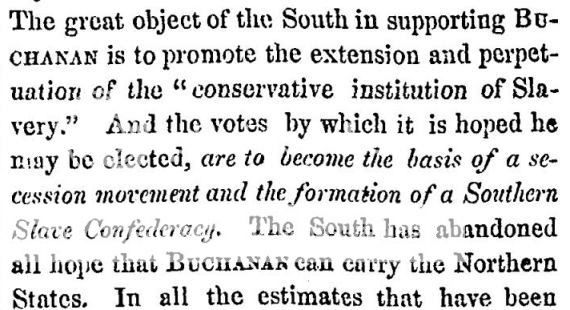
Bold Avowals--The Election of Buchanan to be a Stop Towards Disunion. - Article - NYTimes.com | 1856

<snip>
"The great object of the South in supporting Buchanan is to promote and extend the perpetuation of the "Conservative institution of Slavery." And the votes by which it is hoped he may be elected, are to become the basis of a secession movement and the formation of a Southern Slave Confederacy...

1856FacetheFuture2.jpg
Now, how's this for traitorous:

As the 1856 election drew near, a convention of Governors of the Southern slave states was secretly held at Raleigh, North Carolina. Jefferson Davis -- then the Secretary of War under Franklin Pierce, was full aware of this.

The object was to devise a scheme of rebellion at that time, in the event of the election of Colonel John C. Fremont, the Republican candidate for the Presidency.


Henry Wise, Governor of Virginia at the time ...afterward boasted that, had Fremont been elected, he should have marched, at the head of twenty thousand men, to Washington, taken possession of the Capitol, and prevented the inauguration of the President elect.
Source: Pictorial history of the Civil War in the United States of America - Lossing, 1866

Well, as we know, Buchanan was elected, and that staved off the fury for a few more years.

And get this: James Mason of Virginia, who was the leading Senator, wrote to US Sec. of War, Jeff Davis, later Confederate President, directly requesting him to arm the Southern states for war against the US -- a four full years before -- in any event a Republican would become President.

This was the letter

"I have a letter from WISE, of the 27th, full of spirit. He says the Governments of North Carolina, South Carolina, and Louisiana, have already agreed to rendezvous at Raleigh, and others will—this in your most private ear.

He says, further, that he had officially requested you to exchange with Virginia, on fair terms of difference, percussion for flint muskets. I don't know the usage or power of the Department in such cases, but if it can be done,
even by liberal construction, I hope you will accede. … Virginia probably has more arms than the other Southern States, and would divide in case of need. In a letter yesterday to a Committee in South Carolina. I gave it as my judgment, in the event of FREMONT's election, the South should not pause, but proceed at once to "immediate, absolute, and eternal separation."

As I said earlier, had Fremont been elected, the date of the start of the Civil War would have likely been 1856.

Thank you- interesting sources I had not heard before. I knew about Fremont(and you are right- any Republican would have been the same, but they really seemed to despise Lincoln)
 
Secession does not necessarily need to lead to war- but certainly did in this case- when the South started firing on American troops.

Was it necessary for the United States to respond to the unprovoked attack on American troops?

Hell we declared war on Spain for the mere suspicion that Spain had attacked American sailors.

Bullshit. Those troops were ordered to leave a military installation that no longer belonged to the United States and they refused to do so. .

And who said that the military installation no longer belonged to the United States? Why the people who fired upon them.

South Carolina chose to attack federal troops in a federal fort- to try to enforce its claim that the fort was no longer part of the United States.

And by doing so- fired the first shots of the Civil War- which caused a war that was not necessary- and cost the lives of 600,000.

And they lost the slaves that they were trying to keep ownership of. If they had not seceded- or even had not fired on American troops- they could possibly still be enjoying the ownership of their black slaves to this day.
The garrison commander was given warning to leave peacefully. He chose to stay and die even though he knew he had no functioning warheads to fire back.

That's called suicide.

And? None of that is a response to my post.

And who said that the military installation no longer belonged to the United States? Why the people who fired upon them.

South Carolina chose to attack federal troops in a federal fort- to try to enforce its claim that the fort was no longer part of the United States.

And by doing so- fired the first shots of the Civil War- which caused a war that was not necessary- and cost the lives of 600,000.

And they lost the slaves that they were trying to keep ownership of. If they had not seceded- or even had not fired on American troops- they could possibly still be enjoying the ownership of their black slaves to this day.
No it wasn't the people who fired on them. Soldiers follow orders. The article of secession was notice that South Carolina was withdrawing its membership in the union and rescinding all previous negotiations including the lease of land that Ft. Sumpter was on. The fact that the US government refused to relinquish territory it no longer had rights to is what caused that conflict. That's putting responsibility back where it belongs.

As I said- South Carolina chose to attack federal troops in a federal fort- I was not saying that the soldier who lit the first fuse was at fault- it was the civilian and military command who chose to go to war against the United States and ordered him to fire the first shot

South Carolina chose to attack federal troops in a federal fort- to try to enforce its claim that the fort was no longer part of the United States.

And by doing so- fired the first shots of the Civil War- which caused a war that was not necessary- and cost the lives of 600,000.

And they lost the slaves that they were trying to keep ownership of. If they had not seceded- or even had not fired on American troops- they could possibly still be enjoying the ownership of their black slaves to this day.
 
Take Lincoln out of the mix- and there would have been no secession.
...
I would clarify that by saying -- take a Republican as president out of the mix - and there would have been no secession.

Go back a few more years, to the the presidential race of 1856. The first time ever a Republican was on the ballot: John C. Fremont. Slavery was a Yoooooge issue. All consuming.

Fremont was against the expansion of slavery, and of course was despised in the South.

Here is a campaign ribbon from 1856:

fremont-rib-1.jpg


Here is an 1856 anti-Fremont ribbon:
heritage0615-5.jpg


(Heh. What do you think they were trying to impress there?)

The South threatened at that time, if an anti-slavery President was elected - it would mean Civil War and "the Conservative South (soon) will burst forth in a carnival of blood..."

Bold Avowals--The Election of Buchanan to be a Stop Towards Disunion. - Article - NYTimes.com | 1856

<snip>
"The great object of the South in supporting Buchanan is to promote and extend the perpetuation of the "Conservative institution of Slavery." And the votes by which it is hoped he may be elected, are to become the basis of a secession movement and the formation of a Southern Slave Confederacy...

1856FacetheFuture2.jpg
Now, how's this for traitorous:

As the 1856 election drew near, a convention of Governors of the Southern slave states was secretly held at Raleigh, North Carolina. Jefferson Davis -- then the Secretary of War under Franklin Pierce, was full aware of this.

The object was to devise a scheme of rebellion at that time, in the event of the election of Colonel John C. Fremont, the Republican candidate for the Presidency.


Henry Wise, Governor of Virginia at the time ...afterward boasted that, had Fremont been elected, he should have marched, at the head of twenty thousand men, to Washington, taken possession of the Capitol, and prevented the inauguration of the President elect.
Source: Pictorial history of the Civil War in the United States of America - Lossing, 1866

Well, as we know, Buchanan was elected, and that staved off the fury for a few more years.

And get this: James Mason of Virginia, who was the leading Senator, wrote to US Sec. of War, Jeff Davis, later Confederate President, directly requesting him to arm the Southern states for war against the US -- a four full years before -- in any event a Republican would become President.

This was the letter

"I have a letter from WISE, of the 27th, full of spirit. He says the Governments of North Carolina, South Carolina, and Louisiana, have already agreed to rendezvous at Raleigh, and others will—this in your most private ear.

He says, further, that he had officially requested you to exchange with Virginia, on fair terms of difference, percussion for flint muskets. I don't know the usage or power of the Department in such cases, but if it can be done,
even by liberal construction, I hope you will accede. … Virginia probably has more arms than the other Southern States, and would divide in case of need. In a letter yesterday to a Committee in South Carolina. I gave it as my judgment, in the event of FREMONT's election, the South should not pause, but proceed at once to "immediate, absolute, and eternal separation."

As I said earlier, had Fremont been elected, the date of the start of the Civil War would have likely been 1856.

Thank you- interesting sources I had not heard before. I knew about Fremont(and you are right- any Republican would have been the same, but they really seemed to despise Lincoln)
You're welcome.

"but they really seemed to despise Lincoln" only because he was elected.And he was a moderate on slavery!

If Fremont had been elected, whoa baby. Fremont was much more abolitionist and radical than Lincoln.
 
Bullshit. Those troops were ordered to leave a military installation that no longer belonged to the United States and they refused to do so. .

And who said that the military installation no longer belonged to the United States? Why the people who fired upon them.

South Carolina chose to attack federal troops in a federal fort- to try to enforce its claim that the fort was no longer part of the United States.

And by doing so- fired the first shots of the Civil War- which caused a war that was not necessary- and cost the lives of 600,000.

And they lost the slaves that they were trying to keep ownership of. If they had not seceded- or even had not fired on American troops- they could possibly still be enjoying the ownership of their black slaves to this day.
The garrison commander was given warning to leave peacefully. He chose to stay and die even though he knew he had no functioning warheads to fire back.

That's called suicide.

And? None of that is a response to my post.

And who said that the military installation no longer belonged to the United States? Why the people who fired upon them.

South Carolina chose to attack federal troops in a federal fort- to try to enforce its claim that the fort was no longer part of the United States.

And by doing so- fired the first shots of the Civil War- which caused a war that was not necessary- and cost the lives of 600,000.

And they lost the slaves that they were trying to keep ownership of. If they had not seceded- or even had not fired on American troops- they could possibly still be enjoying the ownership of their black slaves to this day.
No it wasn't the people who fired on them. Soldiers follow orders. The article of secession was notice that South Carolina was withdrawing its membership in the union and rescinding all previous negotiations including the lease of land that Ft. Sumpter was on. The fact that the US government refused to relinquish territory it no longer had rights to is what caused that conflict. That's putting responsibility back where it belongs.

As I said- South Carolina chose to attack federal troops in a federal fort- I was not saying that the soldier who lit the first fuse was at fault- it was the civilian and military command who chose to go to war against the United States and ordered him to fire the first shot

South Carolina chose to attack federal troops in a federal fort- to try to enforce its claim that the fort was no longer part of the United States.

And by doing so- fired the first shots of the Civil War- which caused a war that was not necessary- and cost the lives of 600,000.

And they lost the slaves that they were trying to keep ownership of. If they had not seceded- or even had not fired on American troops- they could possibly still be enjoying the ownership of their black slaves to this day.
That hurt. (-:
 
Rather than refighting the civil war could we return to the OP?

Secession could occur if a state or states decided to leave the USA. Whether the USA considered it legal or illegal would not matter because the act of secession would an act of denoucing the constitution and all US laws. (similar to what is happening every day when people illegally enter this country).

The question is whether the military in the seceding states would side with the states or the federal government and whether the federal government would engage in an armed conflict to prevent secession.

I don't think any of us want that, but it is an interesting discussion.
 
Take Lincoln out of the mix- and there would have been no secession.
...
I would clarify that by saying -- take a Republican as president out of the mix - and there would have been no secession.

Go back a few more years, to the the presidential race of 1856. The first time ever a Republican was on the ballot: John C. Fremont. Slavery was a Yoooooge issue. All consuming.

Fremont was against the expansion of slavery, and of course was despised in the South.

Here is a campaign ribbon from 1856:

fremont-rib-1.jpg


Here is an 1856 anti-Fremont ribbon:
heritage0615-5.jpg


(Heh. What do you think they were trying to impress there?)

The South threatened at that time, if an anti-slavery President was elected - it would mean Civil War and "the Conservative South (soon) will burst forth in a carnival of blood..."

Bold Avowals--The Election of Buchanan to be a Stop Towards Disunion. - Article - NYTimes.com | 1856

<snip>
"The great object of the South in supporting Buchanan is to promote and extend the perpetuation of the "Conservative institution of Slavery." And the votes by which it is hoped he may be elected, are to become the basis of a secession movement and the formation of a Southern Slave Confederacy...

1856FacetheFuture2.jpg
Now, how's this for traitorous:

As the 1856 election drew near, a convention of Governors of the Southern slave states was secretly held at Raleigh, North Carolina. Jefferson Davis -- then the Secretary of War under Franklin Pierce, was full aware of this.

The object was to devise a scheme of rebellion at that time, in the event of the election of Colonel John C. Fremont, the Republican candidate for the Presidency.


Henry Wise, Governor of Virginia at the time ...afterward boasted that, had Fremont been elected, he should have marched, at the head of twenty thousand men, to Washington, taken possession of the Capitol, and prevented the inauguration of the President elect.
Source: Pictorial history of the Civil War in the United States of America - Lossing, 1866

Well, as we know, Buchanan was elected, and that staved off the fury for a few more years.

And get this: James Mason of Virginia, who was the leading Senator, wrote to US Sec. of War, Jeff Davis, later Confederate President, directly requesting him to arm the Southern states for war against the US -- a four full years before -- in any event a Republican would become President.

This was the letter

"I have a letter from WISE, of the 27th, full of spirit. He says the Governments of North Carolina, South Carolina, and Louisiana, have already agreed to rendezvous at Raleigh, and others will—this in your most private ear.

He says, further, that he had officially requested you to exchange with Virginia, on fair terms of difference, percussion for flint muskets. I don't know the usage or power of the Department in such cases, but if it can be done,
even by liberal construction, I hope you will accede. … Virginia probably has more arms than the other Southern States, and would divide in case of need. In a letter yesterday to a Committee in South Carolina. I gave it as my judgment, in the event of FREMONT's election, the South should not pause, but proceed at once to "immediate, absolute, and eternal separation."

As I said earlier, had Fremont been elected, the date of the start of the Civil War would have likely been 1856.

Thank you- interesting sources I had not heard before. I knew about Fremont(and you are right- any Republican would have been the same, but they really seemed to despise Lincoln)
You're welcome.

"but they really seemed to despise Lincoln" only because he was elected.And he was a moderate on slavery!

If Fremont had been elected, whoa baby. Fremont was much more abolitionist and radical than Lincoln.
Do you think the war would have been any less horrible, or more so, with Fremont instead of Lincoln?
 
Take Lincoln out of the mix- and there would have been no secession.
...
I would clarify that by saying -- take a Republican as president out of the mix - and there would have been no secession.

Go back a few more years, to the the presidential race of 1856. The first time ever a Republican was on the ballot: John C. Fremont. Slavery was a Yoooooge issue. All consuming.

Fremont was against the expansion of slavery, and of course was despised in the South.

Here is a campaign ribbon from 1856:

fremont-rib-1.jpg


Here is an 1856 anti-Fremont ribbon:
heritage0615-5.jpg


(Heh. What do you think they were trying to impress there?)

The South threatened at that time, if an anti-slavery President was elected - it would mean Civil War and "the Conservative South (soon) will burst forth in a carnival of blood..."

Bold Avowals--The Election of Buchanan to be a Stop Towards Disunion. - Article - NYTimes.com | 1856

<snip>
"The great object of the South in supporting Buchanan is to promote and extend the perpetuation of the "Conservative institution of Slavery." And the votes by which it is hoped he may be elected, are to become the basis of a secession movement and the formation of a Southern Slave Confederacy...

1856FacetheFuture2.jpg
Now, how's this for traitorous:

As the 1856 election drew near, a convention of Governors of the Southern slave states was secretly held at Raleigh, North Carolina. Jefferson Davis -- then the Secretary of War under Franklin Pierce, was full aware of this.

The object was to devise a scheme of rebellion at that time, in the event of the election of Colonel John C. Fremont, the Republican candidate for the Presidency.


Henry Wise, Governor of Virginia at the time ...afterward boasted that, had Fremont been elected, he should have marched, at the head of twenty thousand men, to Washington, taken possession of the Capitol, and prevented the inauguration of the President elect.
Source: Pictorial history of the Civil War in the United States of America - Lossing, 1866

Well, as we know, Buchanan was elected, and that staved off the fury for a few more years.

And get this: James Mason of Virginia, who was the leading Senator, wrote to US Sec. of War, Jeff Davis, later Confederate President, directly requesting him to arm the Southern states for war against the US -- a four full years before -- in any event a Republican would become President.

This was the letter

"I have a letter from WISE, of the 27th, full of spirit. He says the Governments of North Carolina, South Carolina, and Louisiana, have already agreed to rendezvous at Raleigh, and others will—this in your most private ear.

He says, further, that he had officially requested you to exchange with Virginia, on fair terms of difference, percussion for flint muskets. I don't know the usage or power of the Department in such cases, but if it can be done,
even by liberal construction, I hope you will accede. … Virginia probably has more arms than the other Southern States, and would divide in case of need. In a letter yesterday to a Committee in South Carolina. I gave it as my judgment, in the event of FREMONT's election, the South should not pause, but proceed at once to "immediate, absolute, and eternal separation."

As I said earlier, had Fremont been elected, the date of the start of the Civil War would have likely been 1856.

Thank you- interesting sources I had not heard before. I knew about Fremont(and you are right- any Republican would have been the same, but they really seemed to despise Lincoln)
You're welcome.

"but they really seemed to despise Lincoln" only because he was elected.And he was a moderate on slavery!

If Fremont had been elected, whoa baby. Fremont was much more abolitionist and radical than Lincoln.
Do you think the war would have been any less horrible, or more so, with Fremont instead of Lincoln?
More so.

Fremont was not the man for the job.

Lincoln was.

Look at what Fremont did in Missouri, emancipating the slaves of his own accord, going against the law, and Lincoln had to spank him for it.
 
Rather than refighting the civil war could we return to the OP?

Secession could occur if a state or states decided to leave the USA. Whether the USA considered it legal or illegal would not matter because the act of secession would an act of denoucing the constitution and all US laws. (similar to what is happening every day when people illegally enter this country).

The question is whether the military in the seceding states would side with the states or the federal government and whether the federal government would engage in an armed conflict to prevent secession.

I don't think any of us want that, but it is an interesting discussion.


A very wise statesman said this in 1850:

Peaceable Secession an Impossibility
By Daniel Webster

[Speech on the Aspect of the Slavery Question. U. S. Senate, 7 March, 1850.]

MR. PRESIDENT,....

I hear with distress and anguish the word “secession,” especially when it falls from the lips of those who are patriotic, and known to the country, and known all over the world, for their political services. Secession! Peaceable secession!

Sir, your eyes and mine are never destined to see that miracle. The dismemberment of this vast country without convulsion! The breaking up of the fountains of the great deep without ruffling the surface! Who is so foolish, I beg everybody’s pardon, as to expect to see any such thing?

Sir, he who sees these States, now revolving in harmony around a common centre, and expects to see them quit their places and fly off without convulsion, may look the next hour to see the heavenly bodies rush from their spheres, and jostle against each other in the realms of space, without causing the wreck of the universe.

There can be no such thing as a peaceable secession. Peaceable secession is an utter impossibility. Is the great Constitution under which we live, covering this whole country, is it to be thawed and melted away by secession, as the snows on the mountain melt under the influence of a vernal sun, disappear almost unobserved, and run off? No, sir! No, sir!

I will not state what might produce the disruption of the Union; but, sir, I see as plainly as I see the sun in heaven what that disruption itself must produce; I see that it must produce war, and such a war as I will not describe, in its twofold character.


Peaceable secession! Peaceable secession! The concurrent agreement of all the members of this great republic to separate!

A voluntary separation, with alimony on one side and on the other. Why, what would be the result? Where is the line to be drawn? What States are to secede? What is to remain American? What am I to be? An American no longer? Am I to become a sectional man, a local man, a separatist, with no country in common with the gentlemen who sit around me here, or who fill the other house of Congress?

...our children and our grandchildren would cry out shame upon us, if we of this generation should dishonor these ensigns of the power of the government and the harmony of that Union which is every day felt among us with so much joy and gratitude.

What is to become of the army? What is to become of the navy? What is to become of the public lands? How is each of the thirty States to defend itself? I know, although the idea has not been stated distinctly, there is to be, or it is supposed possible that there will be, a Southern Confederacy. I do not mean, when I allude to this statement, that any one seriously contemplates such a state of things.

I do not mean to say that it is true, but I have heard it suggested elsewhere, that the idea has been entertained, that, after the dissolution of this Union, a Southern Confederacy might be formed.

I am sorry, sir, that it has ever been thought of, talked of, or dreamed of, in the wildest flights of human imagination. But the idea, so far as it exists, must be of a separation, assigning the slave States to one side and the free States to the other.

Sir, I may express myself too strongly, perhaps, but there are impossibilities in the natural as well as in the physical world, and I hold the idea of a separation of these States, those that are free to form one government, and those that are slave-holding to form another, as such an impossibility. We could not separate the States by any such line, if we were to draw it. We could not sit down here to-day and draw a line of separation that would satisfy any five men in the country. There are natural causes that would keep and tie us together, and there are social and domestic relations which we could not break if we would, and which we should not if we could.

Sir, nobody can look over the face of this country at the present moment, nobody can see where its population is the most dense and growing, without being ready to admit, and compelled to admit, that ere long the strength of America will be in the Valley of the Mississippi. Well, now, sir, I beg to inquire what the wildest enthusiast has to say on the possibility of cutting that river in two, and leaving free States at its source and on its branches, and slave States down near its mouth, each forming a separate government? Pray, sir, let me say to the people of this country, that these things are worthy of their pondering and of their consideration.

Here, sir, are five millions of freemen in the free States north of the river Ohio. Can anybody suppose that this population can be severed, by a line that divides them from the territory of a foreign and an alien government, down somewhere, the Lord knows where, upon the lower banks of the Mississippi? What would become of Missouri? Will she join the arrondissement of the slave States?

Shall the man from the Yellowstone and the Platte be connected, in the new republic, with the man who lives on the southern extremity of the Cape of Florida? Sir, I am ashamed to pursue this line of remark. I dislike it, I have an utter disgust for it. I would rather hear of natural blasts and mildews, war, pestilence, and famine, than to hear gentlemen talk of secession. To break up this great government! to dismember this glorious country! to astonish Europe with an act of folly such as Europe for two centuries has never beheld in any government or any people! No, sir! no, sir! There will be no secession!"

Daniel Webster 1782-1852 . Peaceable Secession an Impossibility. Stedman and Hutchinson eds. 1891. A Library of American Literature An Anthology in 11 Volumes
 
Take Lincoln out of the mix- and there would have been no secession.
...
I would clarify that by saying -- take a Republican as president out of the mix - and there would have been no secession.

Go back a few more years, to the the presidential race of 1856. The first time ever a Republican was on the ballot: John C. Fremont. Slavery was a Yoooooge issue. All consuming.

Fremont was against the expansion of slavery, and of course was despised in the South.

Here is a campaign ribbon from 1856:

fremont-rib-1.jpg


Here is an 1856 anti-Fremont ribbon:
heritage0615-5.jpg


(Heh. What do you think they were trying to impress there?)

The South threatened at that time, if an anti-slavery President was elected - it would mean Civil War and "the Conservative South (soon) will burst forth in a carnival of blood..."

Bold Avowals--The Election of Buchanan to be a Stop Towards Disunion. - Article - NYTimes.com | 1856

<snip>
"The great object of the South in supporting Buchanan is to promote and extend the perpetuation of the "Conservative institution of Slavery." And the votes by which it is hoped he may be elected, are to become the basis of a secession movement and the formation of a Southern Slave Confederacy...

1856FacetheFuture2.jpg
Now, how's this for traitorous:

As the 1856 election drew near, a convention of Governors of the Southern slave states was secretly held at Raleigh, North Carolina. Jefferson Davis -- then the Secretary of War under Franklin Pierce, was full aware of this.

The object was to devise a scheme of rebellion at that time, in the event of the election of Colonel John C. Fremont, the Republican candidate for the Presidency.


Henry Wise, Governor of Virginia at the time ...afterward boasted that, had Fremont been elected, he should have marched, at the head of twenty thousand men, to Washington, taken possession of the Capitol, and prevented the inauguration of the President elect.
Source: Pictorial history of the Civil War in the United States of America - Lossing, 1866

Well, as we know, Buchanan was elected, and that staved off the fury for a few more years.

And get this: James Mason of Virginia, who was the leading Senator, wrote to US Sec. of War, Jeff Davis, later Confederate President, directly requesting him to arm the Southern states for war against the US -- a four full years before -- in any event a Republican would become President.

This was the letter

"I have a letter from WISE, of the 27th, full of spirit. He says the Governments of North Carolina, South Carolina, and Louisiana, have already agreed to rendezvous at Raleigh, and others will—this in your most private ear.

He says, further, that he had officially requested you to exchange with Virginia, on fair terms of difference, percussion for flint muskets. I don't know the usage or power of the Department in such cases, but if it can be done,
even by liberal construction, I hope you will accede. … Virginia probably has more arms than the other Southern States, and would divide in case of need. In a letter yesterday to a Committee in South Carolina. I gave it as my judgment, in the event of FREMONT's election, the South should not pause, but proceed at once to "immediate, absolute, and eternal separation."

As I said earlier, had Fremont been elected, the date of the start of the Civil War would have likely been 1856.

Thank you- interesting sources I had not heard before. I knew about Fremont(and you are right- any Republican would have been the same, but they really seemed to despise Lincoln)
You're welcome.

"but they really seemed to despise Lincoln" only because he was elected.And he was a moderate on slavery!

If Fremont had been elected, whoa baby. Fremont was much more abolitionist and radical than Lincoln.
Do you think the war would have been any less horrible, or more so, with Fremont instead of Lincoln?
More so.

Fremont was not the man for the job.

Lincoln was.

Look at what Fremont did in Missouri, emancipating the slaves of his own accord, going against the law, and Lincoln had to spank him for it.

Yes, Missouri was the template. But the South couldn't have fought much harder than it did. If the Army of the Potomoc had had competent leadership, the war should not have lasted five years. McClellan was an organizer, but not a battlefield commander. His protégé Fitz-John Porter was unfairly court martialed and perhaps read battles better than he, but then at Antietam, he counseled McClellan to use caution, when the war could have been ended then and there.

Rosecrans and Thomas were in the Midwestern theatres, but Rosecrans managed to get his army trapped, and as a Southerner, it's hard to see Thomas having much more political support than he did.

Gettysburg was a stalemate that came from Lee choosing the wrong ground, and Reynolds seeing that, and then Meade who was a great engineer managing a battle. Reynolds might have been the one great general to come from the AOP, but he died there. And by then, the AOP was man for man a match for the ANV.

Then Lincoln brought in Grant and Sherman. But, Grant and Sherman were not ready for prime time at Shiloh. Had the South had competent generals, they might have won that battle ... and saved Vicksburg. But, Grant showed himself to be a master of movement and grew into a much much better general than he was initially. And from 1864-5, he just ground down the ANV.

I just don't see how it could have been avoided, unless better Generals won the Eastern battles in 61 and 62.

Certainly, had Lincoln lived, Reconstruction would have been much different ... and not as bad. But I don't see how Fremont would have had an effect. Possibly, politically, as the horror of 61 and 62 emerged, he would have been forced more towards Lincoln on the South keeping its slaves, but Lincoln was unsuccessful in persuading the South to give up its war, and just keep the dman slaves.

The ultimate irony being that by 1961, the South would have done just about everything to get rid of the slaves' descendants.
 
Last edited:
Rather than refighting the civil war could we return to the OP?

Secession could occur if a state or states decided to leave the USA. Whether the USA considered it legal or illegal would not matter because the act of secession would an act of denoucing the constitution and all US laws. (similar to what is happening every day when people illegally enter this country).

The question is whether the military in the seceding states would side with the states or the federal government and whether the federal government would engage in an armed conflict to prevent secession.

I don't think any of us want that, but it is an interesting discussion.


A very wise statesman said this in 1850:

Peaceable Secession an Impossibility
By Daniel Webster

[Speech on the Aspect of the Slavery Question. U. S. Senate, 7 March, 1850.]

MR. PRESIDENT,....

I hear with distress and anguish the word “secession,” especially when it falls from the lips of those who are patriotic, and known to the country, and known all over the world, for their political services. Secession! Peaceable secession!

Sir, your eyes and mine are never destined to see that miracle. The dismemberment of this vast country without convulsion! The breaking up of the fountains of the great deep without ruffling the surface! Who is so foolish, I beg everybody’s pardon, as to expect to see any such thing?

Sir, he who sees these States, now revolving in harmony around a common centre, and expects to see them quit their places and fly off without convulsion, may look the next hour to see the heavenly bodies rush from their spheres, and jostle against each other in the realms of space, without causing the wreck of the universe.

There can be no such thing as a peaceable secession. Peaceable secession is an utter impossibility. Is the great Constitution under which we live, covering this whole country, is it to be thawed and melted away by secession, as the snows on the mountain melt under the influence of a vernal sun, disappear almost unobserved, and run off? No, sir! No, sir!

I will not state what might produce the disruption of the Union; but, sir, I see as plainly as I see the sun in heaven what that disruption itself must produce; I see that it must produce war, and such a war as I will not describe, in its twofold character.


Peaceable secession! Peaceable secession! The concurrent agreement of all the members of this great republic to separate!

A voluntary separation, with alimony on one side and on the other. Why, what would be the result? Where is the line to be drawn? What States are to secede? What is to remain American? What am I to be? An American no longer? Am I to become a sectional man, a local man, a separatist, with no country in common with the gentlemen who sit around me here, or who fill the other house of Congress?

...our children and our grandchildren would cry out shame upon us, if we of this generation should dishonor these ensigns of the power of the government and the harmony of that Union which is every day felt among us with so much joy and gratitude.

What is to become of the army? What is to become of the navy? What is to become of the public lands? How is each of the thirty States to defend itself? I know, although the idea has not been stated distinctly, there is to be, or it is supposed possible that there will be, a Southern Confederacy. I do not mean, when I allude to this statement, that any one seriously contemplates such a state of things.

I do not mean to say that it is true, but I have heard it suggested elsewhere, that the idea has been entertained, that, after the dissolution of this Union, a Southern Confederacy might be formed.

I am sorry, sir, that it has ever been thought of, talked of, or dreamed of, in the wildest flights of human imagination. But the idea, so far as it exists, must be of a separation, assigning the slave States to one side and the free States to the other.

Sir, I may express myself too strongly, perhaps, but there are impossibilities in the natural as well as in the physical world, and I hold the idea of a separation of these States, those that are free to form one government, and those that are slave-holding to form another, as such an impossibility. We could not separate the States by any such line, if we were to draw it. We could not sit down here to-day and draw a line of separation that would satisfy any five men in the country. There are natural causes that would keep and tie us together, and there are social and domestic relations which we could not break if we would, and which we should not if we could.

Sir, nobody can look over the face of this country at the present moment, nobody can see where its population is the most dense and growing, without being ready to admit, and compelled to admit, that ere long the strength of America will be in the Valley of the Mississippi. Well, now, sir, I beg to inquire what the wildest enthusiast has to say on the possibility of cutting that river in two, and leaving free States at its source and on its branches, and slave States down near its mouth, each forming a separate government? Pray, sir, let me say to the people of this country, that these things are worthy of their pondering and of their consideration.

Here, sir, are five millions of freemen in the free States north of the river Ohio. Can anybody suppose that this population can be severed, by a line that divides them from the territory of a foreign and an alien government, down somewhere, the Lord knows where, upon the lower banks of the Mississippi? What would become of Missouri? Will she join the arrondissement of the slave States?

Shall the man from the Yellowstone and the Platte be connected, in the new republic, with the man who lives on the southern extremity of the Cape of Florida? Sir, I am ashamed to pursue this line of remark. I dislike it, I have an utter disgust for it. I would rather hear of natural blasts and mildews, war, pestilence, and famine, than to hear gentlemen talk of secession. To break up this great government! to dismember this glorious country! to astonish Europe with an act of folly such as Europe for two centuries has never beheld in any government or any people! No, sir! no, sir! There will be no secession!"

Daniel Webster 1782-1852 . Peaceable Secession an Impossibility. Stedman and Hutchinson eds. 1891. A Library of American Literature An Anthology in 11 Volumes


It worked in the USSR. You are making a false assumption that the USA would remain as a nation. It is more likely that two or three new countries would be formed, much like what happened when the USSR broke apart.

I am certainly not advocating for that, but the topic of "legality" is just asinine.
 
In point of fact, the words "perpetual" and "permanent" do *not* appear in the Constitution. This is revealing because the Articles of Confederation, from which the framers borrowed heavily, contained several references to a "perpetual" union. Yet, the framers declined to describe the new federal union as permanent.

A "more perfect union" is not necessarily a permanent union. There is a huge difference. Something that is "more perfect," i.e., better, will not automatically endure forever.

Senator Henry Cabot Lodge of Massachusetts wrote the following in his 1899 biography of the famous nationalist Daniel Webster:

When the Constitution was adopted by the votes of States at Philadelphia, and accepted by the votes of States in popular conventions, it is safe to say there was no man in this country, from Washington and Hamilton on the one side to George Clinton and George Mason on the other, who regarded our system of Government, when first adopted, as anything but an experiment entered upon by the States, and from which each and every State had the right to peaceably withdraw, a right which was very likely to be exercised. (Henry Cabot Lodge, Daniel Webster, Boston, Massachusetts: Houghton, Mifflin, and Company, 1899, p. 176)​

Thomas Jefferson, the author of the Declaration of Independence and the third president of the United States, viewed the Union as voluntary. In a letter to William Crawford in 1816, Jefferson stated that if a state wanted to leave the Union, he would not hesitate to say “Let us separate,” even if he didn’t agree with the reasons the state wanted to leave (Letter from Thomas Jefferson to William Crawford, June 20, 1816).
 
I'm in the United States. New York cannot declare my property to be part of a foreign country any more than Mexico can annex San Diego.


If a majority of the citizens of New York, or any state, voted to secede from the US, you would have a choice--stay in that state or move. If you chose to move, you would forfeit your property.

NY isn't simply NY State territory. Its also territory of the United States which holds concurrent jurisdiction. No unilateral action could be taken by either party. It would be like a couple that owned a house. One party couldn't sell the house without the consent of the other.

So a vote by the majority of the people of NY would be only half of the equation.


The real question is whether the US would take up arms against a state or states that decided to secede. Its not about 'permission' or 'legality'.

Given that you've just utterly abandoned the 'legality' argument, have you acknowledged that unilateral secession isn't legal?

Why not divide the country into the liberal states and the conservative states, split the national assets and debts evenly and then see which system worked best. The blue states would all look like Detroit and the red would be rich and successful.

Because there are more than 2 perspectives.

Nor would we leave US citizens to have either their property or rights stripped from them in a 'conservative' state that dreams itself its own country. As you know the stripping of constitutional protections would be one of the first things that conservatives states would do if unconfined by the US constitution.


pay attention. it doesn't matter if its legal or not. the seceding states would secede from the USA and its laws and constitution and form a new country with its own laws and constitution. The US could declare it "illegal" if it wanted to but it would be meaningless unless they were willing to go to war over it.

Constitutional rights would be established by the new country and its new constitution.

Where your thinking goes wrong is when you assume that the US constitution is valid in any country other than the US.

Yeah, it actually does matter. The whole liberal narrative is based on the theory that the Civil War was a crusade for justice and everything good about America, and they've been trading on that ever since. Every school boy has tons of propaganda rammed into his head based on liberal myths about the war. It turns out the truth is that Lincoln was a brutal mass murdering tyrant who wiped his ass on the Constitution. If people knew that, they would have a whole different attitude about all these laws designed to overturn society that liberals have been assaulting us with for 60 years.
 
15th post
Yeah, it actually does matter. The whole liberal narrative is based on the theory that the Civil War was a crusade for justice and everything good about America, and they've been trading on that ever since. Every school boy has tons of propaganda rammed into his head based on liberal myths about the war. It turns out the truth is that Lincoln was a brutal mass murdering tyrant who wiped his ass on the Constitution. If people knew that, they would have a whole different attitude about all these laws designed to overturn society that liberals have been assaulting us with for 60 years.

^^^Sore loser.
 
If a majority of the citizens of New York, or any state, voted to secede from the US, you would have a choice--stay in that state or move. If you chose to move, you would forfeit your property.

NY isn't simply NY State territory. Its also territory of the United States which holds concurrent jurisdiction. No unilateral action could be taken by either party. It would be like a couple that owned a house. One party couldn't sell the house without the consent of the other.

So a vote by the majority of the people of NY would be only half of the equation.


The real question is whether the US would take up arms against a state or states that decided to secede. Its not about 'permission' or 'legality'.

Given that you've just utterly abandoned the 'legality' argument, have you acknowledged that unilateral secession isn't legal?

Why not divide the country into the liberal states and the conservative states, split the national assets and debts evenly and then see which system worked best. The blue states would all look like Detroit and the red would be rich and successful.

Because there are more than 2 perspectives.

Nor would we leave US citizens to have either their property or rights stripped from them in a 'conservative' state that dreams itself its own country. As you know the stripping of constitutional protections would be one of the first things that conservatives states would do if unconfined by the US constitution.


pay attention. it doesn't matter if its legal or not. the seceding states would secede from the USA and its laws and constitution and form a new country with its own laws and constitution. The US could declare it "illegal" if it wanted to but it would be meaningless unless they were willing to go to war over it.

Constitutional rights would be established by the new country and its new constitution.

Where your thinking goes wrong is when you assume that the US constitution is valid in any country other than the US.

Yeah, it actually does matter. The whole liberal narrative is based on the theory that the Civil War was a crusade for justice and everything good about America, and they've been trading on that ever since. Every school boy has tons of propaganda rammed into his head based on liberal myths about the war. It turns out the truth is that Lincoln was a brutal mass murdering tyrant who wiped his ass on the Constitution. If people knew that, they would have a whole different attitude about all these laws designed to overturn society that liberals have been assaulting us with for 60 years.

The civil war was the evil south throwing a treasonous hissy fit over the erosion of their capacity to maintain the institution of slavery.

The civil war was stupid and horrible. It was not necessary and any sane American would have preferred that it never happened. Unfortunately it did happen and fortunately we had a fantastic leader to bring us through it and fortunately it helped us end that horrible period of American history where we so blatantly disregarded the God given rights of man.
 
What if a state proclaimed itself to have seceded, and then proceeded to ban something like handgun ownership?

You think the gun rights people in that state wouldn't try to invoke a claim of status as US citizens protected by the 2nd amendment?

U.S. citizens have no gun rights in Mexico, so why do you think they would have gun rights in a state that seceded? If they want to exercise their gun rights, all they have to do is go back to the United States.
But in fact the opposite would happen and likely every able body man in a seceding state would be REQUIRED to have a gun. NYcarbineer's proposal is stupid beyond belief.

You want an example you can relate to better? What if a state proclaims it's seceded and then proceeds to outlaw the practice of Islam?


that would be up to the citizens of that new country. Why is this so hard for you to understand?

There is no new country. I'm a US citizen. The state of NY cannot legally revoke my US citizenship nor anything that goes with it.

If your state secedes, then you're in a new country. Pretending your stupid isn't a convincing argument.
 

New Topics

Latest Discussions

Back
Top Bottom