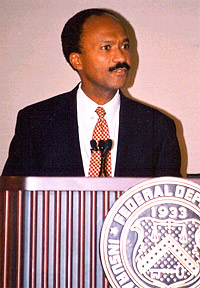
In 1969, Raines first worked in national politics, preparing a report for the
Nixon administration on the causes and patterns of youth unrest around the country related to the
Vietnam War.
[3] He served in the
Carter Administration as associate director for economics and government in the Office of Management and Budget and assistant director of the
White House Domestic Policy Staff from 1977 to 1979. Then he joined
Lazard Freres and Co., where he worked for 11 years and became a general partner. In 1991 he became Fannie's Mae's Vice Chairman, a post he left in 1996 in order to join the
Clinton Administration as the Director of the
U.S. Office of Management and Budget, where he served until 1998. In 1999, he returned to Fannie Mae as CEO.
On December 21, 2004, Raines accepted what he called "early retirement"
[4] from his position as CEO while
U.S. Securities and Exchange Commission investigators continued to investigate alleged accounting irregularities. He was accused by The
Office of Federal Housing Enterprise Oversight (OFHEO), the regulating body of Fannie Mae, of abetting widespread accounting errors, which included the shifting of losses so senior executives, such as himself, could earn large bonuses.
[5]
In 2006, the OFHEO announced a suit against Raines in order to recover some or all of the $90 million in payments made to Raines based on the overstated earnings,
[6] initially estimated to be $9 billion but have been announced as $6.3 billion.
[7]
Civil charges were filed against Raines and two other former executives by the OFHEO in which the OFHEO sought $110 million in penalties and $115 million in returned bonuses from the three accused.
[8] On April 18, 2008, the government announced a settlement with Raines together with J. Timothy Howard, Fannie's former chief financial officer, and Leanne G. Spencer, Fannie's former controller dismissing its charges. The three executives maintained their denial of the charges but agreed to the payment of fines totaling about $3 million, which were paid by Fannie's insurance policies. Raines also agreed to donate to charity the proceeds from the sale of $1.8 million of his Fannie stock newly issued to him by the company and to give up stock options, which were valued at $15.6 million when issued. The stock options however had no value.[
citation needed] The OFHEO press release said Raines also gave up an estimated $5.3 million of "other benefits" said to be related to his pension and forgone bonuses. Raines denied that he gave up any such benefits or paid any money out of pocket for the settlement.
[9]