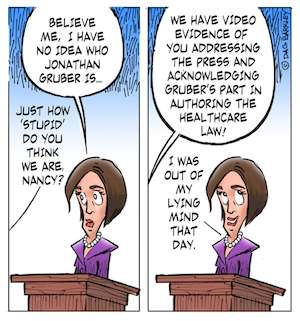
Up until this point, most of the attention regarding the failure to disclose the connection between Jonathan Gruber and the White House has
fallen on Gruber himself. Far more troubling, however, is the lack of disclosure on the part of the White House, the Senate, the DNC and other Democratic leaders who distributed Gruber's work and cited it as independent validation of their proposals, orchestrating the appearance of broad consensus when in fact it was all part of the same effort.
The White House is placing a giant collective bet on Gruber's "assumptions" to justify key portions of the Senate bill such as the "Cadillac tax," which they allowed people to believe was independent verification. Now that we know that Gruber's work was not that of an independent analyst but rather work performed as a contractor to the White House and paid for by taxpayers, and economists like Larry Mishel are
raising serious questions about its validity, it should be made publicly available so others can judge its merits.
Gruber began negotiating a sole-source contract with the Department of Health and Human Services in February of 2009, for which he was
ultimately paid $392,600. The contract called for Gruber to use his statistical model for evaluating alternatives "derived from the President's health reform proposal." It was not a research grant, but rather a consulting contract to advise
the White House Office of Health Reform, headed by Obama's
health care czar Nancy-Ann DeParle, to "develop proposals" for health care reform.
How did the feedback loop work? Well, take Gruber's appearance before the Senate HELP Committee on November 2, 2009, for which he used his microsimulation model to make calculations about small business insurance coverage. On the same day, Gruber released an analysis of the House health care bill, which he sent to Ezra Klein of
the Washington Post. Ezra published an excerpt.
White House blogger Jesse Lee then promoted both Gruber's Senate testimony and Ezra Klein's article on the
White House blog. "We thought it would all be a little more open and transparent if we went ahead and published what our focus will be for the day" he said, pointing to Gruber's "objective analysis." The "transparent" part apparently stopped when everyone got to Gruber's contractual relationship to the White House, which nobody in the three-hit triangle bothered to disclose.
But that was child's play compared to the effort that went into selling Gruber's analysis of the bill unveiled by the Senate on Wednesday, November 18. Two days later on Friday November 20, Gruber
published a paper entitled "Impacts of the Senate High Cost Insurance Excise Tax on Wages: Updated," claiming that the excise tax would result in wage hikes of $234 billion from 2013 through 2019.
And it was off to the races.