Warming during the Medieval Climatic Anomaly was not global
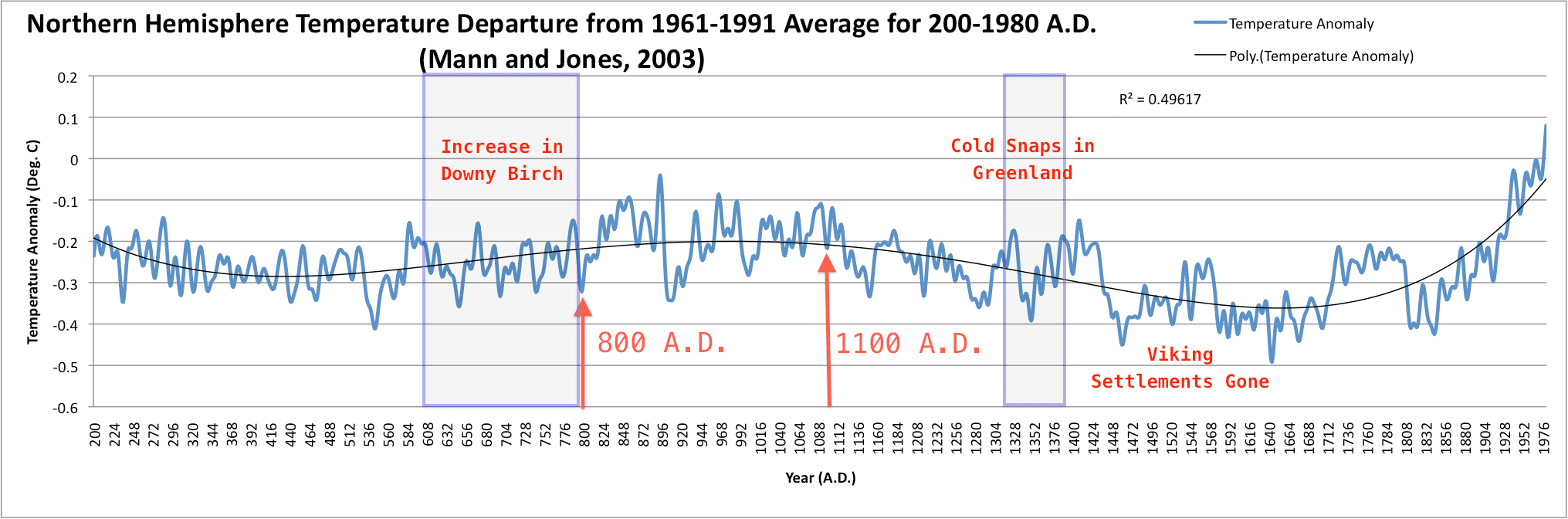
During the Medieval Climatic Anomaly, some areas, most notably in the North Atlantic and parts of Europe, were at least as warm as today, if not warmer. However, other areas were colder, and overall evidence suggests that global temperatures during this period were similar to those at the beginning or middle of the 20th century, and colder than today.
This period is explored in more depth here.
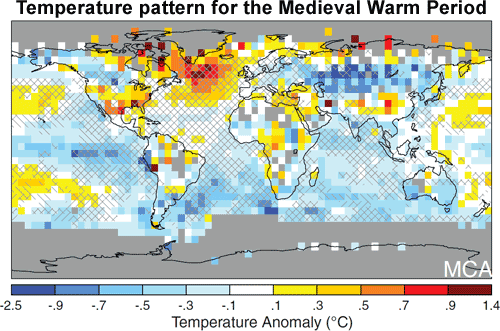
So not only was Greenland already mostly covered in ice when Europeans settled there, but also the relatively warm conditions during this period were not a global phenomenon. This contrasts with what we are seeing today, where warming is truly global. Figure 1 is a map showing reconstructions of temperature anomalies during the Medieval Warm Period. Blue colours show lower temperatures and warm colours show higher temperatures when compared to the 1961-1990 reference period.
Figure 1 - Reconstructed surface temperature anomalies for the Medieval Warm Period(950-1250) compared to a 1961-1990 reference period. (Source:
Mann et al., 2009)
You just take it all in at face value when it comes from your priests don't you rocks? The scientific method never even enters your mind...just believe it and pass it on. Clearly you never bothered to check up on your climate heroes to see if they are taking you for a fool.
Looking at your map from left to right, the first thing I see is that according to them, Alaska was quite cool during the MWP. However, according to actual studies, that claim simply isn't true.
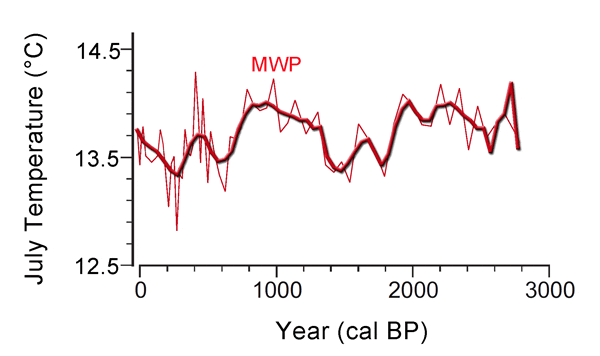
I see a dark blue dot there in the vicinity of south central Alaska. Here is a study done at Hallet Lake, right in that dark blue zone.
http://openknowledge.nau.edu/725/1/..._high-resolution_quantitative_temperature.pdf
[clip]
[17] BSi-inferred summer temperatures were warmer than the long-term (2 ka) average (3.1°C) from 100 to 500 AD, before decreasing rapidly to 2°C by 600 AD (Figure 3). This cooling coincides with a period of glacial advance in the Chugach Range, and the Kenai and St. Elias Mountains [Wiles et al., 2008]. After 600 AD, summer temperature gradually increased from 2 to 4°C by 1300 AD, and remained above the 2 ka average until 1500 AD. Summer temperature began to decrease at 1450 AD, cooling nearly 2°C by 1875 AD (Figure 3). The maximum cooling at Hallet Lake during the past 2 ka occurred from 1750 to 1900 AD. Summer temperature at Hallet Lake increased 2.5°C in the 130 yr since the coldest part of the Little Ice Age (LIA), and the reconstructed temperatures for the past 20 yr are the highest for the past 2 ka at Hallet Lake. These unprecedented changes over the past 150 yr are consistent with changes recorded in lake sediments throughout the Arctic [Smol and Douglas, 2007].