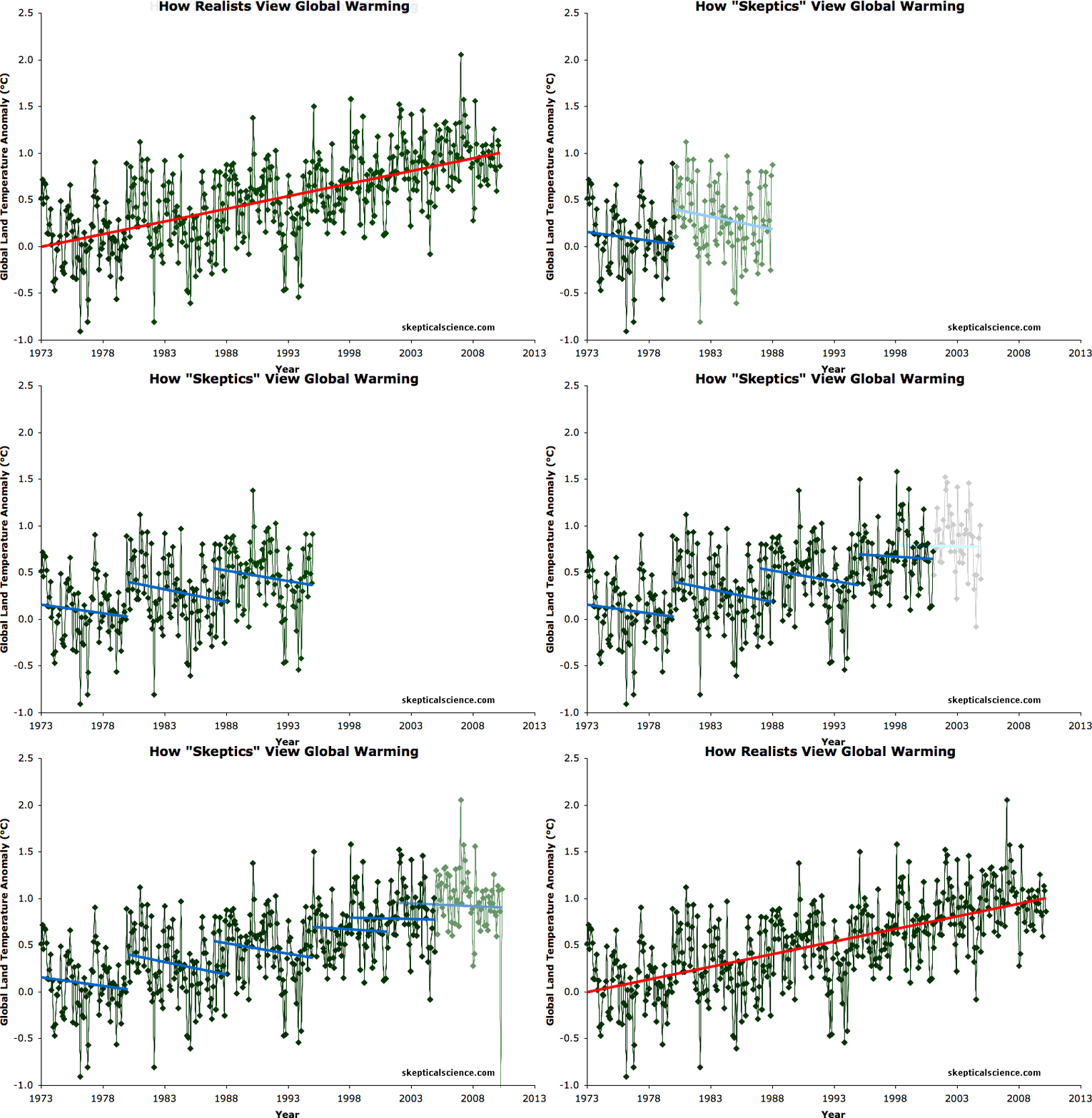
so one of your favored Jim Hansen makes that claim yet you doubt him. Interesting...
This sounds suspiciously like the 70's Time article supposedly quoting climate scientists. Show me anywhere in the article you posted that Hansen said anything about a 20 year hiatus.
It does however end with a warning:
Hansen's bottom line is that increased short-term masking of greenhouse gas warming by fossil fuel particulate and nitrogen pollution represents a "doubling down" of the Faustian bargain, an increase in the stakes.
"The more we allow the Faustian debt to build, the more unmanageable the eventual consequences will be," he says.
his words in his paper Climate forcing growth rates: doubling
down on our Faustian bargain-
The growth rate for the total climate forcing by well-mixed greenhouse gases
has remained below the peak values reached in the 1970s and early 1980s, has
been relatively stable for about 20 years, and is falling below IPCC (2001)
scenarios (figure 5)...
So is the new data we present here good news or bad news, and how does it
alter the Faustian bargain? At first glance there seems to be some good news.
First, if our interpretation of the data is correct, the surge of fossil fuel emissions,
especially from coal burning, along with the increasing atmospheric CO2 level is
fertilizing the biosphere, and thus limiting the growth of atmospheric CO2.
Also, despite the absence of accurate global aerosol measurements, it seems that
the aerosol cooling effect is probably increasing based on evidence of aerosol
increases in the Far East and increasing background stratospheric aerosols.
Both effects work to limit global warming and thus help explain why the rate
of global warming seems to be less this decade than it has been during the prior
quarter century. This data interpretation also helps explain why multiple warnings
that some carbon sinks are drying up and could even become carbon sources,
e.g., boreal forests infested by pine bark beetles (Kurz et al 2008) and the
Amazon rain forest suffering from drought (Lewis et al 2011), have not produced
an obvious impact on atmospheric CO2.
and from an interview -
The climate may be heating up less in response to greenhouse-gas emissions than was once thought. But that does not mean the problem is going away.
OVER the past 15 years air temperatures at the Earths surface have been flat while greenhouse-gas emissions have continued to soar. The world added roughly 100 billion tonnes of carbon to the atmosphere between 2000 and 2010. That is about a quarter of all the CO2 put there by humanity since 1750. And yet, as James Hansen, the head of NASAs Goddard Institute for Space Studies, observes, "the five-year mean global temperature has been flat for a decade."
The Economist
Temperatures fluctuate over short periods, but this lack of new warming is a surprise. Ed Hawkins, of the University of Reading, in Britain, points out that surface temperatures since 2005 are already at the low end of the range of projections derived from 20 climate models (see chart 1). If they remain flat, they will fall outside the models range within a few years.
The global temperature standstill shows that climate models are diverging from observations, says David Whitehouse of the Global Warming Policy Foundation.
If we have not passed it already, we are on the threshold of global observations becoming incompatible with the consensus theory of climate change, he says.
Whitehouse argues that whatever has happened to make temperatures remain constant requires an explanation because the pause in temperature rise has occurred despite a sharp increase in global carbon emissions.
Cookies must be enabled. | The Australian twenty-year-hiatus-in-rising-temperatures-has-climate-scientists-puzzled


 Since the beginning of the industrial revolution there have been