what exactly is a "black person with no white in him"???
----the human genome consists of shared DNA thruout the
whole damned planet. You are hilarious-----you keep harpting on ------this or that people has "black DNA"---
and then come up with "black person with no white
in him"--------do not give up your day job-----genetics is not
your forte
A black person that has no admixture from someone in from europe. Black people inhabited this planet long before people with white skin appeared in europe. You must hate science. I already posted proof the gene for white skin did not come about until 7K years ago. Black skin was natures decision. White skin is a recent mutation. White people carry the genes given to them by Black people not the other way around.
Your statement is so inaccurate, I honestly don't even know where to begin. Human beings have lived all over the planet for millions of years, including whites in Europe.
White skin evolved as a result of climate, not "mutation" you uneducated shmuck.
You really should do some research instead of just popping off at the mouth. I cant believe you actually said that. Even if you knew what you were talking about you should realize it would still be a mutation in the DNA that caused the lightening of the skin. There were no white people unless they were albinos. 7K years ago a mutation occurred in europe that gave rise to white skin. Its science not conjecture.
European Gene for Light Skin Evolved Much Later Than Thought
"The analysis of the man, who lived in modern-day Spain only about 7,000 years ago, shows
light-skin genes in Europeans evolved much more recently than previously thought."
You are truly pathetic! Ha ha ha.
Neanderthal
Origin
The first humans with proto-Neanderthal
traits are believed to have existed in
Eurasia as early as 350,000 - 600,000 years ago with the first "true Neanderthals" appearing between 200,000 and 250,000 years ago.The exact date of their extinction had been disputed. However, in 2014, Thomas Higham of the
University of Oxford performed the most comprehensive dating of Neanderthal bones and tools ever carried out, which demonstrated that Neanderthals died out in Europe between 41,000 and 39,000 years ago - this coincides with the start of a very cold period in Europe and is 5,000 years after
Homo sapiens reached the continent. This was based on improved radiocarbon dating of materials from 40 sites in Western Europe.
Comparison of the DNA of Neanderthals and Homo sapiens suggests that they diverged from a common ancestor between 350,000 and 400,000 years ago. This ancestor was probably Homo heidelbergensis. Heidelbergensis originated between 800,000 and 1,300,000 years ago, and continued until about 200,000 years ago. It ranged over Eastern and South Africa, Europe and Western Asia. Between 350,000 and 400,000 years ago the African branch is thought to have started evolving towards modern humans and the Eurasian branch towards Neanderthals. Scientists do not agree when Neanderthals can first be recognised in the fossil record, with dates ranging between 200,000 and 300,000 years BP.
Discovery
Neander Valley site
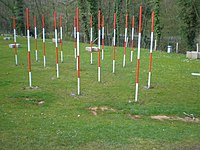
The site of
Kleine Feldhofer Grottewhere the type specimen was unearthed by miners in the 19th century.
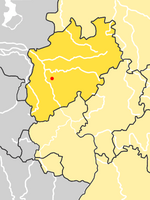
Location of
Neander Valley, Germany, with the modern federal state of
North Rhine-Westphalia highlighted.
Neanderthal skulls were first discovered in Engis Caves (fr), in what is now Belgium (1829) by Philippe-Charles Schmerling and in Forbes' Quarry, Gibraltar, dubbed
Gibraltar 1 (1848), both prior to the type specimen discovery in a
limestone quarry of the
Neander Valley in
Erkrath near Düsseldorf in August 1856, three years before
Charles Darwin's
On the Origin of Species was published.
The
type specimen, dubbed
Neanderthal 1, consisted of a skull cap, two
femora, three bones from the right arm, two from the left arm, part of the left
ilium, fragments of a
scapula, and ribs. The workers who recovered this material originally thought it to be the remains of a bear. They gave the material to amateur naturalist
Johann Carl Fuhlrott, who turned the fossils over to anatomist
Hermann Schaaffhausen.
To date, the bones of over 400 Neanderthals have been found.


 Let me try to make some kind of connection. Massad, Iran, race. The mossad wants to stop Iran from getting nukes. Iran backed rebels have just taken over Yemen who still keeps black slaves. That would cover the race issue. That's the best i can do