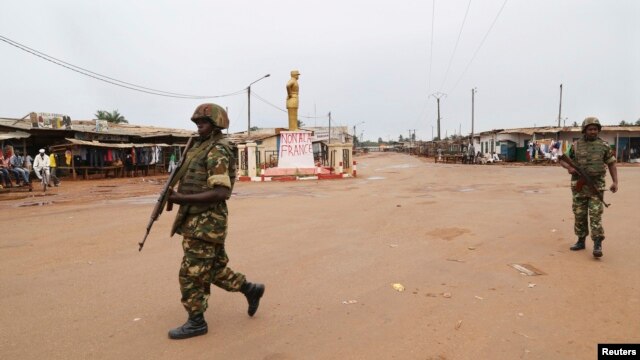
Instead, it drew fury on social media this week for its portrayal of CAR and the sources interviewed. Sarah Knuckey, a professor at Columbia University's law school and the co-director of the university's Human Rights Institute, called it "shallow" and "reckless" in its reporting. The piece, "Conflict Is More Profitable Than Peace," written by New York Times columnist Nicholas Kristof, was published in the Times on March 25. A two-time Pulitzer winner, Kristof explains why years of violence and conflict in the CAR have created major barriers to alleviating poverty, hunger and preventable disease. Kristof argues that international donors, including the U.S. government, should amp up investments in security efforts like the U.N. peacekeeper budget — not just humanitarian aid.
The story was part of Kristof's annual "Win A Trip" contest, where he takes a promising student journalist on a reporting trip to highlight under-covered global development issues. Kristof chose the CAR because it is indeed a country in crisis. It ranks 188 out of 188 in the Human Development Index, which measures such data as life expectancy, education and per capita income. As for the story's intent, in an interview with NPR on Thursday, Kristof said, "I was writing a piece about global conflict as an impediment to development and health care. I was using CAR as an example of that. South Sudan would have been as good an example." Within hours of publication, Kristof's column was slammed in a tweetstorm on Twitter by Knuckey, who has visited the CAR in her research on human rights crimes. Her tweets ignited a conversation across the global humanitarian community.
The Central African Republic has one of the world's highest neonatal mortality rates: 1 in 24, according to UNICEF. Above: A mother holds her child during a consultation on February 14 at the maternity clinic in the town of Boali.
A few thoughts on this @NickKristof piece on the Central African Republic 1/n
Nicholas Kristof on Twitter
— Sarah Knuckey (@SarahKnuckey) March 25, 2018
There is little recognition of the agency and work of the countless Central Africans who run NGOs, provide healthcare, work for peace, prosecute crimes, risk their lives to protect others 11/n
— Sarah Knuckey (@SarahKnuckey) March 25, 2018
He tells his readers that death results from “chaos and dysfunction,” and fails to grapple with the complexities of the conflict, the harms of colonization, the systems & structures leading to poverty 17/n
— Sarah Knuckey (@SarahKnuckey) March 25, 2018
"Kristof represented CAR as if it were miserable across the board, and that the people who live there are victims," Knuckey told NPR. "It represents a brand of journalism that has been heavily criticized for decades, and that is harmful." Kristof himself says he was a "little bit" surprised by the reaction on social media but "understands the frustration that people have with the lack of coverage about things they care deeply about," referring to researchers, academics and aid workers who work to improve conditions in the CAR. For Moussa Abdoulaye, a Central African activist, founder of a community school and consultant for media companies like Al Jazeera, VICE and HBO, perhaps the worst offense was Kristof's depiction of his country as a hopeless place. Kristof described the CAR as "the world's most wretched country," "the capital of human misery" and home to "the world's most neglected crisis."
MORE