Yes, I agree. I was simply being a smart-ass because Old Rocks refuses to believe that the Federal Reserve had anything to do with the downturn.
You mean the guy in charge was a 'free market' type guy and 'believed' the markets would self regulate?
The former Federal Reserve chairman, Alan Greenspan, has conceded that the global financial crisis has exposed a "mistake" in the free market ideology which guided his 18-year stewardship of US monetary policy.
...."I made a mistake in presuming that the self-interests of organisations, specifically banks and others, were such that they were best capable of protecting their own shareholders and their equity in the firms," said Greenspan.
Greenspan - I was wrong about the economy. Sort of | Business | The Guardian
Regulators and policymakers enabled this process at virtually every turn. Part of the reason they failed to understand the housing bubble was willful ignorance: they bought into the argument that the market would equilibrate itself. In particular, financial actors and regulatory officials both believed that secondary and tertiary markets could effectively control risk through pricing.
http://www.tobinproject.org/sites/tobinproject.org/files/assets/Fligstein_Catalyst of Disaster_0.pdf
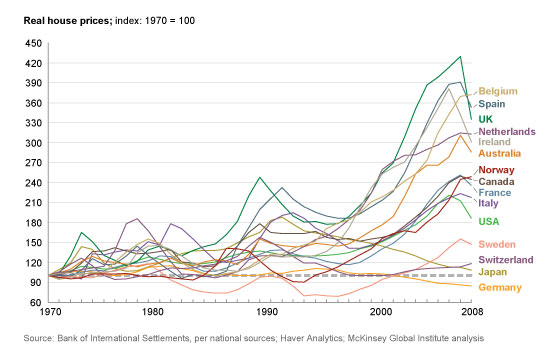
There was no one cause, but all bubbles occur because of excess credit or money, and global excess credit was created primarily by the Federal Reserves. That the crisis was global is evidence that the bubble was caused primarily by central banks.
How? By pinning interest rates so low for so long, it lowered the price of credit. All credit is priced off of government interest rates. The United States is the most important economy in the world. The Fed is the most important central bank in the world. Thus, when the Fed lowered rates, central banks around the world had little choice but to follow. Otherwise, their currencies would have become uncompetitive against the dollar. The credit that was created fed into asset markets because consumer prices were being constrained by a global shift in manufacturing to China and because of the after-effects of the tech and stock market bubbles of the 1990s. Thus, there were housing bubbles all around, particularly in those countries with a culture of home ownership and policies which were designed to increase credit to borrowers.
That's not the only reason. I'd put deregulation a distant number two and Wall Street as number three on the list. But both pale in comparison to the gross mis-pricing and mis-understanding of credit and asset markets due to the Fed.
Got it, Fed reserves is responsible for the rest of the worlds money policy, even though NO nation doesn't have a central banking system you support and history show's the bubbles created (and bank failures), pre fed reserves
Regulation had almost zero to do with the Dubya subprime crisis, Dubya's lack of REGULATORS and his other policies, however ALLOWED the wall street Banksters to hose US
DUBYA FOUGHT ALL 50 STATE AG'S IN 2003, INVOKING A CIVIL WAR ERA RULE SAYING FEDS RULE ON "PREDATORY" LENDERS!
Eliot Spitzer - Predatory Lenders' Partner in Crime
FBI saw threat of loan crisis
"It has the potential to be an epidemic,"
A top official warned of widening mortgage fraud in 2004, but the agency focused its resources elsewhere
"We think we can prevent a problem that could have as much impact as the S&L crisis,"
They ended up with fewer resources, rather than more.
Later in 2004 Dubya allowed the leverage rules to go from 12-1 to 35-1+ which flooded the market with cheap money!
The SEC Rule That Broke Wall Street
Yeah, wall street was a distant 3rd
According to a study by the consulting firm Mercer Oliver Wyman, nonconventional lending accounted for approximately half of originations in 2005, but over 85% of profits
Once lenders figured this out they would often try to sell subprime loans even to persons who qualified for a cheaper prime loan. The repackaging of nonconventional mortgages into bonds also became the largest fee generation business for many investment banks including Lehman Bros., Bear Stearns, Merrill Lynch, Morgan Stanley, and Goldman Sachs. Commercial banks and bank holding companies like Bank of America, Wells Fargo, Citibank, and Countrywide Financial also became deeply involved in all stages of the market, from origination to packaging, to servicing.
http://www.tobinproject.org/sites/tobinproject.org/files/assets/Fligstein_Catalyst of Disaster_0.pdf
For instance, in both 2006 and 2007, well over 40 percent of subprime borrowers were awarded mortgages with either little or no documentation of their ability to pay. With these so-called "liar loans," borrowers did not have to show proof of either earnings or assets.
The Residential Real Estate Crash Index | Stock Discussion Forums
It is clear to anyone who has studied the financial crisis of 2008 that the private sectors drive for short-term profit was behind it
Asset managers sought new ways to make money
The credit rating agencies gave their blessing
Fund managers didnt do their homework
Derivatives were unregulated
The SEC loosened capital requirements
The federal government overrode anti-predatory state laws
Compensation schemes encouraged gambling: Wall Streets compensation system wasand still isbased on short-term performance, all upside and no downside. This creates incentives to take excessive risks.
Wall Street became creative:
Private sector lenders fed the demand
Financial gadgets milked the market
Commercial banks jumped in
Derivatives exploded uncontrollably
Lest We Forget: Why We Had A Financial Crisis - Forbes
The FBI correctly identified the epidemic of mortgage control fraud at such an early point that the financial crisis could have been averted had the Bush administration acted with even minimal competence. To understand the crisis we have to focus on how the mortgage fraud epidemic produced widespread accounting fraud.
William K. Black: The Two Documents Everyone Should Read to Better Understand the Crisis