FDR's Progressive Doctrine vs The Union of Soviet Socialist Republic's Constitution

Nah, nothing at all indicates BHO wants to be like Uncle Joe. Now, oddball might want to, but no evidence for BHO there.

You gotta read this then man [ame=http://www.amazon.com/Dreams-My-Father-Story-Inheritance/dp/1400082773]Amazon.com: Dreams from My Father: A Story of Race and Inheritance (9781400082773): Barack Obama: Books[/ame]

Trust me its worth the time to read considering he is our president.

I have read parts of it. What about it scares you?

Too fast I quoted the wrong book and edited it to fix, lol.

Post-1960s politics more about moral attitude than issues After the 1960s, liberalism and conservatism were defined in the popular imagination less by class than by attitude--the position you took toward the traditional culture and counterculture. What mattered was how you felt about sex, drugs, rock and roll, the Latin Mass or the Western canon. For white ethnic voters in the North and whites in the South, this new liberalism made little sense. The violence in the streets and the excuses for such violence in intellectual circles, blacks moving next door and white kids bused across town, the burning of flags and spitting on vets, all of it seemed to insult and diminish family, faith, flag, neighborhood, and for some at least, white privilege. And when, in the wake of assassinations and Vietnam, economic expansion gave way to gas lines, inflation and plant closings, and the best Jimmy Carter could suggest was turning down the thermostat, the New Deal coalition began looking for another political home. Source: The Audacity of Hope, by Barack Obama, p. 28-29

Filibuster has long tradition, but used to harm civil rights Throughout the Senate's modern history, the filibuster has been a guarded prerogative, one of the distinguishing features that separates the Senate from the House and serves as a firewall against the dangers of majority overreach. There is another, grimmer history to the filibuster, one that carries special relevance for me. For almost a century, the filibuster was the South's weapon of choice in its efforts to protect Jim Crow from federal interference, the blockade that effectively gutted the 14t & 15th Amendments. Decade after decade, courtly, erudite men like Senator Richard B. Russell of Georgia used the filibuster to choke off any and every piece of civil rights legislation before the Senate, whether voting rights bills, or fair employment bills, or anti-lynching bills. With words, with rules, with procedures & precedents--with law--Southern senators had succeeded in perpetuating black subjugation in ways that mere violence never could. For many blacks, the filibuster had snuffed out hope. page 81.

I have notes at home that reference me back to more page numbers (yeah i have the book in my office)

I have to side with Justice Breyer's view of the Constitution--that it is not a static but rather a living document and must be read in the context of an ever-changing world.....I see democracy as a conversation to be had. According to this conception, the genius of Madison's design is not that it provides a fixed blueprint for action. It provides us with a framework and rules, but all its machinery are designed to force us into a conversation.


Owes unions who endorsed him; that's why he's in politics The leaders of service workers unions broke ranks & chose to endorse me over [my opponent], support that proved critical to my campaign. It was a risky move on their part; had I lost, they might have paid a price in access, in support, in credibility. So I owe those unions. When their leaders call, I do my best to call them back right away. I do not consider this corrupting in any way; I do not mind feeling obligated toward home health-care workers or toward teachers. I got into politics to fight for those folks, and I am glad a union is around to remind me of their struggles. 118


Stuff like that
 
He supports teachers and home health-care workers, and this worries you? We need good schools and health-care facilities devoted to service.

He says unions as a balance to big business, and this worries you? Business does pretty well in its struggles with unions; watch its donations in the next two election cycles sky rocket.

Minorities including women are getting a better shake, and this worries you? This worries me that it worries you.

The Constitution is viewed as set of rules and procedures that forces each generation into a dialogue, and this worries you? Yes, I agree with this. I have all of my adult life.
 
He supports teachers and home health-care workers, and this worries you? We need good schools and health-care facilities devoted to service.

He says unions as a balance to big business, and this worries you? Business does pretty well in its struggles with unions; watch its donations in the next two election cycles sky rocket.

Minorities including women are getting a better shake, and this worries you? This worries me that it worries you.

The Constitution is viewed as set of rules and procedures that forces each generation into a dialogue, and this worries you? Yes, I agree with this. I have all of my adult life.

I have been trying to let you have your fun for the last few posts now but this dishonesty has put an end to that. Its obvious I did not state any of those things. This is my last response to you and thats too bad because now I have my notes and quotes that are relevant to the topic of the thread. I quoted 4 sections for the following reasons

1) Shows he has a negatively prejudicial view of white people
2) Shows he wants to do away with a philabuster. While his story about the philibuster gives great reasons and pulls at emotions to want to agree, the reason for a philibuster is to prevent the majority from having overreaching power to create law. It is part of our Government's checks and balance system.
3) Feels the constition, and the limits it places on our government's power, is a living document meant to be changed as the times change to give the government varying powers instead of a static document meant to restrain the government's power at all times.
4) Shows he is beholden to the special interests of Unions. As you can see from his most recent financial bill this level of responsibility to them comes at the expense of non-union american taxpayers.


You can have the last word.
 
No, I did not quote you. I made logical inference based on what you wrote, plymco. I am not being dishonest. That would be Liability and that gang with which you are confusing me for.

1) No, he does not have a negative view of white folks. Where, in heaven's holy name, where do you come up with that nonsense.

2) The filibuster is a political tool used by both sides. He does not like that the racists used it. Neither do you, I think, and I know I don't.

3) The document is not static. By virtue of time and man's mortality, it cannot be. It must be flexible enough to meet the times. It has certainly done that.

4) Most government-service interests support Democrats because the Republicans would break them if they could. I see nothing that discriminates against non-union folks like me.
 
The Second Bill of Rights was a list of rights declared by Franklin D. Roosevelt, the then President of the United States, during his State of the Union Address on January 11, 1944.


CONSTITUTION
(FUNDAMENTAL LAW)
OF THE UNION
OF SOVIET SOCIALIST
REPUBLICS

Adopted at the Seventh
(Special) Session of
the Supreme Soviet
of the USSR,
Ninth Convocation,
On October 7, 1977


Pea brain alert... the Soviets are really closet 'New Dealers'
 
I thought the New Dealers were communists!?!? :lol:
 
I thought the New Dealers were communists!?!? :lol:

Yea, FDR was a time traveler don't 'ya know. He traveled 33 years through time to find his ideas for the Second Bill of Rights. If you double 33 it is 66 ...then add 3+3 and that equals 6...

666...
 
The Second Bill of Rights was a list of rights declared by Franklin D. Roosevelt, the then President of the United States, during his State of the Union Address on January 11, 1944.


CONSTITUTION
(FUNDAMENTAL LAW)
OF THE UNION
OF SOVIET SOCIALIST
REPUBLICS

Adopted at the Seventh
(Special) Session of
the Supreme Soviet
of the USSR,
Ninth Convocation,
On October 7, 1977


Pea brain alert... the Soviets are really closet 'New Dealers'


Thank you for finally agreeing with me that the 2 (2nd bill of rights and soviet constitution) are very similar to each other. The fact that the soviets adopted FDR's ideas into their constitution shows that my comparison is valid and accurate. It took you long enough but i'm glad your finally accepting the truth.
 
Last edited:
Your comparison means nothing, though, plymco. Mexico copied its constitution from us, and everybody and their cousin wants to come here. So have quite a few Russians. This type of one-upmanship serves no purpose at all. If you did this in a logic or analysis class, the prof would want to know if you were Political Chic's brother!
 
Last edited:
The Second Bill of Rights was a list of rights declared by Franklin D. Roosevelt, the then President of the United States, during his State of the Union Address on January 11, 1944.


CONSTITUTION
(FUNDAMENTAL LAW)
OF THE UNION
OF SOVIET SOCIALIST
REPUBLICS

Adopted at the Seventh
(Special) Session of
the Supreme Soviet
of the USSR,
Ninth Convocation,
On October 7, 1977


Pea brain alert... the Soviets are really closet 'New Dealers'


Thank you for finally agreeing with me that the 2 (2nd bill of rights and soviet constitution) are very similar to each other. The fact that the soviets adopted FDR's ideas into their constitution shows that my comparison is valid and accurate. It took you long enough but i'm glad your finally accepting the truth.

The problem is FDR's Second Bill of Rights is nothing radical or harmful. It simply reiterates basic human values that are shared by ALL people.

It expands and defines Thomas Jefferson's profound words in the Declaration of Independence:
We hold these truths to be self-evident, that all men are created equal, that they are endowed by their Creator with certain unalienable Rights, that among these are Life, Liberty and the pursuit of Happiness.

No government or social system is so evil that its people must be considered as lacking in virtue. As Americans, we find communism profoundly repugnant as a negation of personal freedom and dignity. But we can still hail the Russian people for their many achievements--in science and space, in economic and industrial growth, in culture and in acts of courage.

So, let us not be blind to our differences--but let us also direct attention to our common interests and to the means by which those differences can be resolved. And if we cannot end now our differences, at least we can help make the world safe for diversity. For, in the final analysis, our most basic common link is that we all inhabit this small planet. We all breathe the same air. We all cherish our children's future. And we are all mortal.

Commencement Address at American University

President John F. Kennedy
Washington, D.C.
June 10, 1963
 
I didn't say it was, or was not, harmful. What I said all along in this thread is that the 2 share many similarities.

I also explained the issue I take with it through how a government would impliment said ideals.


Why is it that no one in this thread who doesn't like the comparison just adress what I actually posted instead of either putting words in my mouth or just insulting me instead?

Here i will repeat myself since people can't seem to adress my specific issues and opinions.

Plymco_pilgrim said:
Its veers from the constitution in such a way that puts decision making power into the hands of government that We The People are guaranteed to have for ourselves.

Who gets to decide what is adequate food?
Who decides what is adequate cloathing?
Who decides what is adequate housing?

Does the farmers right to sell his food at a rate that earns him "a decent living" conflict with my right for adequate food? who decides this?

Who decides what is a decent home, does everyone get the same exact home as me? If not why do they get better/worse homes with the same size family?

Who decides what level of health care is adequate for me?

I tell you I'd like to make those decisions for myself. The government has no constiutional authority to make these decisions for individuals, if it did FDR would not have needed to write a second bill of rights. There was a reason the founders didn't include these powers within our government, because they belong in the hands of the people not some washington fat cat beurocrats
 
Last edited:
Plymco, I thought you were about sliming by implied inference. For shame.
 
I didn't say it was, or was not, harmful. What I said all along in this thread is that the 2 share many similarities.

I also explained the issue I take with it through how a government would impliment said ideals.


Why is it that no one in this thread who doesn't like the comparison just adress what I actually posted instead of either putting words in my mouth or just insulting me instead?

Here i will repeat myself since people can't seem to adress my specific issues and opinions.

Plymco_pilgrim said:
Its veers from the constitution in such a way that puts decision making power into the hands of government that We The People are guaranteed to have for ourselves.

Who gets to decide what is adequate food?
Who decides what is adequate cloathing?
Who decides what is adequate housing?

Does the farmers right to sell his food at a rate that earns him "a decent living" conflict with my right for adequate food? who decides this?

Who decides what is a decent home, does everyone get the same exact home as me? If not why do they get better/worse homes with the same size family?

Who decides what level of health care is adequate for me?

I tell you I'd like to make those decisions for myself. The government has no constiutional authority to make these decisions for individuals, if it did FDR would not have needed to write a second bill of rights. There was a reason the founders didn't include these powers within our government, because they belong in the hands of the people not some washington fat cat beurocrats

WHY is it? Because I didn't just fall off the back of a turnip truck. You compare FDR and the Soviet Union as if there is some association.

IRONY...

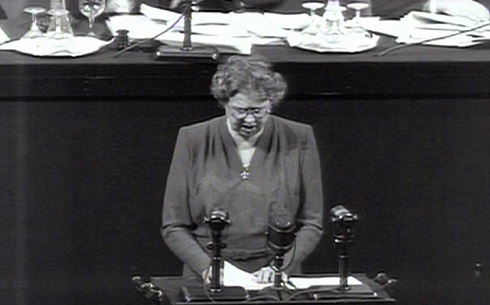
It was former First Lady Eleanor Roosevelt who publicly took the Soviet Union to task over the adoption of the Universal Declaration of Human Rights, which FDR was a big catalyst of.

Eleanor Roosevelt served as United States Delegate to the United Nations General Assembly and as the President and Chair of the United Nations Commission on Human Rights.

In his 1941 State of the Union address US president Franklin Roosevelt called for the protection of what he termed the "essential" Four Freedoms: freedom of speech, freedom of conscience, freedom from fear and freedom from want.

It led to the Universal Declaration of Human Rights (UDHR) It is a declaration adopted by the United Nations General Assembly on 10 December 1948.


Eleanor Roosevelt


On the Adoption of the Universal Declaration of Human Rights

delivered 9 December 1948 in Paris, France

eleanorroosevelthumanrights2.JPG


Mr. President, fellow delegates:

The long and meticulous study and debate of which this Universal Declaration of Human Rights is the product means that it reflects the composite views of the many men and governments who have contributed to its formulation. Not every man nor every government can have what he wants in a document of this kind. There are of course particular provisions in the Declaration before us with which we are not fully satisfied. I have no doubt this is true of other delegations, and it would still be true if we continued our labors over many years. Taken as a whole the Delegation of the United States believes that this is a good document -- even a great document -- and we propose to give it our full support. The position of the United States on the various parts of the Declaration is a matter of record in the Third Committee. I shall not burden the Assembly, and particularly my colleagues of the Third Committee, with a restatement of that position here.

I should like to comment briefly on the amendments proposed by the Soviet delegation. The language of these amendments has been dressed up somewhat, but the substance is the same as the amendments which were offered by the Soviet delegation in committee and rejected after exhaustive discussion. Substantially the same amendments have been previously considered and rejected in the Human Rights Commission. We in the United States admire those who fight for their convictions, and the Soviet delegation has fought for their convictions. But in the older democracies we have learned that sometimes we bow to the will of the majority. In doing that, we do not give up our convictions. We continue sometimes to persuade, and eventually we may be successful. But we know that we have to work together and we have to progress. So, we believe that when we have made a good fight, and the majority is against us, it is perhaps better tactics to try to cooperate.

I feel bound to say that I think perhaps it is somewhat of an imposition on this Assembly to have these amendments offered again here, and I am confident that they will be rejected without debate.

The first two paragraphs of the amendment to article 3 deal with the question of minorities, which committee 3 decided required further study, and has recommended, in a separate resolution, their reference to the Economic and Social Council and the Human Rights Commission. As set out in the Soviet amendment, this provision clearly states "group," and not "individual," rights.

The Soviet amendment to article 20 is obviously a very restrictive statement of the right to freedom of opinion and expression. It sets up standards which would enable any state practically to deny all freedom of opinion and expression without violating the article. It introduces the terms "democratic view," "democratic systems," "democratic state," and "fascism," which we know all too well from debates in this Assembly over the past two years on warmongering and related subjects are liable to the most flagrant abuse and diverse interpretations.

The statement of the Soviet delegate here tonight is a very good case in point on this. The Soviet amendment of article 22 introduces new elements into the article without improving the committed text and again introduces specific reference to "discrimination." As was repeatedly pointed out in committee 3, the question of discrimination is comprehensively covered in article 2 of the Declaration, so that its restatement elsewhere is completely unnecessary and also has the effect of weakening the comprehensive principles stated in article 2. The new article proposed by the Soviet delegation is but a restatement of State obligation, which the Soviet delegation attempted to introduce into practically every article in the Declaration. It would convert the Declaration into a document stating obligations on states, thereby changing completely its character as a statement of principles to serve as a common standard of achievement for the members of the United Nations.

The Soviet proposal for deferring consideration of the Declaration to the 4th session of the Assembly requires no comment. An identical text was rejected in committee 3 by a vote of 6 in favor and 26 against. We are all agreed, I am sure, that the Declaration, which has been worked on with such great effort and devotion, and over such a long period of time, must be approved by this Assembly at this session.

Certain provisions of the Declaration are stated in such broad terms as to be acceptable only because of the provisions in article 30 providing for limitation on the exercise of the rights for the purpose of meeting the requirements of morality, public order, and the general welfare. An example of this is the provision that everyone has the right to equal access to the public service in his country. The basic principle of equality and of nondiscrimination as to public employment is sound, but it cannot be accepted without limitation. My government, for example, would consider that this is unquestionably subject to limitation in the interest of public order and the general welfare. It would not consider that the exclusion from public employment of persons holding subversive political beliefs and not loyal to the basic principles and practices of the constitution and laws of the country would in any way infringe upon this right.

Likewise, my government has made it clear in the course of the development of the Declaration that it does not consider that the economic and social and cultural rights stated in the Declaration imply an obligation on governments to assure the enjoyment of these rights by direct governmental action. This was made quite clear in the Human Rights Commission text of article 23 which served as a so-called "umbrella" article to the articles on economic and social rights. We consider that the principle has not been affected by the fact that this article no longer contains a reference to the articles which follow it. This in no way affects our whole-hearted support for the basic principles of economic, social, and cultural rights set forth in these articles.

In giving our approval to the Declaration today it is of primary importance that we keep clearly in mind the basic character of the document. It is not a treaty; it is not an international agreement. It is not and does not purport to be a statement of law or of legal obligation. It is a Declaration of basic principles of human rights and freedoms, to be stamped with the approval of the General Assembly by formal vote of its members, and to serve as a common standard of achievement for all peoples of all nations.

We stand today at the threshold of a great event both in the life of the United Nations and in the life of mankind. This Universal Declaration of Human Rights may well become the international Magna Carta of all men everywhere. We hope its proclamation by the General Assembly will be an event comparable to the proclamation of the Declaration of the Rights of Man by the French people in 1789, the adoption of the Bill of Rights by the people of the United States, and the adoption of comparable declarations at different times in other countries.

At a time when there are so many issues on which we find it difficult to reach a common basis of agreement, it is a significant fact that 58 states have found such a large measure of agreement in the complex field of human rights. This must be taken as testimony of our common aspiration first voiced in the Charter of the United Nations to lift men everywhere to a higher standard of life and to a greater enjoyment of freedom. ManÂ’s desire for peace lies behind this Declaration. The realization that the flagrant violation of human rights by Nazi and Fascist countries sowed the seeds of the last world war has supplied the impetus for the work which brings us to the moment of achievement here today.

In a recent speech in Canada, Gladstone Murray said:

The central fact is that man is fundamentally a moral being, that the light we have is imperfect does not matter so long as we are always trying to improve it Â… we are equal in sharing the moral freedom that distinguishes us as men. ManÂ’s status makes each individual an end in himself. No man is by nature simply the servant of the state or of another man Â… the ideal and fact of freedom -- and not technology -- are the true distinguishing marks of our civilization.

This Declaration is based upon the spiritual fact that man must have freedom in which to develop his full stature and through common effort to raise the level of human dignity. We have much to do to fully achieve and to assure the rights set forth in this Declaration. But having them put before us with the moral backing of 58 nations will be a great step forward.

As we here bring to fruition our labors on this Declaration of Human Rights, we must at the same time rededicate ourselves to the unfinished task which lies before us. We can now move on with new courage and inspiration to the completion of an international covenant on human rights and of measures for the implementation of human rights.

In conclusion, I feel that I cannot do better than to repeat the call to action by Secretary Marshall in his opening statement to this Assembly:

Let this third regular session of the General Assembly approve by an overwhelming majority the Declaration of Human Rights as a standard of conduct for all; and let us, as Members of the United Nations, conscious of our own short-comings and imperfections, join our effort in good faith to live up to this high standard.


American Rhetoric: On the Adoption of the Universal Declaration of Human Rights
 
FDR's Second bill of rights is one of the first examples of the progressive agenda in the united states

the progressive bill of rights said:
  • the right to a useful and remunerative job in the industries or shops or farms or mines of the nation; The right to earn enough to provide adequate food and clothing and recreation;
  • The right of every farmer to raise and sell his products at a return which will give him and his family a decent living;
  • The right of every businessman, large and small, to trade in an atmosphere of freedom from unfair competition and domination by monopolies at home or abroad;
  • The right of every family to a decent home;
  • The right to adequate medical care and the opportunity to achieve and enjoy good health;
  • The right to adequate protection from the economic fears of old age, sickness, accident, and unemployment;
  • The right to a good education.
  • All of these rights spell security. And after this war is won we must be prepared to move forward, in the implementation of these rights, to new goals of human happiness and well-being.
  • AmericaÂ’s own rightful place in the world depends in large part upon how fully these and similar rights have been carried into practice for our citizens.

Compare that to the Soviet Socialist Republic's Constitution

Article 39. Citizens of the USSR enjoy in full the social, economic, political and personal rights and freedoms proclaimed and guaranteed by the Constitution of the USSR and by Soviet laws. The socialist system ensures enlargement of the rights and freedoms of citizens and continuous improvement of their living standards as social, economic, and cultural development programmes are fulfilled.

Enjoyment by citizens of their rights and freedoms must not be to the detriment of the interests of society or the state, or infringe the rights of other citizens.

Article 40. Citizens of the USSR have the right to work (that is, to guaranteed employment and pay in accordance wit the quantity and quality of their work, and not below the state-established minimum), including the right to choose their trade or profession, type of job and work in accordance with their inclinations, abilities, training and education, with due account of the needs of society.

This right is ensured by the socialist economic system, steady growth of the productive forces, free vocational and professional training, improvement of skills, training in new trades or professions, and development of the systems of vocational guidance and job placement.

Article 41. Citizens of the USSR have the right to rest and leisure.

This right is ensured by the establishment of a working week not exceeding 41 hours, for workers and other employees, a shorter working day in a number of trades and industries, and shorter hours for night work; by the provision of paid annual holidays, weekly days of rest, extension of the network of cultural, educational, and health-building institutions, and the development on a mass scale of sport, physical culture, and camping and tourism; by the provision of neighborhood recreational facilities, and of other opportunities for rational use of free time.

The length of collective farmers' working and leisure time is established by their collective farms.

Article 42. Citizens of the USSR have the right to health protection.

This right is ensured by free, qualified medical care provided by state health institutions; by extension of the network of therapeutic and health-building institutions; by the development and improvement of safety and hygiene in industry; by carrying out broad prophylactic measures; by measures to improve the environment; by special care for the health of the rising
generation, including prohibition of child labour, excluding the work done by children as part of the school curriculum; and by developing research to prevent and reduce the incidence of disease and ensure citizens a long and active life.

Article 43. Citizens of the USSR have the right to maintenance in old age, in sickness, and in the event of complete or partial disability or loss of the breadwinner.

The right is guaranteed by social insurance of workers and other employees and collective farmers; by allowances for temporary disability; by the provision by the state or by collective farms of retirement pensions, disability pensions, and pensions for loss of the breadwinner; by providing employment for the partially disabled; by care for the elderly and the disabled; and by other forms of social security.

Article 44. Citizens of the USSR have the rights to housing.

This right is ensured by the development and upkeep of state and socially-owned housing; by assistance for co-operative and individual house building; by fair distribution, under public control, of the housing that becomes available through fulfilment of the programme of building well-appointed dwellings, and by low rents and low charges for utility services. Citizens of the USSR shall take good care of the housing allocated to them.

Article 45. Citizens of the USSR have the right to education.

This right is ensured by free provision of all forms of education, by the institution of universal, compulsory secondary education, and broad development of vocational, specialised secondary, and higher education, in which instruction is oriented toward practical activity and production; by the development of extramural, correspondence and evening courses, by the
provision of state scholarships and grants and privileges for students; by the free issue of school textbooks; by the opportunity to attend a school where teaching is in the native language; and by the provision of facilities for self-education.


They are not exactly the same but some of the similarties shocked me when I reasearched the comparison I heard.


LOL! Everyone, well maybe not everyone, knows that the Soviet Constitution was one of the most liberal in the world.

It had nothing to do with how they governed They never honored any of it.
 
So BFGRN, after mistakingly agreeing with my assessment in your attempt to "prove my opinion wrong" your only comeback is to project an opinion onto me that I never stated in this thread then follow it with a wall of text.

Kudos for agreeing with me and shame that you resort to such cheap tactics in an apparent attempt to avoid your agreement.
 
Nope, plymco, you don't get it.

Your comparison meant nothing is what it is.
 
15th post
Any similarity is not important, is what I am saying.

You are trying to do guilt by association, and you are failing at it.
 
Any similarity is not important, is what I am saying.

You are trying to do guilt by association, and you are failing at it.

You've tried Republican by association and you totally fucked that up

Indeed it appears that he has done that.

Jake, I did not do guilt by association, I made a comparison of the two.

My reason for comparing the two is that a lot of the current language out of both parties in washington seems to mimic those two documents more and more over time and we have seen in history that running a government with such paramaters always ends up failing.

Are we that arrogant that we think that just because this is the USA we can do it better than everyone else in history? I hope not.
 
Back
Top Bottom