That's odd because most of the Jews who post on this board are atheists.
I am a Jew and certainly NOT an atheist.
I see religion as a very private thing.
Why do Jews feel they have to shout their religion from the rooftops?
I see religion as a very private thing.
Why do Jews feel they have to shout their religion from the rooftops?
.
you must be joking -
there in lies the issue what beheld those that crucified the innocent to remain secret.
Or maybe you just don't understand the first thing about teaching.
.
there in lies the issue what beheld those that crucified the innocent to remain secret.
Or maybe you just don't understand the first thing about teaching.
.
really, what might that be - your choice for who was to live, pray tell the reason, learned one.
Much simpler, that a student believes he reached the conclusion on his own,
that way the information is received with less mental abstraction.
Much like Christianity and Islam are essentially a cultural reform in response to Jewish tradition,
but still express uniquely each in their subjective archetypes.
.
Much simpler, that a student believes he reached the conclusion on his own,
that way the information is received with less mental abstraction.
Much like Christianity and Islam are essentially a cultural reform in response to Jewish tradition,
but still express uniquely each in their subjective archetypes.
.
you avoid the subject matter, the life saved as offered was not the one of your own you rather crucified, what's your secret jew the student will discover for themselves. the undoing of noah. to the present day.
Well, if he did exist and claim what Paul claimed he did,
then his death proves he was a false messiah.
Which leads me to another question:
The really funny thing about this man is that he knows all about Pontius Pilate and how terrible he was and yet most of what is actually known about him seems to come from the New Testament. Obviously, Pilate seems to have been less than "sensitive" around the Jews(likely true of most Romans). But the only reason anything is known concerning this man rests almost entirely on his connection to Jesus. We even know (according to the scriptures) that his wife wanted Pilate to have nothing to do with the whole Jesus "thing" on account of some dream she had. If we can trust the Bible on what is reports regarding Pilate, why can't we accept what the Bible says regarding Jesus?
Because the Christian Bible is compiled and authorized by Rome the authority which killed most of the Christ figures used for their acts of Jesus and those accounts say the character lived in the time of Lysanias (died in 35bc) and king Herod (died 4bc) (Yehuda the Galilean's era died 6bc) but Pilate is an A.D. era character and the only christ in that era was Theudas by the Jordan river.
According to whom? The Temple at Jerusalem was destroyed in 70 AD. Jerusalem was pretty much deserted after that. Yashua of Nazareth was crucified around the age of 30 years of age.
I'm going to consider this narrative as among the best:
What Year Was Yeshua the Messiah Nailed to the Tree?
Have you done the math?
Herod died in 4bc the census was in 7bc they fallaciously moved Jesus birthdate to 6bc to try and fit the Herod acct & king Herod's existance, but it still did not fit the census year in the accts nor Lysanias' death in 35bc. Now you said Jesus died 33 y.o. and lived in Pilate'a era, that'a impossible, however if Jesus is compiled of many Christ figures then that is why there are many eras figures accts compiled along with 2 ages he lived to 33 and closer to 50 says John. 2 hometowns (nt says Capernaum you guys however teach Nazareth, 2 professions fisherman and carpenter, Paul & James fighting that the other is worshiping another Christ,
2 methods of prosecution 1)cross but
2)NT says slew (stoned) and hanged.
2 blames. Rome prosecuted the crucified Yehuda and Theudas but the 100b.c. Yeshu son of Mary was sentenced by his peers to a hanging on passover. You are using the historical name of an 100bc figure a far cry from the Pilate era thus discussing the third christ used for the image called Jesus.
Changing a Jewish name to a new non transliterated greek name is only done when creating a new name for a compiled figure who's historical names need to combine into one given the icon. The fact Rome used the slang Ie(the)Sous(swine) is a dead give away that they were mocking the faith they were compiling into their new 1 world religion=because pigs were forbidden=falling for the imposter/ image of the fallen man was forbidden.
Sources for hanging on a tree;
The crucified christs were Yehuda and Theudas, but Yeshu son of Mary was slew and hanged in the Talmud even acct in Nt in
Acts 5:30, 10:39, 13:29,
1 Peter 2:24.:
Sources for Capernaum being his home town:
hometown liken to Soddom:
Matthew 4:13
Matthew 11:23
Matthew 17:24
Mark 1:21,2:1 etc....
Sources for The many Christs -
Yeshu son of Mary 100bc
Yehuda ben Tabbai 100bc
The following are the only messianic figures in the time of Lysanias(died 35bc) and King Herod(4bc).
Yehuda (Judas) son of Hezekiah (4 BCE)
Simon of Peraea (4 BCE)
Athronges, the shepherd (4 BCE)
Yehuda (Judas) the Galilean (6 CE)
The only Ad era at that time was
Theudas by the Jordan
Benjamin the Egyptian was a christ figure but I don't recall his era.
Later in 70 ad of course was BARACOPA who had
a large following until he failed his liberation...
*hint hint-Jesus (all the fallen christs)failed their liberation*
The Widows mite accountrd in the NT story is a Jannaeus Alexander coin.
There was no Herod Killing Babies event but Yeshu son of Mary in 100bc did flee the Jannaeus revolt towards Egypt with his mentor Rabbi Yohoshua ben Parachya.
This Rabbi is accurately dated as is King Jannaeus who's wife was Salome (friend & follower of Yeshu)who historically recorded reinstated appointed Shimon head priest(=shimon peter becomes head of the church).
Sources for the history of (Yeshu) Jesus: philosopher Celsus (178 CE) Christian writer Epiphanius (c.320-403 CE), the Christian apologist Origen (c.185-254 CE) Within the Talmud Shabbos 104, the gemara explicitly discusses the mother being Stada and the father being Pandera. Jerusalem Talmud (Avodah Zerah II 40d)and in the Tosefta on Hullin II, and (Sanhedrin 43a & 67a). This story is further expanded upon in the Tosefta and Baraitas.
2 accounts:
-Dr. Franz Hartman -
& Gerald Massey's Lectures Originally published in a private edition c. 1900
According to the Babylonian Gemara to the Mishna of Tract "Shabbath," this Jehoshua, the son of Pandira and Stada, was stoned to death as a wizard, in the city of Lud, or Lydda,
Jesus ben Stada (or Pandera) was placedin the time period of about 90 B.C. in Lydda, a town Peter is said to have visited in ACTS.
Interestingly, the early church father Epiphanius around 400 said Pandera was the grandfather of Jesus.
The Galilean christ tax revolter Yehuda in the time of Herod was hated by Rome for his revolt but also the people Josephus wrote were bullied by Yehuda and his followers, if they paid the tax the flock would burn down their house or rob them.
NOTE: Luke mentions him once, in
Acts 5:37, and Josephus several times, once here, sect. 6; and B. XX. ch. 5. sect. 2; Of the War, B. II. ch. 8. sect. 1; and ch. 17. sect. 8, calls this Judas, who was the pestilent author of that seditious doctrine and temper which brought the Jewish nation to utter destruction, a Galilean; but here (sect. 1) Josephus calls him a Gaulonite, of the city of Gamala; it is a great question where this Judas was born, whether in Galilee on the west side, or in Gaulonitis on the east side, of the river Jordan; while, in the place just now cited out of the Antiquities, B. XX. ch. 5. sect. 2, he is not only called a Galilean, but it is added to his story, "as I have signified in the books that go before these," as if he had still called him a Galilean in those Antiquities before, as well as in that particular place, as Dean Aldrich observes, Of the War, B. II. ch. 8. sect. 1.
Theudas came after Yehuda Acts inaccuracies

en.m.wikipedia.org
WAS THERE REALLY A CENSUS DURING THE TIME OF CAESAR AUGUSTUS?
by
Ted Wright|58554
Archaeology Illuminates & Affirms a Key Fact in the Christmas Story
By all counts, Luke’s gospel is a wealth of historical information.
He opens it this way:
Inasmuch as many have taken in hand to set in order a narrative of those things which have been fulfilled among us… it seemed good to me also, having had a perfect understanding of all things from the very first, to write to you an orderly account, most excellent Theophilus, that you might know the certainty of those things in which you were instructed. (Luke 1:1;3-4)
Luke’s primary concern is
order and
accuracy, so that the recipient of the document (a certain Theophilus), “
might know the certainty of those things in which he was instructed (v. 4).”
Not only is Luke’s account
orderly, but it is also an excellent record of what truly happened that no-so-silent night, two thousand years ago.
The great classical archaeologist Sir William Ramsay, said that Luke was a “first-rate historian…”
One who writes “…historical works of the highest order, in which a writer commands excellent means of knowledge, either through personal acquaintance or through access to original authorities, and brings to the treatment of his subject genius, literary skill, and sympathetic historical insight into human character and the movement of events. Such an author seizes the critical events, concentrates the reader’s attention on them by giving them fuller treatment…”[1]
One such event to which Luke draws attention is a government census which took place during the reign of Augustus before Christ was born. This event is a pivotal event in the Christmas story and is often looked at with skepticism by some.
At the very beginning of Luke’s Christmas narrative in
Luke 2:1-5 we are told that a census took place in the entire Roman world. The words are very familiar during Christmas as they are read aloud in so many sermons, plays, musicals and Christmas celebrations.
And it came to pass in those days that a decree went out from Caesar Augustus that all the world should be registered. This census first took place while Quirinius was governing Syria. So all went to be registered, everyone to his own city. Joseph also went up from Galilee, out of the city of Nazareth into Judea, to the city of David, which is called Bethlehem, because he was of the house and lineage of David, to be registered, to Mary, his betrothed wife, who was with child (Luke 2:1-5).
For many years, historians and scholars have pointed to the passage above mentioning the decree by Quirinius, as problematic if not completely inaccurate. Did a census really take place in the
entire Roman world during that time, and did Mary & Joseph actually go up to Bethlehem to be registered, as Luke Gospel says?
New Testament scholar Dr. Harold W. Hoehner has summarized some of the top challenges faced by those who hold to the historical accuracy of Luke’s account.
He writes:
“[Emil] Schurer states that Luke cannot be historically accurate because: (1) nothing is known in history of a general census during the time of Augustus; (2) in a Roman census Joseph would have not had to travel to Bethlehem but would have registered in the principle town of his residence, and Mary would not have had to register at all; (3) no Roman census would have been made in Palestine during Herod’s reign; (4) Josephus records nothing of a Roman census in Palestine in the time of Herod – rather the census of A.D. 6-7 was something new among the Jews; and (5) a census held under Quirinius could not have occurred during Herod’s reign for Quirinius was not governor until after Herod’s death.”[2]
At first glance, these objections to the Roman census during the reigns of emperor [
Imperator] Caesar Augustus (Octavius) and governor [
legatus] Quirinus may seem insurmountable and quite difficult to answer, but an honest appraisal of the historical and archaeological evidence suggests that they are not.
The objections we will answer here are 1 and 2 – (1) the claim that nothing is known in the history of a general census during the time of Augustus, and (2) that in a Roman census Mary & Joseph would not have had to travel to Bethlehem to register.
Was There Census During the Reign of Augustus in the Roman World?
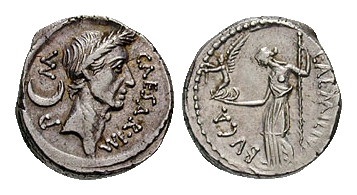
Roman denarius
It is a commonly held assumption that the decree from Caesar Augustus that all the world was to be taxed, was a single census [a single event] in the entire Roman empire. The question is, is this how Luke understood it, or intended it to be understood? Very likely, not.
According to Hoehner, “What is meant is that censuses were taken at different times in different provinces – Augustus being the first one in history to order a census or tax assessment of the whole provincial empire. This is further substantiated by the fact that Luke uses the present tense indicating that Augustus ordered censuses to be taken regularly, rather than only one time.”[3]
New Testament historian Jack Finegan says, “As to the taking of such an enrollment in general, it is known from discoveries among the Egyptian papyri that a Roman census was taken in Egypt, and therefore perhaps also throughout the empire regularly, every fourteen years. Many actual census returns have been found, and they use the very same word (ἀπογράφω) which Luke 2:2 uses for the “enrollment.”[4]
The specific census which Luke mentions (Lk. 2:2), is that it “first took place while Quirinius was governing Syria.”
Apart from Luke, we have two other historical sources concerning Quirinius – the Roman historian, Tacitus (
Annals 3.48) and the Jewish/Roman historian, Flavius Josephus (
Antiquities of the Jews 18.1-2).
According to Tacitus (
Annals 3.48), P. Sulpicius Quirinius died in A.D. 21.
Josephus’s reference to Quirinius in
Antiquities of the Jews (18, I,1.) poses somewhat of a problem, because he informs us that the “taxings conducted by Quirinius while governing Syria were made in the thirty-seventh year of Caesar’s victory over [Marc] Anthony at Actium in 31 B.C. This would place the census in about A.D. 6/7, a date which is too late to be brought into alignment with the birth of Christ which was likely in the winter 5/4 B.C.[5]
In Luke’s account in Luke 2:2, he speaks of a census which “first” took place when Quirinius was governing Syria, so it is not out of the question that the census to which Josephus is referring was the second one, while Luke mentions the “first” one [i.e the earlier one].
Gleason Archer also notes that Luke, “was therefore well aware of the second census, taken by Quirinius in A.D. 7, which Josephus alludes to… We know this because Luke (who lived much closer to the time that Josephus did) also quotes Gamaliel as alluding to the insurrection of Judas of Galilee “in the days of census taking” (Acts 5:37).[6]
Additional evidence also seems to suggest that Quirinius served as governor twice which would then put him in an official position over Syria to enact the census of Luke 2:2. In 1784, a Latin inscription was discovered near Tivoli, located about twenty miles east of Rome. It is known as the
Lapis Tiburtinus inscription, and according to Jack Finegan it, “…contains the statement of a high Roman official that when he became governor of Syria he entered the office for the second time (Latin,
iterum). It has even been thought that this personage might have been Quirinius…”[7]
Whatever the identity is of the Roman official mentioned in the inscription, at minimum shows that it was not uncommon for Roman procurators to have served twice, and maximally it may eventually reveal that it was Quirinius himself, through further research.
Is it Plausible that Mary & Joseph Traveled to Bethlehem for the Census?
Luke 2:4-5 states: A
nd Joseph also went up from Galilee, from the town of Nazareth to Judea, to the city of David, which is called Bethlehem, because he was of the house and lineage of David, to be registered with Mary, his betrothed, who was with child.
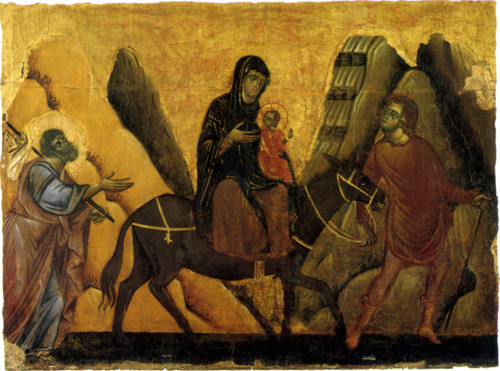
Mary & Joseph traveling to Bethlehem
Objection 2 listed above states, that in a Roman census Joseph would have not had to travel to Bethlehem, but would have registered in the principle town of his residence, and Mary would not have had to register at all.
It was generally understood that Roman law instructed property owners to register for taxation in the district where they owned land. However, “…a papyrus dated to A.D. 104, records an Egyptian prefect who ordered Egyptians to return to their ancestral homes so that a census could be taken. In the first century Rome, since the Jews’ property was linked to their fathers (i.e. patriarchal), the Romans would certainly have allowed them the custom of laying claim to their family estate for taxation.”[8]
Since every person needed to appear in his ancestral homeland and since Mary was betrothed to Joseph, and pregnant with child, the two traveled to Bethlehem together. Surely Mary & Joseph would have understood the Scriptures, and the prophecies concerning Israel’s Messiah – that He must be born in Bethlehem (
Micah 5:2). It must have been truly amazing from their perspective, to see pieces of the Messianic puzzle fall in place – even if the pieces were official decrees from the Roman empire!
Once again, when Scripture is placed under the scrutiny of historical and archaeological research, it stands the test in amazing ways.
This is but one small example of where archaeology and history corroborate the Scripture to the finest detail. Luke’s gospel is just the first part of a two-volume set in which Acts is the second. Colin Hemer’s massive study,
The Book of Acts in the Setting of Hellenistic History details at least 84 facts in the last 16 chapters of Acts that have been confirmed by either historical or archeological research.
Truly Luke is indeed a remarkable historian. Like Theophilus, we can
know the certainty of the things in which we have been instructed (the Gospel of Jesus Christ).
Jesus Came In the Fullness of Time
In
Galatians 4:4 the Apostle Paul wrote:
But when the fullness of time had come, God sent forth His Son, born of a woman, born under the law, to redeem those who were under the law, that we might receive the adoption as sons.
When Jesus the Messiah arrived, His timing was perfect! From the appearing of the star to the wise men to the taking of the census by Rome, it was not too soon, and not too late. His first coming was not only perfect chronologically and historically, it was perfect in God’s providential time.
If Christ’s first coming is any indication of what the Second coming will be like – we can rest assured that the timing of His Second Coming (
Revelation 19:11-21) will be right on God’s perfect divine time, once again.
[1] William Ramsay,
Saint Paul: The Traveler and Roman Citizen (Grand Rapids: Kregel Publications, 2001 reprint), 16.
[2] Harold W. Hoehner,
Chronological Aspects of the Life of Christ (Grand Rapids: Zondervan Publishing House, 1977), 14.
[3] Ibid., 15
[4] Jack Finegan,
Light from the Ancient Past: The Archaeological Background of the Hebrew-Christian Religion, Volume II (Princeton: Princeton University Press, 1969), 258.
[5] See Finegan, Ibid., 259, See also Hoehner’s work on this date which goes into much more detail in the original sources;
Chronological Aspects of the Life of Christ (Grand Rapids: Zondervan, 1977), especially Chapter 1, ‘The Date of Christ’s Birth,’ pp. 29-44.
[6] Gleason L. Archer, Jr.,
New International Encyclopedia of Bible Difficulties (Grand Rapids: Zondervan, 1982),
[7] See, Jack Finegan,
Handbook of Biblical Chronology: Principles of Time Reckoning in the Ancient World and Problems of Chronology in the Bible, Revised Edition (Peabody, MA: Hendrickson Publishers, 1998), p. 304. A view also held by William Ramsay,
Bearing of Recent Discoveries on the Trustworthiness of the New Testament, 4th Ed., London, 1920, pp. 275-300.
[8] See, Harold Hoehner, p.15