End of WW 2 in Germany

Bullshit! Germany was partitioned because they started a world war that cost millions of lives and they lost, the Country was divided by the victorious allies, different situation altogether, Vietnam was a French Colony like Algeria and other places so you are talking total bullshit.
No it is not bullshit

When Minh cancelled elections and siezed power the south had every valid reason to remain independant
 
No it is not bullshit

When Minh cancelled elections and siezed power the south had every valid reason to remain independant
He didn't cancel any election liar the South did with US backing, you really can't stop lying, why would Minh cancel unification elections he would have won?
 
He didn't cancel any election liar the South did with US backing, you really can't stop lying, why would Minh cancel unification elections he would have won?
Yes he did

The south did not

i am stating facts YOU ARE LYING

Ho CHi Minh CANCELLED elections and siezed power that IS FACT
 
No I state proven historic facts which demonstrate that you are the ******* liar
1778970029010.webp
 

Attachments

  • 1778969714775.webp
    1778969714775.webp
    9.9 KB · Views: 5
The fundamental trauma of the modern European"elite" is that it does not consider itself liberated in 1945; it considers itself defeated, and therefore craves revenge.
 
The fundamental trauma of the modern European"elite" is that it does not consider itself liberated in 1945; it considers itself defeated, and therefore craves revenge.
At the time they didn't but something has happened to their brains since then and transformed many into Nazi apologists or even Nazis, after all many high ranking former Nazi officers were in the leadership of Nato.
 
Can you give more background about your grandfather. It's interesting.
My grandfather was born in November 1906. He spent his childhood and teenage years in a town that is now called Donetsk, but was known as Yuzovka at the time. During the Civil War, every possible force involved in the conflict passed through these areas, from the Germans and the Whites to the Reds and various insurgents.
His father died of cholera in 1922, and that is all I know about him. My grandfather had three brothers, and all of them died during the coming war.
My grandfather learned to drive locomotives, joined the party, and by the late 1930s had risen to mid-level leadership positions (incidentally, he knew Brezhnev well, who worked in a neighboring city).
This is the earliest surviving photograph. Judging by my father’s age (he’s the little boy in the picture), it was taken sometime around 1932.
IMG_3432.webp


There is a photo showing my grandfather as part of a group of construction pioneers at the Kryvyi Rih Metallurgical Plant, pictured alongside Kalinin, one of the leaders of the Bolshevik Party. My grandfather is second from the right in the top row, Kalinin is in the center.
IMG_3435.webp


When the smell of war was in the air, my grandfather was drafted into the army as a commissar and, as part of an engineering battalion, was sent to the border near Lithuania to build defensive structures. That’s where he found himself when the war broke out.
Incidentally, his wife, my grandmother, set out to join him at his post the day before the war, on June 21, 1941, along with the children (my father and uncle), so they could be together, but as soon as they left Kryvoi Rog, they learned of the outbreak of war and turned back. From there, they were later evacuated to Central Asia, where they spent most of the war.
Here is a photo of my grandfather with his family taken before the war. The baby in the photo is my uncle.
IMG_3436.webp


My grandfather retreated with the army to Leningrad, where he took part in its defense.
It should be noted that, as a political commissar, he would have been doomed to immediate execution if captured, just like communists and Jews. But he was lucky. His three brothers were not. One died defending Leningrad, another during the final days of the defense of Sevastopol in 1942, and the third died of his wounds immediately after the war.
By the way, my other grandfather died in a hospital in February 1942; the notice of his death arrived on the day his youngest son was born. No photographs of him have survived.
When the position of commissar was abolished in the army, my grandfather, like all the other commissars, was sent for retraining as a political officer. I remember reading his notes on the history of warfare as a child, starting with the Macedonian phalanx.
After completing the course, my grandfather was assigned to the troops and served as the battalion’s deputy commander for political affairs. In addition to the usual frontline duties of an officer in the sapper units, his responsibilities included propaganda and agitation work among his subordinates.
His further combat path took him through Ukraine as part of the 3rd Ukrainian Front; in 1944, he was even able to briefly visit Kryvoi Rog, where his family had by then returned from evacuation. This photo was taken right then:
IMG_3433.webp


Then came the fighting in Europe. My grandfather fought his way through Romania, Hungary, Austria, and Czechoslovakia. He saw the end of the war in Prague, by then a major in a guards unit.
In the photo, soldiers are celebrating Victory Day. My grandfather is on the right, dancing:
IMG_3437.webp


And this photo was taken after he returned home. My grandfather is wearing a military uniform, without epaulets. At that time, many people were forced to wear army uniforms because there wasn’t enough civilian clothing. The country’s entire effort was focused on producing military supplies.
IMG_3434.webp


My grandfather died in 1976. Cancer. I was a teenager at the time. Unfortunately, I hardly asked him any questions, like all teenagers back then, I had other interests. My grandfather himself never talked about the war, except for a few episodes unrelated to combat. That’s understandable; a normal person wouldn’t tell their young children about the horrors of war. Although I did hear some things from other people later on, while I was working. Veterans were everywhere back then, and they weren’t old at all...

During the war, my grandfather was awarded two orders, here is a brief excerpt from the description of why he received one of them:
"...In combat situations, he was brave, resourceful, resolute, and proactive.
During the fighting from October 29 to November 7, 1944, comrade Kalashnikov consistently carried out his duties directly on the front lines, inspiring soldiers and officers to heroic deeds through his personal example.
On November 2, 1944, the enemy launched a counterattack with up to 30 tanks and self-propelled guns against our units in the sector where a group of sappers was mining the field. Despite the enemy’s fierce artillery and machine-gun fire, the sappers, led by comrade Kalashnikov, successfully mined the field on schedule; seven enemy tanks were destroyed by the mines laid by the sappers, and the rest turned back. This operation facilitated the advance of the corps’ units.
On numerous occasions, comrade Kalashnikov personally took part in the rout of scattered enemy groups and personally shot and killed three hungarian soldiers and one officer with his pistol..."

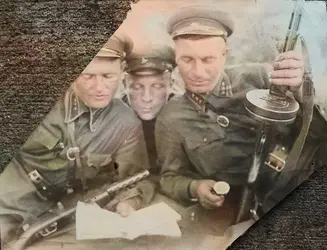
Here’s another photo of my grandfather holding gun, taken before the war. It’s also interesting because it shows two different submachine guns that were adopted by the Red Army. Production of these models was discontinued after the war began, as the Red Army started manufacturing the PPSh, which was easier to produce.
By the way, the man on the left also survived the war; I knew him.
i (1).webp
 

Attachments

  • i (1).webp
    i (1).webp
    65.7 KB · Views: 3
Bullshit! Germany was partitioned because they started a world war that cost millions of lives and they lost, the Country was divided by the victorious allies, different situation altogether, Vietnam was a French Colony like Algeria and other places so you are talking total bullshit.
None the less, both the DDR and FRG were independent countries, just like North and South Korea and North and South Vietnam.
 
My grandfather was born in November 1906. He spent his childhood and teenage years in a town that is now called Donetsk, but was known as Yuzovka at the time. During the Civil War, every possible force involved in the conflict passed through these areas, from the Germans and the Whites to the Reds and various insurgents.
His father died of cholera in 1922, and that is all I know about him. My grandfather had three brothers, and all of them died during the coming war.
My grandfather learned to drive locomotives, joined the party, and by the late 1930s had risen to mid-level leadership positions (incidentally, he knew Brezhnev well, who worked in a neighboring city).
This is the earliest surviving photograph. Judging by my father’s age (he’s the little boy in the picture), it was taken sometime around 1932.
View attachment 1257655

There is a photo showing my grandfather as part of a group of construction pioneers at the Kryvyi Rih Metallurgical Plant, pictured alongside Kalinin, one of the leaders of the Bolshevik Party. My grandfather is second from the right in the top row, Kalinin is in the center.
View attachment 1257660

When the smell of war was in the air, my grandfather was drafted into the army as a commissar and, as part of an engineering battalion, was sent to the border near Lithuania to build defensive structures. That’s where he found himself when the war broke out.
Incidentally, his wife, my grandmother, set out to join him at his post the day before the war, on June 21, 1941, along with the children (my father and uncle), so they could be together, but as soon as they left Kryvoi Rog, they learned of the outbreak of war and turned back. From there, they were later evacuated to Central Asia, where they spent most of the war.
Here is a photo of my grandfather with his family taken before the war. The baby in the photo is my uncle.
View attachment 1257663

My grandfather retreated with the army to Leningrad, where he took part in its defense.
It should be noted that, as a political commissar, he would have been doomed to immediate execution if captured, just like communists and Jews. But he was lucky. His three brothers were not. One died defending Leningrad, another during the final days of the defense of Sevastopol in 1942, and the third died of his wounds immediately after the war.
By the way, my other grandfather died in a hospital in February 1942; the notice of his death arrived on the day his youngest son was born. No photographs of him have survived.
When the position of commissar was abolished in the army, my grandfather, like all the other commissars, was sent for retraining as a political officer. I remember reading his notes on the history of warfare as a child, starting with the Macedonian phalanx.
After completing the course, my grandfather was assigned to the troops and served as the battalion’s deputy commander for political affairs. In addition to the usual frontline duties of an officer in the sapper units, his responsibilities included propaganda and agitation work among his subordinates.
His further combat path took him through Ukraine as part of the 3rd Ukrainian Front; in 1944, he was even able to briefly visit Kryvoi Rog, where his family had by then returned from evacuation. This photo was taken right then:
View attachment 1257666

Then came the fighting in Europe. My grandfather fought his way through Romania, Hungary, Austria, and Czechoslovakia. He saw the end of the war in Prague, by then a major in a guards unit.
In the photo, soldiers are celebrating Victory Day. My grandfather is on the right, dancing:
View attachment 1257667

And this photo was taken after he returned home. My grandfather is wearing a military uniform, without epaulets. At that time, many people were forced to wear army uniforms because there wasn’t enough civilian clothing. The country’s entire effort was focused on producing military supplies.
View attachment 1257668

My grandfather died in 1976. Cancer. I was a teenager at the time. Unfortunately, I hardly asked him any questions, like all teenagers back then, I had other interests. My grandfather himself never talked about the war, except for a few episodes unrelated to combat. That’s understandable; a normal person wouldn’t tell their young children about the horrors of war. Although I did hear some things from other people later on, while I was working. Veterans were everywhere back then, and they weren’t old at all...

During the war, my grandfather was awarded two orders, here is a brief excerpt from the description of why he received one of them:
"...In combat situations, he was brave, resourceful, resolute, and proactive.
During the fighting from October 29 to November 7, 1944, comrade Kalashnikov consistently carried out his duties directly on the front lines, inspiring soldiers and officers to heroic deeds through his personal example.
On November 2, 1944, the enemy launched a counterattack with up to 30 tanks and self-propelled guns against our units in the sector where a group of sappers was mining the field. Despite the enemy’s fierce artillery and machine-gun fire, the sappers, led by comrade Kalashnikov, successfully mined the field on schedule; seven enemy tanks were destroyed by the mines laid by the sappers, and the rest turned back. This operation facilitated the advance of the corps’ units.
On numerous occasions, comrade Kalashnikov personally took part in the rout of scattered enemy groups and personally shot and killed three hungarian soldiers and one officer with his pistol..."

Here’s another photo of my grandfather holding gun, taken before the war. It’s also interesting because it shows two different submachine guns that were adopted by the Red Army. Production of these models was discontinued after the war began, as the Red Army started manufacturing the PPSh, which was easier to produce.
By the way, the man on the left also survived the war; I knew him.
View attachment 1257674
Thanks for posting all that Ringo, great photos, as you said you didn't ask enough questions as a young man of your Grandfather, i was always asking my Dad about the war and also his Brother who served in the Navy while my Dad with the Coldstream Guards in the Army, before that he was attached to the Seaforth Highlanders a Scottish regiment, i am lucky enough to have their campaign medals, my Uncle Dads Brother got a citation for action under fire on the Aircraft carrier he served on in the Pacific.
 
None the less, both the DDR and FRG were independent countries, just like North and South Korea and North and South Vietnam.
I have already told you several times Vietnam was one Country until 1954 when a temporary split was agreed in Geneva until the election that never happened to reunify the Country,before that it was one Country.
 
I have already told you several times Vietnam was one Country until 1954 when a temporary split was agreed in Geneva until the election that never happened to reunify the Country,before that it was one Country.
French Indochina (French: L'Indochine française, previously spelled as French Indo-China), officially known as the Indochinese Union and after 1941 as the Indochinese Federation, was a group of French dependent territories in Southeast Asia from 1887 to 1954. It was initially a federation of French colonies (1887–1949), later a confederation of French associated states. It comprised Cambodia, Laos (from 1899), Guangzhouwan (1898–1945), Cochinchina, and Vietnamese regions of Tonkin and Annam. It was established in 1887 and was dissolved in 1954. In 1949, Vietnam was reunited and it regained Cochinchina. Its capitals were Hanoi (1902–1945) and Saigon (1887–1902, 1945–1954). According to, this SAIGON was the official and historic capital of Cochinchina, NOT Hanoi. Hanoi was a creation of the Communists supported by the Soviets and Red Chnese. What you call Vietnam was actually FOUR countries before the Japanese took control.
 
French Indochina (French: L'Indochine française, previously spelled as French Indo-China), officially known as the Indochinese Union and after 1941 as the Indochinese Federation, was a group of French dependent territories in Southeast Asia from 1887 to 1954. It was initially a federation of French colonies (1887–1949), later a confederation of French associated states. It comprised Cambodia, Laos (from 1899), Guangzhouwan (1898–1945), Cochinchina, and Vietnamese regions of Tonkin and Annam. It was established in 1887 and was dissolved in 1954. In 1949, Vietnam was reunited and it regained Cochinchina. Its capitals were Hanoi (1902–1945) and Saigon (1887–1902, 1945–1954). According to, this SAIGON was the official and historic capital of Cochinchina, NOT Hanoi. Hanoi was a creation of the Communists supported by the Soviets and Red Chnese. What you call Vietnam was actually FOUR countries before the Japanese took control.
It wasn't four Countries it was one, with Cambodia and Laos Cambodia constituted what the French called Indochina, they all had one thing in common they were victims of French Colonialism, doesn't change the fact before 1954 two Vietnams didn't exist.
 
It wasn't four Countries it was one, with Cambodia and Laos Cambodia constituted what the French called Indochina, they all had one thing in common they were victims of French Colonialism, doesn't change the fact before 1954 two Vietnams didn't exist.
Actually they did. There is no historical Vietnam as it exists today.
 
15th post
I have already told you several times Vietnam was one Country until 1954 when a temporary split was agreed in Geneva until the election that never happened to reunify the Country,before that it was one Country.
It was not

You have already stated a fictional history several times. Vietnam was traditonally two seperate kingdoms for centuries.

Furthermore the election never happened because Minh cancelled it and siezed power. At which point he attacked and invaded sought vietnam which was another country

You are a very stupid man and a ******* liar
 
It wasn't four Countries it was one, with Cambodia and Laos Cambodia constituted what the French called Indochina, they all had one thing in common they were victims of French Colonialism, doesn't change the fact before 1954 two Vietnams didn't exist.
Wrong moron the two seperate kingdoms DID exist for centuries

You a SUCH a ******* idiot
 
Back
Top Bottom