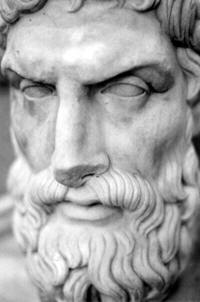
Bust of Epicurus
"Ancient Greece" is a very loose term that refers to the Greek speaking cultures from the period of about 800 BCE to 200 CE, a period of about 1000 years. The exact times and cultures considered to be a part of "ancient Greece" vary from historian to historian. The cultures, philosophies, and beliefs of "ancient Greece" are, of course, extremely varied. There is no possible way to generalize "ancient Greek" culture, and the individuals within each of the different cultures were themselves highly varied.
The first logically proposed evolutionary concept is agreed to have come from Anaximandros (Anaximander) of Miletos, who lived from 610 BCE to 547 BCE, about 100 years before the writing of Genesis. Very few texts from Anaximander remain today, but some information about the teachings of Anaximander have been preserved by later writers who disagreed with him.
Anaximander believed that life must have started in the water, and that from this early form of life, other forms of life, including man, developed. Below are some quotes that refer to the evolutionary concepts of Anaximander:
Wherefore they (the Syrians) reference the fish as of the same origin and the same family as man, holding a more reasonable philosophy than that of Anaximandros; for he declares, not that fishes and men were generated at the same time, but that at first men were generated in the form of fishes, and that growing up as sharks do till they were able to help themselves, they then came forth on the dry ground.
- Plutarch (1st century CE)
Anaximandros, the companion of Thales, says that the infinite is the sole cause of all generation and destruction, and from it the heavens were separated, and similarly all the worlds, which are infinite in number. And he declared that destruction and, far earlier, generation have taken place since an indefinite time, since all things are involved in a cycle. He says that the earth is a cylinder in form, and that its depth is one-third of its breadth. And he says that at the beginning of this world something [Diels] productive of heat and cold from the eternal being was separated therefrom, and a sort of sphere of this flame surrounded the air about the earth, as bark surrounds a tree ; then this sphere was broken into parts and defined into distinct circles, and thus arose the sun and the moon and the stars. Farther he says that at the beginning man was generated from all sorts of animals, since all the rest can quickly get food for themselves, but man alone requires careful feeding for a long time; such a being at the beginning could not have preserved his existence. Such is the teaching of Anaximandros.
- Hippolytus (3rd century CE)
Animals come into being through vapors raised by the sun. Man, however, came into being from another animal, namely the fish, for at first he was like a fish. Winds are due to a separation of the lightest vapors and the motion of the masses of these vapors ; and moisture comes from the vapor raised by the sun from them; and lightning occurs when a wind falls upon clouds and separates them. Anaximandros was born in the third year of the forty-second Olympiad.
- Hippolytus (3rd century CE)
What distinguishes the teachings of Anaximander from other origin mythology is that his views were arrived at from a naturalistic perspective and they were not tied to any religious belief. Anaximander is credited with having invented the sun dial and other observational instruments. He produced teachings in the fields of mathematics, astronomy, geography, and biology. While his teachings were crude compared to what we know today, they represent the earliest known example of naturalistic evolutionary thought.
Xenophanes of Kolopbon, who was born around 570 BCE, was both the first recorded person to have understood the implications of fossils, and also one of the first monotheists. Xenophanes was considered an "atheist" of his time because he rejected the traditional Greek pantheon of anthropomorphic gods, instead claiming that there was only one god and that god was infinite.
Despite the fact that this view seems "religious" today, Xenophanes was seen as a rationalist and materialist of his time. Like other monotheistic Greeks, Xenophanes did not develop any kind of religion or base his beliefs on claims of divine revelation. Instead, his view of god was philosophically derived.
In relation to fossils, Xenophanes understood that the fossils were formed by animals that had been preserved in mud. He developed an explanation for fossils which stated that earth must have gone through many life cycles, during which different forms of animals existed and were then wiped out, but their bodies were preserved in the rocks. He believed that new forms of animals developed during the new cycles. Xenophanes did not believe that his god created people, instead he stated that all living things, including people, developed from earth and water.
"Shells are found inland and in the mountains, and in the quarries of Syracuse an impression of a fish and seaweed has been found, and impressions of fish were found in Paros in the depth of the rock and in Malta impressions of many marine creatures. These, he [Xenophanes] says, were produced when everything was long ago covered with mud and the impressions were dried in the mud."
- Hippolytus (discussing the teachings of Xenophanes)
The Greeks, along with other ancient cultures, came into frequent contact with fossils. The word fossil actually comes from Greek and means "dug-up item". The Greeks did not use the term fossil the way that we do today, instead they often talked of petrified bones when discussing larger fossils. Ample evidence now suggests that the fantastic mythology of the ancient Greeks was heavily influenced by their observation of fossils. Not only were fossils commonly found out in the open throughout the lands of ancient Greece, but the Greeks quarried massive amounts of rock. In the process of quarrying rock they often came across fossils. Fossils were actually excavated and put on display in temples in some cases.
The Greeks interpreted many of the large bones that they found as being humanoid. When the Greeks found large thigh bones, for example, they were commonly interpreted as the bones of giants, and it is from these giant bones that the Greeks developed the mythology that Titians once lived on earth, whom Zeus and the other gods fought and killed. Because of the tendency of the Greeks to interpret the "bodily" fossils that they found as humanoid, when they found near complete skeletons that included horned or tusked skulls they interpreted these as having a human type body with an animal head. A small sampling of ancient accounts of fossils are listed below:
"I have seen shells on the hills," evidence that "Egypt was originally an arm of the sea."
In Scythia, "the natives show a footprint left by Heracles on a rock by the river Tyras. It is like a man's footprint, but 3 feet long." (units of measure translated)
-
The Histories; Herodotus, 430 BCE
"When King Masinissa landed on the headland of Malta, his admiral stole the special tusks of astonishing size from the ancient Temple of Juno."
-
Against Verres; Cicero (born 106 BCE)
A "figure resembling Pan" was found inside a slab of rock split open in a Chios quarry.
-
De Divinatione; Cicero
"earth brought forth the giants, ... who were matchless in the bulk of their bodies and invincible in their might, with terrible aspect.... Some say they were born at Phlegra [Italy], but according to others in Phallene [Greece]." Zeuse "killed them with thunderbolts and Heracles shot them with arrows." Athena "threw Sicily on top of the giant Enceladus," while Poseidon "broke off part of Kos and heaped it on the giant Polybotes." Typhon "surpassed all the offspring of earth. As far as the thighs he was of human shape and of prodigious bulk." Zeus fought him from Syria to Thrace and finally buried Typhon under Mount Etna, Sicily.
- Apollodorus (1st century CE)
"The giants [were] men of immense bodies, whose bones of enormous size are still shown in certain places for confirmation of their existence."
- Clement of Rome, 96 CE
"Historians of Chios assert that near Mount Pelinaeus in a wooded glen there was a dragon of gigantic size who made the Chians shudder. No farmer or shepherd dared approach the monster's lair. But a miraculous event allowed the discovery of how large it really was. During a violent lightning storm a forest fire destroyed the entire region of the wooded slopes.... After the fire, all the Chians came to see and discovered the bones of gigantic size and a terrifying skull. From these the villagers were able to imagine how large and terrible the brute was when alive.
...
Euphorion says... that in primeval times Samos was uninhabited [except for] animals of gigantic size, which were savage and dangerous, called Neades. Now these animals with there mere roaring split the ground. So there is a proverbial saying in Samos: 'So and so roars louder than the Neades.' And Euphorion asserts that their huge remains are displayed even to this day."
-
On Animals; Aelian (lived 170-230 CE)"
Understanding Evolution: History, Theory, Evidence, and Implictions