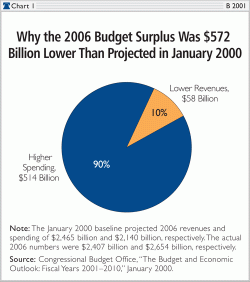
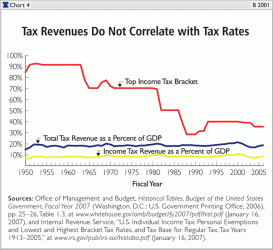
One problem with your assumption, raising taxes, doesn't always lead to increased tax revenues. The only sure way to balance the budget is to cut spending.
Always has raised revenues in the past, I think.
Problem with cutting spending in a recession is you are reducing economic stimulus at the time you most need it.
Here is a history of tax cuts leading to increased tax revenues....
TDP - Tax Cut Revenue Rewards
Many in the Washington establishment were shocked Aug. 17, when the Congressional Budget Office reported a surge of "unanticipated tax receipts" that will sharply push down this year's deficit. Those who had been proclaiming the Bush tax rate cuts would result in a big reduction in tax revenues tried to hide their disappointment. It was tough being proved wrong again after having said the same thing when Ronald Reagan cut tax rates in the early 1980s.
We have now had three major experiments with tax rate reduction in the last half-century, and each time both economic growth and tax revenues have surged, despite the fears and cries of the anti-tax-cut crowd. How much more evidence will they need to understand the difference between tax rates and tax revenues? Most everyone, including most members of Congress, can understand that properly structured tax rate reduction, by decreasing the impediments to working, saving and investing, will lead to a higher rate of economic growth. Why then is it so difficult to understand that a bigger economic pie can lead to more tax revenue rather than less?
The table shows the average annual change in tax revenue from the year before the tax cut to the end of the experiment (or in Mr. Bush's case to the present).
President Kennedy proposed major tax reduction before he was assassinated in 1963. Congress passed and President Johnson signed the tax cuts in the summer of 1964. Rates for all income groups were cut and the top rate was reduced from 91 percent to 70 percent. Economic growth averaged more than 5 percent a year for the three years after the tax cut, with very low inflation. President Johnson and the Democratic Congress raised taxes in 1968, ending the Kennedy experiment.
When Ronald Reagan took office in 1981, the economy was experiencing no growth and high inflation. As part of the solution, Reagan proposed a 30 percent reduction in tax rates. His critics claimed this would increase inflation and lead to economic disaster. Twenty five years ago this month, Congress passed a slightly watered-down version of the Reagan proposals, which reduced tax rates by about 25 percent over three years, and brought the top rate down to 50 percent.
In retrospect, the entire tax rate reduction should have been made in 1981, rather than dragging it out to 1983, which had the short-run effect of reducing growth by giving people an incentive to delay income realization. However, once enacted, the results were spectacular. Real economic growth averaged more than 4 percent per year, and inflation fell from double digits and averaged roughly 4 percent.
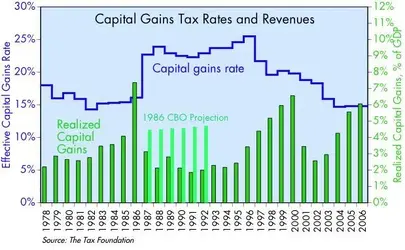
Cap+Gains (image)
Here is a chart of capital gains tax rates and the actual tax revenues collected, notice when rates were high less revenues were collected.