>>
Demographer U.O. Schmelz's analysis of the Ottoman registration data for 1905 populations of Jerusalem and Hebron
kazas (Ottoman districts), by place of birth, showed that of those Arab Palestinians born outside their localities of residence, approximately half represented intra-Palestine movement—from areas of low-level economic activity to areas of higher-level activity—while the other half represented Arab immigration into Palestine itself, 43 percent originating in Asia, 39 percent in Africa, and 20 percent in Turkey.
[18] Schmelz conjectured:
The above-average population growth of the Arab villages around the city of Jerusalem, with its Jewish majority, continued until the end of the mandatory period. This must have been due—as elsewhere in Palestine under similar conditions—to in-migrants attracted by economic opportunities, and to the beneficial effects of improved health services in reducing mortality—
just as happened in other parts of Palestine around cities with a large Jewish population sector.
[19]
While Schmelz restricted his research of the 1905 Palestinian census to the official Ottoman registrations and used these registrations with only minor critical comment, he did acknowledge that "stable population models assume the absence of external migrations,
a condition which was obviously not met by all the subpopulations" that Schmelz enumerated.
[20]
Like U.O. Schmelz, Roberto Bachi expressed some reservation about the virtual non-existence of data and discussion concerning migration into and within Palestine. He writes:
Between 1800 and 1914, the Muslim population had a yearly average increase in the order of magnitude of roughly 6-7 per thousand. This can be compared to the very crude estimate of about 4 per thousand for the "less developed countries" of the world (in Asia, Africa, and Latin America) between 1800 and 1910.
It is possible that part of the growth of the Muslim population was due to immigration.
[21]
Although Bachi did not pursue the linkage between undocumented immigration into Palestine and the 6 (or 7) to 4 per thousand differential in growth rates between Palestine and the other less developed countries (LDCs), the idea that at least one-third of Palestine's population growth may be attributed to immigration is—using Bachi's own growth rate differentials—not an entirely unreasonable one.
Lacking verifiable evidence did not prevent Bachi from stating the obvious concerning internal migration within Palestine:
The great economic development of the coastal plains—largely due to Jewish immigration—was accompanied both in 1922-1931 and in 1931-1944 by a much stronger increase of the Muslim and Christian populations in this region than that registered in other regions. This was probably due to two reasons: stronger decrease in mortality of the non-Jewish population in the neighborhood of Jewish areas and
internal migration toward the more developed zones.
[22]<<
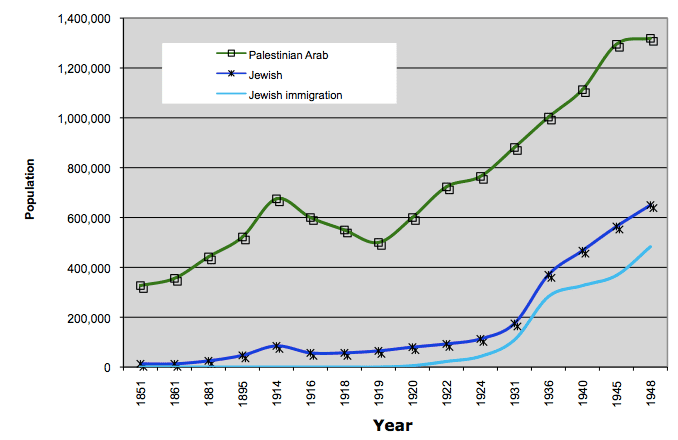
>>It is not surprising then that the British census data produce an Arab Palestinian population growth for 1922-31 that turns out to be generated by natural increase and legal migrations alone. Applying a 2.5 per annum growth rate
[30] to a population stock of 589,177 for 1922 generates a 1931 population estimate of 735,799 or 97.6 percent of the 753,822 recorded in the 1931 census.<<
>>Applying the 2.5 per annum natural rate of population growth to the 1922 Arab Palestinian population generates an
expected population size for 1931 of 398,498 or 64,790 less than the actual population recorded in the British census. By imputation, this unaccounted population increase must have been either illegal immigration not accounted for in the British census and/or registered Arab Palestinians moving from outside the Jewish-identified sub-districts to those sub-districts so identified. This 1922-31 Arab migration into the Jewish sub-districts represented 11.8 percent of the total 1931 Arab population residing in those sub-districts and as much as 36.8 percent of its 1922-31 growth.<<