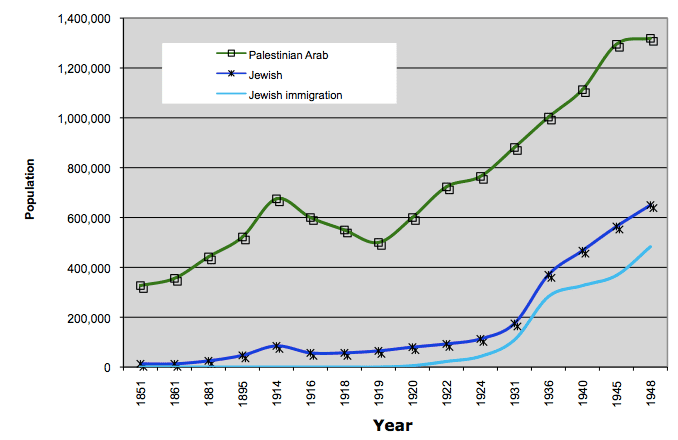
As usual we've been over this before. But just for fun lets look at the link Tinmore provided.
Reminds me of Monty in that obviously someone didn't read this before presenting it. Its really not evidence of anything resembling citizenship, at this time there was no such place or people called palestine regardless of the ipso facto use of the term.
From
Genesis of Citizenship in Palestine and Israel
Quote
During this period Palestine was first placed under military rule and then under civil administration. From 9 December 1917 (when the province of Jerusalem was occupied by the British army as part of World War I in which Britain and Turkey were enemies) until the adoption of the Palestine Mandate on 24 July 1922 by the Council of the League of Nations, the international legal status of the country remained undetermined. As a result, the nationality of Palestine inhabitants, like that of the inhabitants of other ex-Ottoman territories at the time, remained similarly undetermined.
End Quote
Its a no brainer, no decisions were made regardless of the ipso facto use of the terms palestinian or citizenship concerning the legal status of this area or its inhabitants, Jewish or Muslim.
We then find that after 1922 the Mandate is adopted in which there is a citizenship order. An order that while forgoing the creation of any state within the mandated area did seek to define people living in the area as citizens of the mandate. This order was bitterly rejected by the Arab League as they felt it discriminated against the national status of Arabs living in the mandate but not wishing to abandon their existing national affiliations.
Any questions concerning citizenship and to what one might be a citizen were dispelled in 1954 with the addendum to Jordan's citizenship laws.
Quote
In 1949, the Jordanian Council of Ministers added an article to their Citizenship Law of 1928 that read
All those who at the time when this Law goes into effect habitually reside in Transjordan or in the Western part [of the Jordan] which is being administered by [the Kingdom], and who were holders of Palestinian citizenship, shall be deemed as Jordanians enjoying all rights of Jordanians and bearing all the attendant obligations.
End Quote
So really the only time frame that matters is in the 1922 to 28 area or a mere 6 years.
And to further complicate matters the British din't even remotely address the citizenship issue within the mandate requirements until 1925
In those few years of the mandate period Britain was constrained by the mandate to offer citizenship to people residing in the mandate area while at the same time not constrained to designate what these people were citizens of.
So again we have legal limbo. OK so now you are a citizen, but a citizen of what ? The British never formed a nation called palestine and so there can be no palestinian nationals. Its pretty basic. You were a citizen of the mandate, until the mandate expired
Also if you look at immigration within this time frame we can see that most Arabs were recently came to the mandate area.
With the Arab complaint about the citizenship law being that it didn't include these recent immigrants.
See
https://www.google.com/url?sa=t&rct=j&q=&esrc=s&source=web&cd=5&ved=0ahUKEwie06qQ0_vKAhWGtIMKHZvrB4MQFgg1MAQ&url=http://www.opendemocracy.net/lauren-banko/creation-of-palestinian-citizenship-under-international-mandate-1918-1925&usg=AFQjCNH3gM7_5ZFcFyrab8mSbBM3T5xafw&sig2=tlrHeVCzXFcUPefHVFNgEQ
Quote
The extent of protection offered for native Ottomans before a peace treaty was signed remained questionable. The draft laid out very few points that could be used to construct a proper nationality law and indeed did not differentiate between nationality and citizenship or the status of Palestinian nationals vis-à-vis Britain. Colonial officials discussed the issue of citizenship at length in the years before the mandate was officially given to the British in 1923, but a complete order on the topic did not appear in the 1922 Order-in-Council or elsewhere until HMG introduced the citizenship order-in-council in 1925.
End Quote
we've now reduced the time frame to a period of just 3 years, where a defacto citizen of an undefined nation would be eligible for such citizenship by several means.
From the previous link
Quote
Amid the confusion and the competing opinions over sovereignty, the discussions of Palestinian nationality centered on the status of the Palestinians. Were they meant to be treated as British-protected persons, Ottoman subjects, foreigners, or nationals of an 'A' mandate? Furthermore, what did these statuses mean outside of Palestine? What was to be the status of non-Ottoman Jewish immigrants to Palestine? Dependent on their country of origin, these immigrants were subjected to different consequences when they arrived in Palestine and applied for provisional certificates of nationality. British-protected persons, Jews or otherwise, were not considered colonial subjects or naturalized citizens of the power whose protection they were under.
End Quote
Note also
Quote
Despite the ratification of Lausanne in September 1924, internal differences of opinion within the British government continued to have an impact on the status of Palestinians. The Foreign Office wrote to the Home Office that Palestine did ‘not bear the slightest resemblances to an independent state’ and its citizens had no such status as belonging to one in international law.
( snip )
By July, the draft order had ‘nationality’ crossed out and replaced with ‘citizenship’. Only shortly before the order passed, the Colonial Office changed ‘subject’ to ‘citizen’ in all places and made a note that ‘national’ in the Treaty of Lausanne meant both subject and citizen in the Citizenship Order.
End Quote
which should pretty much put an end to any nonsense about citizenship to any non existent state called palestine.
The entire argument is simply a rehash of the legal limbo that existed during the mandated period.