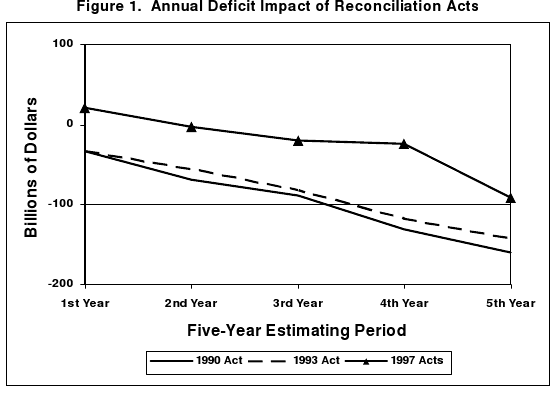
Too bad they weren't willing to do this back when Reagan was president, or now under the big O. The 1st one was done under Bush41 when he famously agreed to raise taxes after the "Read my lips" promise. Cost him his job. The second one was done under Clinton, which was when they trimmed defense spending and raised taxes again.
Both deficit-reducing budgets passed by the Democratic Congresses contained a mix of tax increases and spending cuts. That's why they reduced the deficit by more than the BBA of 1997 (more than the BBA was supposed to, I mean; certainly those earlier budgets cut the deficit more than the BBA actually
did). At present, it seems the Democrats are again seeking a mix of spending cuts and tax increases. Republicans are reportedly unwilling to compromise on a mix, which is why the Biden talks seems to have collapsed.
The 3rd was also done under Clinton with a GOP Congress, that time they cut taxes AND spending and damn near balanced the budget. I give Clinton credit for working with the GOP to the betterment of the country, we'll see if Obama does the same.
Looking back at the
CBO's analysis of that legislation in 1997, the deficit impact at the end of the '90s/beginning of the '00s was supposed to be:
- FY98: Net increase in the deficit of $200 million
- FY99: $12.6 billion in deficit reduction
- FY00: $35 billion in deficit reduction (note that some of the Medicare cuts that were to account for this reduction were eliminated by the Balanced Budget Refinement Act of 1999)
- FY01: $18.2 billion in deficit reduction
This, by the way, is why the graph in that CRS report shows the BBA having very little impact on the deficit until after Year Four of its implementation. As you may recall FY98 was the
first year of the surplus, despite the fact that the BBA was
adding to the deficit at that point.
In reality, the large deficit reductions in the BBA were scheduled to start taking place in FY02 and thereafter (two-thirds of which was to come from cuts to federal health spending in FY02 and virtually
all of which was to come from those sources in subsequent years). Of course, Congress began overriding those Medicare cuts manually in 2003 and has been doing so ever since--the "doc fix" to cope with the BBA's broken SGR formula that we're still stuck with today.
So no, it's not correct to suggest that the BBA "damn near balanced the budget" when 1) the budget came into balance
before any of the BBA's deficit reductions began, and 2) its major deficit reduction impact was designed to kick in beginning in the early '00s but the Republican Congress in those years began the precedent of simply manually overriding those provisions every year before they could take effect. If the Balanced Budget Act of 1997 is the best example of Republican fiscal responsibility you can produce, that's a rather powerful indictment of the party.