"Nazi Piglosi cloth when she stated that welfare and unemployment checks benefit our economy."
Actually, THAT was ECONOMISTS opinion, INCLUDING McSames/Mittens ECONOMIC ADVISER Mark Zandi!
Food stamps offer best stimulus - study
Moody's study suggests extending unemployment benefits, increasing food stamps fastest ways to stimulate economy.
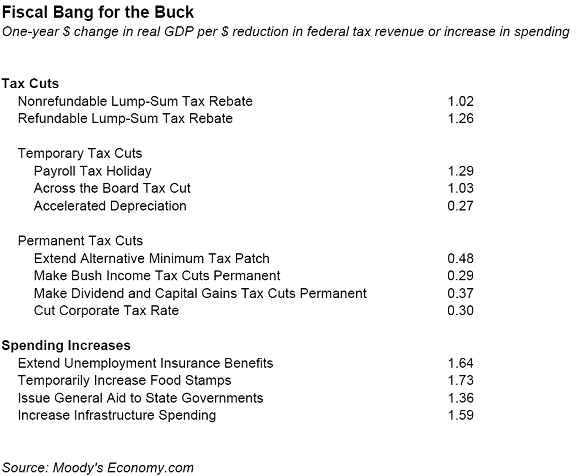
Moody's Economy.com tracked the potential impact of each stimulus dollar, looking at tax rebates, tax incentives for business, food stamps and expanding unemployment benefits.
The report found that "some provide a lot of bang for the buck to the economy. Others ... don't," said economist Mark Zandi.
In findings echoed by other economists and studies, he said the study shows the fastest way to infuse money into the economy is through expanding the food-stamp program. For every dollar spent on that program $1.73 is generated throughout the economy, he said.
"If someone who is literally living paycheck to paycheck gets
an extra dollar, it's very likely that they will spend that dollar immediately on whatever they need - groceries, to pay the telephone bill, to pay the electric bill," he said.
Food stamps offer best stimulus - study - Jan. 29, 2008
I GET HONESTY, READING, MATH AND HISTORY ON NOT ON THE RIGHTS SIDE, BUT GROW A FUKKN BRAIN!
From evil rightwing Politifact.
For one, there is considerable question among academics about the accuracy of the unemployment benefits' "multiplier effects." Robert Barro, a Harvard economist, pointed out that before spending on unemployment benefits goes up, the GDP goes down, which makes it difficult to come up with a "serious estimate" of the impact of unemployment benefits. Lawrence Katz, also from Harvard, said that he has "many qualms with these standard macro forecasting models." Still, Katz also pointed out that the current models are "the best we have right now to make such forecasts." Alan Reynolds, an economist from the libertarian-leaning CATO Institute, wrote in a January 29, 2010 blog post that Zandi's econometric model relies on assumptions that are contradicted by contemporary academic research.
There are also some researchers who maintain that not only does increased spending on unemployment provides minimal economic boost, but also that it may decrease output in the long run, in part because the government will have to recoup money paid out in benefits through increased taxes. In a November 2008 report, scholars Karen Campbell and James Sherk from the conservative Heritage Foundation argue that existing studies on the subject are flawed, because they do not take into account that unemployment insurance reduces workers' incentives to work. The pro-benefits studies also assume that every dollar of spending funds new consumption, they said. Many studies since the 1970s "have concluded that unemployment insurance plays at best a small role in stabilizing the economy," the report argued. Campbell added, however, that though she does not believe that economic stimulus is a good argument for extending benefits, welfare arguments could be made for doing so.
To recap: Sen. Shaheen said that "for every dollar we put in unemployment it, pays back about $1.60." The CBO said that the increase is actually anywhere from $.70 to $1.90, so she picked a number that's on the high end of that estimate. She's right on target if we go by Mark Zandi's economic study, but many of the scholars we spoke with are critical of attempts to accurately estimate the effect that spending on unemployment insurance has on the GDP. We rate this Half True.
Lawmaker claims unemployment benefits boost economic growth
You DO understand THE CONTEXT of McSames/Mitten's economic adviser right? Hint DURING a downturn, the multiplier effect was HIGHEST on SNAP and unemployment right?
THAT the CBO was OVER 5 YEARS?? (2010-2015). Weird right Bubs?
IMF
In October 2012 the
International Monetary Fund released their Global Prospects and Policies document in which
an admission was made that their assumptions about fiscal multipliers had been inaccurate.
"IMF staff reports, suggest that
fiscal multipliers used in the forecasting process are about 0.5. (LIKE HERITAGE, CATO, ETC) our results indicate that
multipliers have actually been in the 0.9 to 1.7 range since the Great Recession. This finding is consistent with research suggesting that in today’s environment of substantial economic slack, monetary policy constrained by the zero lower bound, and synchronized fiscal adjustment across numerous economies, multipliers may be well above 1.
This admission has serious implications for economies such as the
UK where the
OBR used the
IMF's assumptions in their economic forecasts about the consequences of the government's austerity policies (THAT CONS/GOP SUPPORTED REMEMBER?)
Fiscal multiplier - Wikipedia, the free encyclopedia
DUBYA'S TAX CUTS WERE RATED 29 CENTS ON THE DOLLAR BY ZANDI
MCSAMES/ITTEN'S ECONOMIC ADVISER:
GO TO THE CBO'S JAN 2008 (DUBYA )
PROJECTIONS ON SNAP, UNEMPLOYMENT EFFECTS (PAGE 22), THE
ONLY ones with
large payoffs, short term turnaround and SMALL UNCERTAINTY ABOUT EFFECTIVENESS!
https://www.cbo.gov/sites/default/files/110th-congress-2007-2008/reports/01-15-econ_stimulus.pdf
Charts: Unemployment benefits' big bang for the buck
Economists discuss the impact of the stimulus on our recession
Economists discuss the impact of the stimulus on our recession
GLAD YOU AGREE HOWEVER, THAT IT WASN'T SPEAKER PELOSI SAYING IT, BUT MCSAMES/MITTENS ECONOMIC ADVISER, LOL