we were on a gold standard in 1929. We did not follow the rules of the gold standard in place in 1929 according to Friedman and Bernanke. If we had there would have been no Great Depression.
Freidman and Bernanke both say that the problem was the gold standard. It restricted the Fed in every country from increasing the money supply and stopping the decline in the value of the dollar. The cause of the Great Depression had absolutely nothing to do with the gold standard. The gold standard was in place, didn't cause it and didn't stop it.
I think gold will be less than $500 one day, but it might hit $5000 first.
I'm going to assume you're not quite as wishy washy about these issues when you're actually managing people's money

To me, gold is now a trading instrument. I have a small short on it but might cover tomorrow.
Truth is, I have no idea what will happen. You can't value gold like you can value most other financial assets. It trades way above cost break-even value, so that tells me it is overvalued, but the fundamentals - central banks printing money and keeping interest rates extremely low - is bullish for gold. So I rely heavily on technical analysis. The technicals can be looked at either of two ways - gold is either topping or consolidating for a move higher. But there is nothing in the charts right now that says table-pounding buy. So I have to respect the market and wait. In the meantime, it looks like it is headed lower to support levels but I don't want to take a big bet on it.
So, gold sells at prices that are far above its cost to produce, either through mining and refining or recycling jewelry. It doesn't return a dividend or profit like company stock based on production. And it doesn't have a face value and interest rate to compare to the rate of inflation or return on other financial assets.
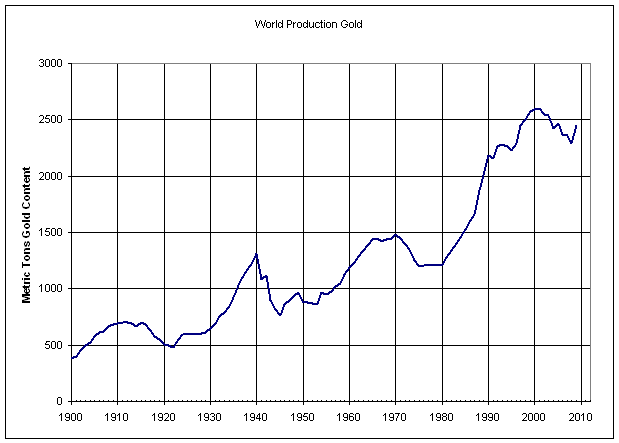
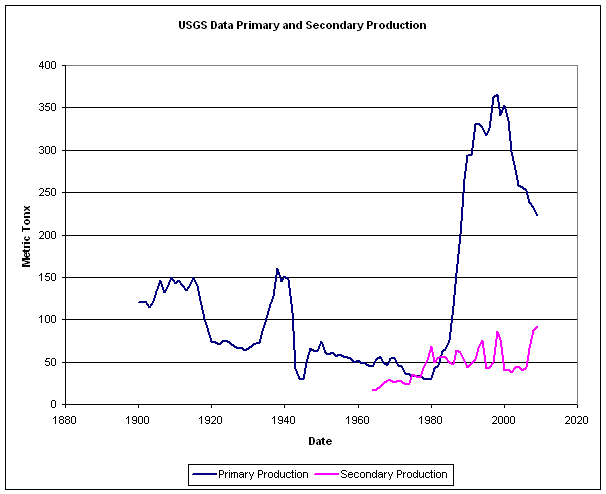
It is driven purely by supply and demand. Is the supply increasing at any appreciable rate? I should think not and as such, it is essentially demand driven only with a fixed supply. That means it is priced purely by demand speculation which is based on either it's past performance, especially its recent past performance, and secondary events that have meaning to the investors.
One such event are advertisements run on radio talk show programs. The demand, and price, of gold increases immediately during and after the advertisement is run. I have no idea by how much. Perhaps just for the company advertising.
Other events would be anything that makes certain people feel uncertain about the value of the dollar, such as a debt ceiling crisis. Specifically, when the US Government credit rating was downgraded, the stock market dropped and then remained increasingly volatile immediately after the decline, even as it recovered.
My guess is that gold saw an increase in trading volume and an increase in price at the same time.
Do news events of stability see people selling? Does it react to unemployment, CPI, and GDP reports?
It should be possible to research the news headlines and match events to the change in price and volume.
The fundamental measures in a technical analysis are the rate of change and the variance, growth and volatility. Volatility increases after the event and dampens over time. A sudden decline in price alone, simply because a large number of people simply decided to randomly sell, would increase volatility. A news event that triggers selling with also increase volatility.
Rule 1: Buy low, sell high.
Rule 2: Read rule 1 again.
Rule 3: Never buy high and sell low.
It is so obvious but failing to follow that simple rule is how people lose money. It's not as easy as it sounds. Even the most rational investor can get caught up in a moment of panic, deciding to get out before they lose too much. When it is above the price they purchase, they keep hoping it will turn around. Then, when it falls below what they purchased at, they remain hopeful for a while, watching it drop, then they dump it before they lose too much.
It is all valued on perception of growth based demand. That is what you said, and I believe your are correct.
Does it vary sufficiently and slowly enough that you can repeatedly catch it on a local low and sell it on a local peak?
Then, whether in it for the short term or the long term, what rate of change for how long and what level is sufficient to trigger you to sell?
Just some thoughts.