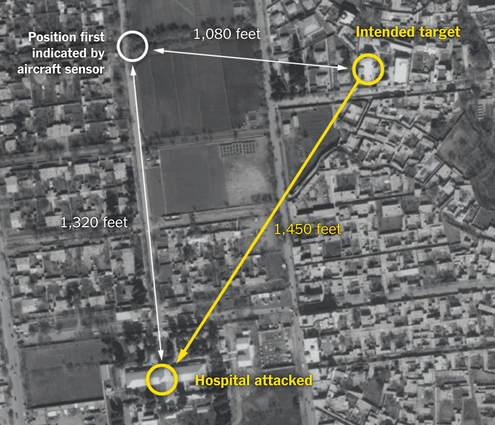
Calling the airstrike a “tragic mistake,” General Campbell read a statement announcing the findings of the investigation, which he said concluded that “avoidable human error” was to blame, compounded by technical, mechanical and procedural failures. He said another contributing factor was that the Special Forces members in Kunduz had been fighting continuously for days and were fatigued. The strike, which involved repeated attacks by a Special Operations AC-130 gunship early on Oct. 3, killed 30 people, mostly patients and Doctors Without Borders staff members, and gutted the main hospital building. The aid group said the attack continued for more than an hour despite repeated calls to the military by staff members, and despite the hospital’s coordinates having been repeatedly sent to the American command.
General Campbell and his staff did not say how many people were being disciplined, or how. But a senior United States military official, speaking on the condition of anonymity, said one of those punished was the Army Special Forces commander on the ground in Kunduz during the fighting. The official would not identify the commander by name but said the officer, a captain, was relieved of his command in Afghanistan on Wednesday morning. Kunduz, a provincial capital in northern Afghanistan, had been seized by the Taliban in the days before the airstrike. General Campbell said the gunship’s crew believed it was firing on a different building identified as a Taliban base in the city. He said that the aircraft’s targeting systems had failed to deliver accurate information and that email and other electronic systems aboard the aircraft, including a video feed that would normally have sent pictures to higher-level commanders in real time, had also failed during the operation.
American officials said that the Special Operations troops did not follow the rules of engagement and that the airstrike should not have taken place. After reading the statement, General Campbell left the briefing room, at his headquarters in Kabul, without taking questions. Following up, the spokesman for the American command, Brig. Gen. Wilson Shoffner, sought to deflect a reporter’s suggestion that responsibility might rest higher up the chain of command. He said the actions of the aircrew and the Special Operations forces “were not appropriate to the threat that they faced.” And he repeatedly said the service members involved had not followed correct procedures for airstrikes or choosing targets.
MORE