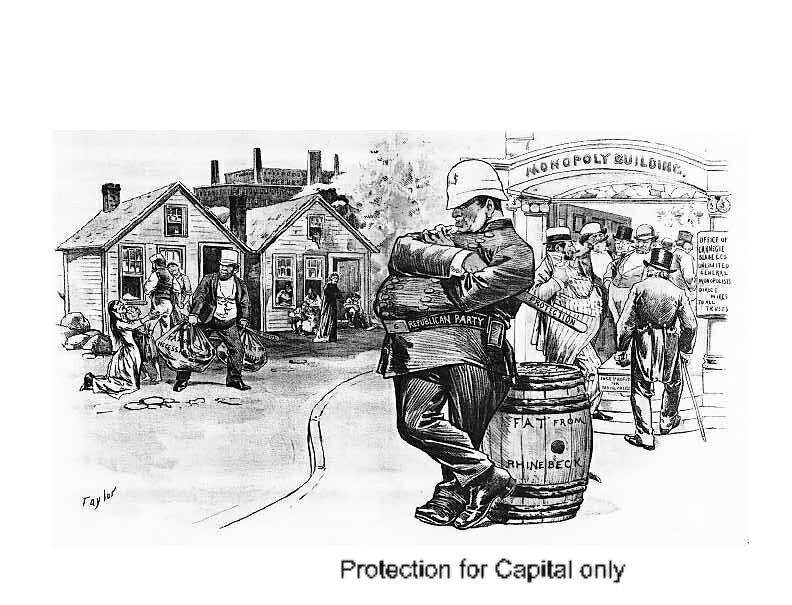
But you and I will disagree on why. There is no evidence that it was the tariff was the cause of this.
Instead, what is much more likely to be the cause, is that there was very low regulations of business. Zero corporate income tax. Zero personal income tax. People were allowed to keep, and invest as they saw fit, all of their own earnings. Corporations were largely allowed to keep, and invest whatever they wished, as they saw fit, to grow their companies, with virtually no legal red tape.
Well, imagine there had been no tariffs.
Would the local industry have stood any chance against the British industry? I think not.
The 19 century was the poin in which merchantilism started to give way to free trade. This didn't happen overnight. And certainly tariffs were enacted in part because GB had similar laws and to protect the newly born American industry.
"Having just fought a war over taxation (among other things) the U.S. Congress wanted a reliable source of income that was relatively unobtrusive and easy to collect. It also sought to protect the infant industries that had developed during the war but which were now threatened by cheaper imports, especially from England."
...
"Once industrialization and mass production started, the demand for higher and higher tariffs came from manufacturers and factory workers. They believed that their businesses should be protected from the lower wages and more efficient factories of Britain and the rest of Europe. Nearly every northern Congressman was eager to logroll a higher tariff rate for his local industry"
Now, it might be that lower regulations and zero personal income tax can fuel the economy. But you can't have it both ways. You either tax individuals and corporations or increase the tariffs. You can't run a government without revenue.
Tariffs in United States history - Wikipedia the free encyclopedia
And yet we compete with companies all over the world with zero tariffs.
You do know that prior to 1776, there was tons of industry in the American colonies, and under British rule, there of course was ZERO protectionism on goods imported from there.
So the entire claim falls flat, given that obviously if it were true, than there could not have been any manufacturing in the colonies. And there was.
Medieval Technology and American History - In-Depth Articles - Perfection in the Mechanical Arts
John Adams visited Bethlehem, Pennsylvania, and discusses all the manufacturing that had sprung up under British rule, with zero protectionism.
Saddle-tree maker, Sadler, Glover, Shoemaker, Stocking-weavers..., Button maker, Taylor & Women Taylor, Hatter, Ribband-weavers; Linnen-weavers..., Woollen-weavers..., Wool-comber, Dyer, Fuller, Dresser, Tanner, Currier, Skinner, Butcher, Miller, Chandler, Oil-maker; Baker, Cooper, Joiner, Carpenter, Mason, Glazier, Brick maker, Stone Cutter, Turner, Potter, Stovemaker, Wheelwright, Blacksmith, Gunsmith, Nailmaker, Lock-smith, Pewterer, Tinman, Silver-smith, Clockmaker, Harries-maker, Hemp dresser, Boat-builder, Surgeon, Apothecary.
All of these industries here are are directly competing with imported goods. But according to you, "Would the local industry have stood any chance against the British industry? I think not. " and yet.... they did. In fact, the Brits were very discouraging of domestic productions, specifically because it competed with their imported goods, and made no attempt to help domestic manufacturing of anything.....
And yet.... there they all were. Weavers, testiles, silver smiths, clockmakers, gunsmiths, tanners, boat builders.....
Now how could this be, against London with cheap labor, and more advanced and efficient, as well as much larger and profitable companies and businesses?
The same exact reason that Service and Repair at my company, will likely never be outsourced. Cost of transport.
The home team, always has the advantage of not having to ship it very far. I purchased a $169 9MM Luger Pistol. How did I get such a gun for that cheap? It's locally made, just a half hour drive from Columbus Ohio. Lower shipping charges, cheaper price.
So as I said, that claim is completely garbage. Just not true. With zero tariffs, American business would have competed, and likely done better than they did, even against the Brits.