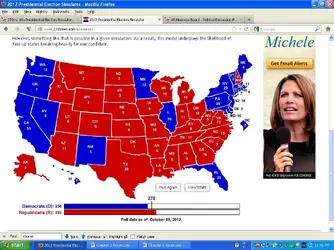
Methodology We take current state-by-state polls and turn the results into probabilities. Each simulation picks a winner in each individual state, based on the probabilities for that state. For example, if Romney has a 55% chance of winning Nevada, he will, in the long run, win Nevada in 55% of the simulations conducted. Some uncontested states (e.g., Utah) will always yield the same result. The simulator does not consider the possibility of split electoral votes in Maine or Nebraska.
The simulator is not a predictor of the election. It provides a range of electoral outcomes that are plausible if the election were today, if the state polls were accurate and if each state were a fully independent event. The election is still months away; state polling is still infrequent and may be ‘stale’. While each state is, in theory, a separate election, the reality is that there are usually correlations. For example, if Obama were to win Georgia, he wouldn’t lose Virginia. However, something like that is possible in a given simulation. As a result, this model underplays the likelihood of toss-up states breaking heavily for one candidate.