The root cause was Clinton's policy to force banks to make sub-prime loans and then provide endless, virtually zero interest loans to fund them. W in typical Republican style did nothing but continue the policy. Once again, Democrats are malignant and Republicans are useless.
Clinton forced banks to make sub-prime loans to wealthy speculators and set up the private lending companies behind those garbage loans?
Strawman, and without a basis in history. If you were right, you would argue from historical truth, you would not ignore it. Which shows what you are doing, pumping the cause.
I
DID argue from historical truth backed up with FACTS. YOU are the one who ignored it.
How did U.S. regulations against redlining in inner cities also cause a boom in Spain, Ireland and Australia? How can we explain the boom occurring in countries that do not have a tax deduction for mortgage interest or government-sponsored enterprises? And why, after nearly a century of mortgage interest deduction in the United States, did it suddenly cause a crisis?
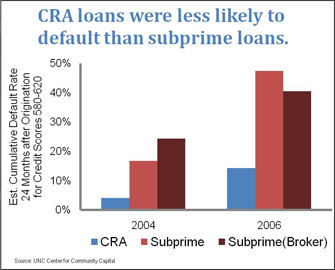
These questions show why proximity and statistical validity are so important. Lets get more specific.The Community Reinvestment Act of 1977 is a favorite boogeyman for some, despite the numbers that so easily disprove it as a cause.It is a statistical invalid argument, as the data show.
For example, if the CRA was to blame, the housing boom would have been in CRA regions; it would have made places such as Harlem and South Philly and Compton and inner Washington the primary locales of the run up and collapse. Further, the default rates in these areas should have been worse than other regions.
CRA were less likely to default than Subprime Mortgages Source: University of North Carolina at Chapel Hill
What occurred was the exact opposite: The suburbs boomed and busted and went into foreclosure in much greater numbers than inner cities. The tiny suburbs and exurbs of South Florida and California and Las Vegas and Arizona were the big boomtowns, not the low-income regions. The redlined areas the CRA address missed much of the boom; places that busted had nothing to do with the CRA.
Suburbs and Exurbs were where the boom & bust occurred and not the CRA regions Source: Washington Post
The market share of financial institutions that were subject to the CRA has steadily declined since the legislation was passed in 1977. As noted by Abromowitz & Min, CRA-regulated institutions, primarily banks and thrifts, accounted for only 28 percent of all mortgages originated in 2006.
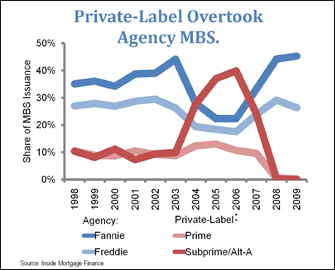
Nonbank mortgage underwriting exploded from 2001 to 2007, along with the private label securitization market, which eclipsed Fannie and Freddie during the boom.
Check the mortgage origination data: The vast majority of subprime mortgages the loans at the heart of the global crisis were underwritten by unregulated private firms. These were lenders who sold the bulk of their mortgages to Wall Street, not to Fannie or Freddie. Indeed, these firms had no deposits, so they were not under the jurisdiction of the Federal Deposit Insurance Corp or the Office of Thrift Supervision. The relative market share of Fannie Mae and Freddie Mac dropped from a high of 57 percent of all new mortgage originations in 2003, down to 37 percent as the bubble was developing in 2005-06.
Nonbank mortgage underwriting exploded from 2001 to 2007, along with the private label securitization market,
which eclipsed Fannie and Freddie during the boom Source: University of North Carolina at Chapel Hill
Check the mortgage origination data: The vast majority of subprime mortgages the loans at the heart of the global crisis were underwritten by unregulated private firms. These were lenders who sold the bulk of their mortgages to Wall Street, not to Fannie or Freddie. Indeed, these firms had no deposits, so they were not under the jurisdiction of the Federal Deposit Insurance Corp or the Office of Thrift Supervision. The relative market share of Fannie Mae and Freddie Mac dropped from a high of 57 percent of all new mortgage originations in 2003, down to 37 percent as the bubble was developing in 2005-06.
Only one of the top 25 subprime lenders in 2006 was directly subject to the housing laws overseen by either
Fannie Mae, Freddie Mac or the Community Reinvestment Act Source: McClatchy
These firms had business models that could be called Lend-in-order-to-sell-to-Wall-Street-securitizers. They offered all manner of nontraditional mortgages the 2/28 adjustable rate mortgages, piggy-back loans, negative amortization loans. These defaulted in huge numbers, far more than the regulated mortgage writers did.
Consider a study by McClatchy: It found that more than 84 percent of the subprime mortgages in 2006 were issued by private lending. These private firms made nearly 83 percent of the subprime loans to low- and moderate-income borrowers that year. And McClatchy found that out of the top 25 subprime lenders in 2006, only one was subject to the usual mortgage laws and regulations.
A 2008 analysis found that the nonbank underwriters made more than 12 million subprime mortgages with a value of nearly $2 trillion. The lenders who made these were exempt from federal regulations.