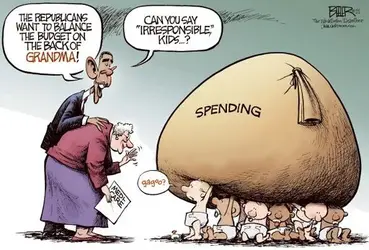
Yes, we can pay for needed services, and you know it.
True, because most of the "services" the federal government provides are not "needed." They are the fruit of swag plundered from the productive members of society.
However, all the money in the world wouldn't be enough to fund all the promises that Democrat demagogues have made.
I get a kick out of your silly posts. I really do.
■Defense and security: In 2010, some 20 percent of the budget, or $705 billion, paid for defense and security-related international activities. The bulk of the spending in this category reflects the underlying costs of the Department of Defense and other security-related activities. The total also includes the cost of supporting operations in Iraq and Afghanistan, which totaled $170 billion in 2010.
■Social Security: Another 20 percent of the budget, or $707 billion, paid for Social Security, which provided retirement benefits averaging $1,175 per month to 34.6 million retired workers in December 2010. Social Security also provided benefits to 2.9 million spouses and children of retired workers, 6.4 million surviving children and spouses of deceased workers, and 10.2 million disabled workers and their eligible dependents in December 2010.
■Medicare, Medicaid, and CHIP: Three health insurance programs — Medicare, Medicaid, and the Children’s Health Insurance Program (CHIP) — together accounted for 21 percent of the budget in 2010, or $732 billion. Nearly two-thirds of this amount, or $452 billion, went to Medicare, which provides health coverage to around 47 million people who are over the age of 65 or have disabilities. The remainder of this category funds Medicaid and CHIP, which in a typical month in 2010 will provide health care or long-term care to about 60 million low-income children, parents, elderly people, and people with disabilities. Both Medicaid and CHIP require matching payments from the states.
Safety net programs: About 14 percent of the federal budget in 2010, or $496 billion, went to support programs that provide aid (other than health insurance or Social Security benefits) to individuals and families facing hardship.
These programs include: the refundable portion of the earned-income and child tax credits, which assist low- and moderate-income working families through the tax code; programs that provide cash payments to eligible individuals or households, including Supplemental Security Income for the elderly or disabled poor and unemployment insurance; various forms of in-kind assistance for low-income families and individuals, including food stamps, school meals, low-income housing assistance, child-care assistance, and assistance in meeting home energy bills; and various other programs such as those that aid abused and neglected children.
■Interest on the national debt: The federal government must make regular interest payments on the money it has borrowed to finance past deficits — that is, on the national debt held by the public, which reached $9 trillion by the end of fiscal 2010. In 2010, these interest payments claimed $196 billion, or about 6 percent of the budget.
Policy Basics: Where Do Our Federal Tax Dollars Go? — Center on Budget and Policy Priorities