The Interior Ministry, which is controlled by Houthi rebels, reported that Mr. Saleh had been killed. Ali al-Bukhaiti, a Yemeni politician who is well connected with Mr. Saleh’s party, the General People’s Congress, also said the president had died. “The news is 100 percent true,” he said. The precise circumstances of his death remained unclear. Ahmad al-Hawati, a resident of Sana, was told by relatives living near Mr. Saleh’s complex that it had been bombed by rebels, and an official in the General People’s Congress also said the complex, on a busy street, had been bombed. The official declined to be identified by name because he had not been authorized to speak to reporters. The episode followed a rift two days ago with the Houthis, Mr. Saleh’s former allies in the fight against a Saudi-led coalition, which imposed a blockade on Yemen last month after a missile fired by the rebels was intercepted near the Saudi capital.
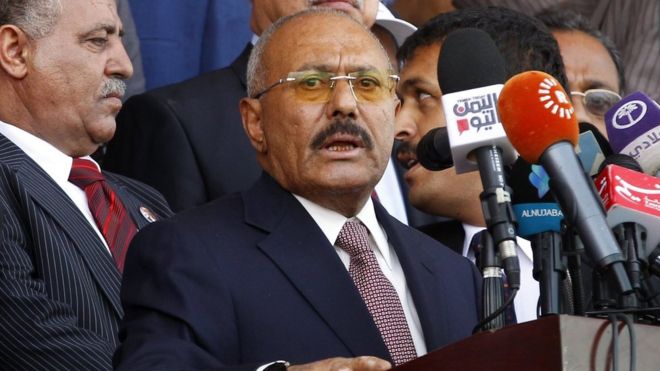
Former president Ali Abdullah Saleh of Yemen at a rally with his supporters in Sana, Yemen, in August.
In a televised speech on Saturday, Mr. Saleh blamed the “idiocy” of the Shiite Houthis for years of war in Yemen and said he was ready to turn a “new page” in his relationship with the Saudi-led coalition if its forces ceased attacking Yemen. Mr. Saleh stepped down in 2011, in the popular uprising known as the Arab Spring, after many Yemenis turned against him. Until then, he had been known as a shrewd and dogged survivor of Yemen’s tangled, tribal politics. He once compared his years in office to “dancing on the heads of snakes.” In the latest fighting, he was initially allied with the Houthis, themselves loosely aligned with Iran, but the relationship became fissured. Sunni-led Arab states embroiled in the conflict suspect the Shiite theocracy in Tehran of using the Houthis as part of their broader struggle against Saudi Arabia for regional dominance.
In his televised address on Saturday, Mr. Saleh declared: “I call upon the brothers in neighboring states and the alliance to stop their aggression, lift the siege, open the airports and allow food aid and the saving of the wounded, and we will turn a new page by virtue of our neighborliness.” The Saudi-led coalition seemed to welcome his remarks. A statement on the Saudi-owned news outlet Al Hadath said the coalition was “confident of the will of the leaders and sons” of Mr. Saleh’s political party to effect a rapprochement. The weekend maneuvering came as Mr. Saleh’s supporters fought Houthi adversaries for a fourth day in Sana. At least 80 people were reported killed as the fighting threatened to escalate.
Houthi fighters during clashes with forces loyal to former president Ali Abdullah Saleh, in Sana on Monday.
On Sunday, Houthi rebels said they had fired a cruise missile at a $20 billion nuclear facility under construction in Abu Dhabi, the United Arab Emirates, which is allied with Saudi Arabia. But a state-run news agency in the United Arab Emirates denied the assertion. The fighting in Yemen has been accompanied by signs of famine and outbreaks of cholera as humanitarian conditions have sharply deteriorated.
Ali Abdullah Saleh, Ex-President of Yemen, Is Said to Have Died