I guess at the heart of the issue is Kaz thinks/or spams that somehow mandatory spending must be appropriated on a yearly basis, as is discretionary spending in appropriations bills.
Perhaps Kaz, like me, thinks there should be no such thing as "mandatory spending", and everything about the federal government, its spending, and it's power over our lives should be volitional, reviewed, and thought-about on a regular basis, rather than put on auto-pilot.
My question is, why don't YOU think that?
The mandatory spending programs include Old-Age and Survivors Insurance (OASI) and the Disability Insurance (DI). These are what we typically know as Social Security Insurance and Medicare Part D. The funding from these are from FICA taxes. These are self funded programs that "for which lawmakers set eligibility rules and benefit formulas." So, they are " reviewed, and thought-about on a regular basis".
I find this on the Wiki;
"However, portions of the budgets for several other departments, including the Department of Agriculture, Department of Defense, Department of Education, and the Department of Veterans Affairs, include some mandatory spending."
I also saw a comment about Medicaid being manditory.
This is a details article on manditory spending.
http://www.fas.org/sgp/crs/misc/RL33074.pdf
The difference is that mandatory spending is set by law while discretionary spending is set by appropriations. To change mandatory spending requires and act of Congress.
Other mandatory spending programs include Temporary Assistance for Needy Families (TANF),
Supplemental Security Income (SSI), unemployment insurance, some veterans benefits, federal
employee retirement and disability, and Supplemental Nutrition Assistance Program (SNAP).
It looks like UI has a tax specifically associated with it.
Medicare part B and D are discretionary.
Because there is the cross-over where some mandatory spending has a specific tax and trust fund; some mandatory spending apparently does not include a specific tax; some discretionary spending is on social programs like Medicare, I don't find the categories of "mandatory" and "discretionary" spending particularly useful. Except for the difference in one being by law and the other being appropriated, the two categories don't really mean much more.
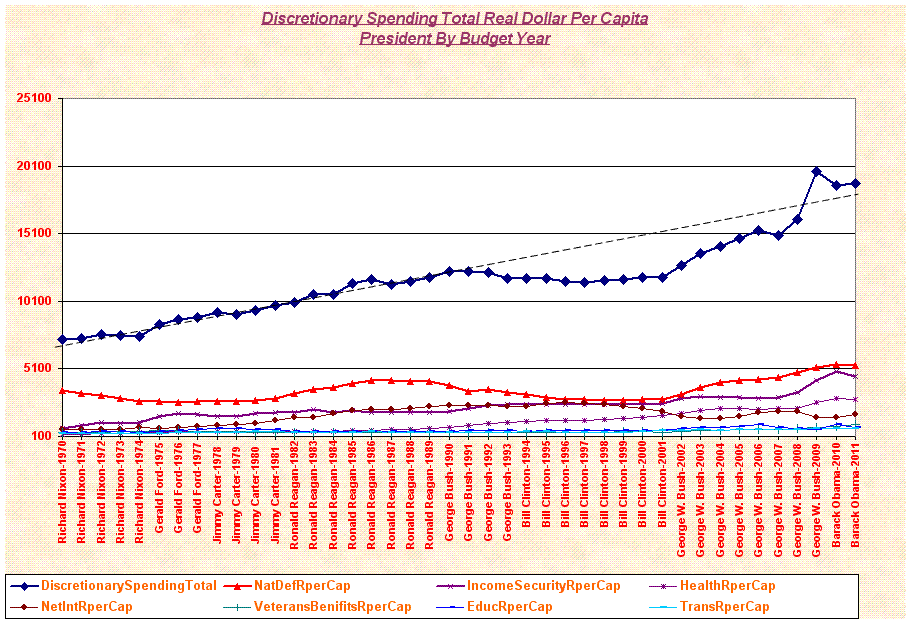
Here is a graph that separates out the discretionary spending by category. (real dollars per capita. Obviously, things go up due to inflation and population growth.)