WWII, and the destruction of vast amounts of the industrialized world, EXCEPT for the US, is a pretty big part to ignore.
IMO, the immediate post war situation is a terrible place to drawn conclusions from because of the oddity of the economic situation.
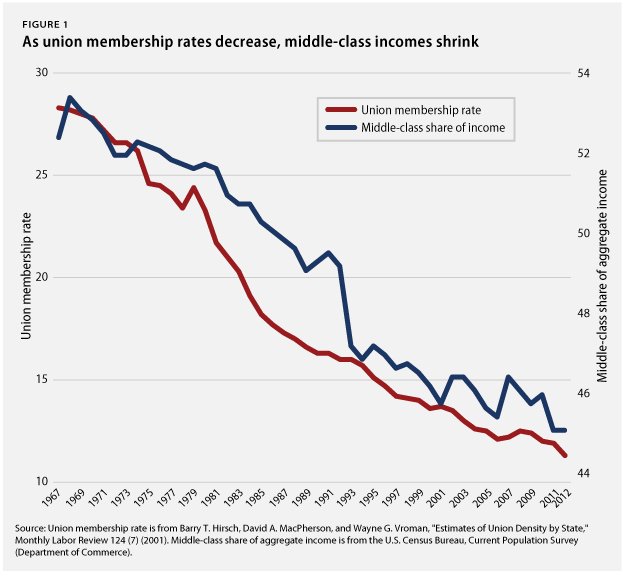
Oddity? 90% of the world was rebuilt by 1955, why did the US middle class contuse to grow until 1971? Why did IUS incomes grow until 1979? What relation to taxes on the very wealthiest in the US (effective rates above 50% from 1932-1980) did the boom have? Why is it that through history, supply side has failed over and over yet cons don't get it?
Middle Class Series: The Failure of Supply-Side Economics
Three Decades of Empirical Economic Data Shows That Supply-Side Economics Doesn’t Work
When President Bill Clinton, raised taxes that same year did the economy suffer a slowdown, as was predicted by those who believe in supply-side economics? The data says no.
The Failure of Supply-Side Economics Center for American Progress
The world was rebuilt by 1955?
Lmao, what an ignorant yard ... Try late 60s early 70s when we had the japanese invasion of cars.
God you are stupid.
Yes Dummy look to history that 90% of the factories and places of commerce were rebuilt by 1955
We had an "invasion" of autos that took market share BECAUSE of the oil crisis of the early 1970's (NOT late 1960's) , as US auto comps were morons (Proven later with quality issues) , just like they did with Dubya's "go out and spend" they created the demand for SUV's!
The 1950s onwards saw the beginning of the reconstruction of a new global economy. Between 1950 and 1973 the annual real GDP growth of developed market economies averaged around 5 percent. This growth was smooth, with none of the major recessions seen in the interwar years. World War II left the United States in a uniquely powerful position. While Europe and Asia had experienced extensive destruction and loss of life, no battles had been fought on the soil of the United States. The U.S. dollar became the world's major reserve currency. U.S. corporations assumed leading positions in many industries. Europe and Japan had to spend the immediate postwar decade undergoing extensive reconstruction, heavily dependent on official aid from the United States, yet over time Europe and Japan closed the technological and productivity gap with the United States. The emergence of a U.S. deficit on its balance of trade in the 1960s, and the devaluation of the U.S. dollar and the end of its convertibility into gold in 1971, provided symbolic signs of the ending of an era.
....In the twenty years after 1945 the European colonial empires were dismantled. In some cases, decolonization was followed by an aggressive reaction against the businesses of the former colonial power, and sometimes all foreign investment. The relatively small number of expropriations without compensation until the late 1960s—when a period of large-scale expropriation began—
reflected the power and determination of the United States to protect foreign investments, but Western countries were unable to reestablish an international legal regime that guaranteed the property rights of international investors. Even in the developed countries, receptivity towards multinationals fell. In Europe and the United States, whole sectors were closed to foreign companies. The Japanese economy grew so fast that it had become the world's second-largest capitalist economy by the 1970s, but its governments systematically discouraged wholly owned FDI [foreign direct investment], and restricted it to a low level.
During the 1940s and early 1950s only the U.S. dollar was available as a major convertible currency. Elsewhere exchange controls regulated capital movements. They were often the instruments used by governments to screen or monitor FDI flows. The world-wide controls over capital movements were related to balance of payments concerns and the system of fixed exchange rates established at Bretton Woods. It was not until 1958 that most European countries adopted nonresident convertibility, which permitted foreigners to move funds for current account purposes freely from one country to another. This was the key development in the establishment of a liberal and open international economy
...It was only after the collapse of the Bretton Woods system of fixed exchange rates in the early 1970s that controls over capital movements began to be slowly dismantled. The advent of floating exchange rates permitted a huge explosion in international financial markets from the 1970s, but these capital flows were different than before 1914, for they largely occurred between rich countries
World trade barriers were reduced under the auspices of the General Agreement on Tariffs and Trade (GATT) signed in 1947. This process peaked in the 1960s, when the Kennedy Administration in the United States made major efforts to secure radical reductions in tariff rates. During the middle of this decade there was a comprehensive reduction of barriers to trade in manufactured goods.
By the end of the 1960s, however, the U.S.-inspired drive for trade liberalization showed a loss of momentum, as U.S. balance of payments deficits began to cause concern about the scale of foreign imports. Nontariff barriers spread in the following decade. Most developing countries in Latin America, Asia, and Africa became progressively closed to international trade from the 1950s to the 1980s. Even the richest and most developed countries maintained very high levels...
The resumption of multinational growth
The expansion of the world economy prompted a recovery in the growth rate of world FDI. The system of international cartels was dismantled. By 1960 the world stock of FDI had reached $60 billion. By 1980 it was over $500 billion. These were the decades when the term "multinational" was invented, and when economic theorists turned their attention to explaining their existence.
Restoring a Global Economy 1950 1980 HBS Working Knowledge