Navigation
Install the app
How to install the app on iOS
Follow along with the video below to see how to install our site as a web app on your home screen.
Note: This feature may not be available in some browsers.
More options
Style variation
You are using an out of date browser. It may not display this or other websites correctly.
You should upgrade or use an alternative browser.
You should upgrade or use an alternative browser.
What percent of the atmosphere is CO2?
- Thread starter Votto
- Start date


Mushroom
Gold Member
I bet no one here knew that, even the so called "experts" that are pushing the Climate Cult.
I know it's somewhere around 0.03 or 0.04% CO2. And I only remember it's 420 ppm because of a shirt I saw for sale stating that a while back. The majority gas is nitrogen, which we have to take into consideration for diving.

Muhammed
Diamond Member
78% nitrogen, 21% oxygen and 1% trace gasses.I know it's somewhere around 0.03 or 0.04% CO2. And I only remember it's 420 ppm because of a shirt I saw for sale stating that a while back. The majority gas is nitrogen, which we have to take into consideration for diving.
Then the Global Warming Doomsday Cult dupes will stupidly compare it to Venus which has a atmosphere that's 90 times thicker than Earth's atmosphere consisting of 96% CO2 3.5% Nitrogen and 0.5% trace gasses.
Mushroom
Gold Member
Then the Global Warming Doomsday Cult dupes will stupidly compare it to Venus which has a atmosphere that's 90 times thicker than Earth's atmosphere consisting of 96% CO2 3.5% Nitrogen and 0.5% trace gasses.
And the issue there is not even the high amounts of CO2 at all. There, the issue is a combination of closeness to the Sun, and the absolutely insane atmospheric density of 92 bars of pressure. To put that in perspective, on Earth at sea level it's 1 bar of pressure. In order to replicate that kind of pressure on Earth, you have to go about a kilometer below the surface of the ocean.
That is the reason that Venus is so damned hot, and not an almost desolate planet like Mars with an atmospheric pressure of around .1 bar. And even though Mars has a CO2 level close to that of Venus (95%), the atmospheric density is so low that there is no heat.
Then you get to the fun part of Jupiter. It is an insane distance from the Sun. Yet it has a surface temperature hotter than that of the sun at around 43,000f (24,000c). Of course, that is because it has an atmospheric density of around 3 million bars. The higher the atmospheric density is, the hotter the planet. The lower the atmospheric density is, the colder the planet.
You could convert the atmosphere of Venus into Oxygen, Nitrogen, Helium, or any other gas you want and the result will be the exact same thing. It's insanely hot because of atmospheric pressure, not because of what the gas is.
This is the basic science kind of thing that a lot of people absolutely fail to grasp. Early on in the evolution of our planet, we had the same conditions. Extreme atmospheric temperatures and extreme barometric pressure. And it was not the removal of CO2 that changed the surface and allowed for life to form, it was the reduction of the atmospheric pressure. That is what allowed life to take hold, and start to convert that high CO2 content to O2.
I find that most of the "Global Warming Alarmists" are sadly lacking in some basic knowledge of science. And more than one has tried to explain to me that unless we "fix things", we will enter a "Runaway Greenhouse Effect" and turn into Venus II. And when asked how in the hell our atmosphere will become 92 times more dense than it is now, they just give me blank stares.
And here is a simple answer, the only reason that can ever happen is if somehow some insane geological event was to happen where every plate boundary was to split open by kilometers and spew insane amounts of volcanic gasses into the atmosphere. For tens of thousands of years (and even that is a made up number that people would accept, because in reality it would take tens of millions of years). Not that it will matter worth a dam, that will be an Extinction Level Event for all but the most hardy extremophiles globally. With 99.999999999999% of life going extinct within a year or less.
Those kinds just don't do science very well.

Mars also has an atmosphere that is mostly CO2, but it is also about 1/100th as thick as Earth's.78% nitrogen, 21% oxygen and 1% trace gasses.
Then the Global Warming Doomsday Cult dupes will stupidly compare it to Venus which has a atmosphere that's 90 times thicker than Earth's atmosphere consisting of 96% CO2 3.5% Nitrogen and 0.5% trace gasses.
When doing ppm - Parts Per Million, 1% of DRY Atmosphere total = 10,000 ppm*.
*Dry atmosphere because there tends to be about 10% additional atmosphere in form of water vapor, which is a several times more potent GHG/Green House Gas than CO2.
Mushroom
Gold Member
And to help some people visualize what that kind of pressure would do, this is a fun way to visualize it.
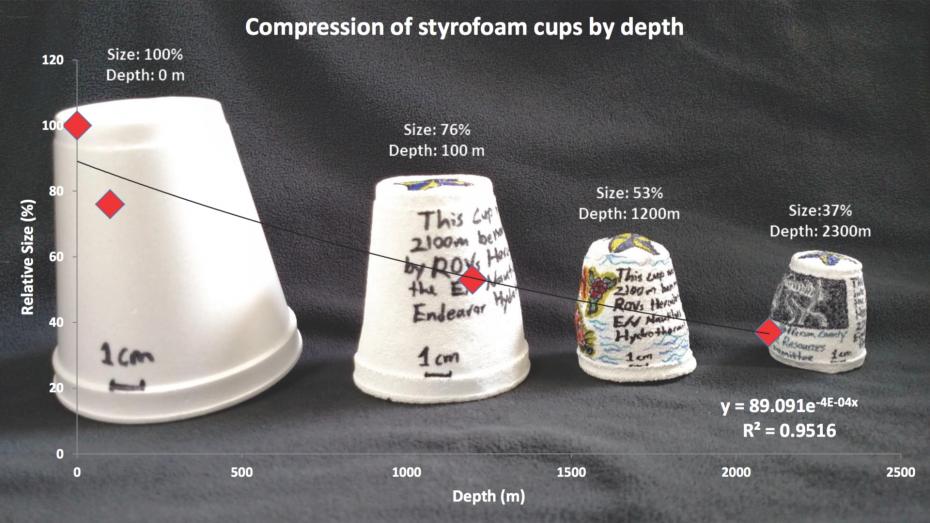
Now I was first exposed to things like this about 30 years ago at the museum in Vallejo, California. That was the home of US Navy submarines for decades, and they had a display of these. Just simply Styrofoam cups, that were taken to extreme depths by submarines. And at depths like that, it really does compress cups like that until they are closer to thimbles than what you drink coffee out of.
And I have even seen these effects first hand. I had a foam floating keychain when I was a diver, and at 100 feet (about 10 bars), I could see it was about half the thickness it was at the surface. And why diving requires training, because if a person was to dive down that deep with SCUBA equipment and take a breath then hold it as they surface, their lungs would rupture. As along with the body, the air we take with us is also compressed. Because literally with each breath you take, you are using more gas at that pressure than you are at the surface.
Probably the only recreational activities other than high altitude mountain climbing to get people to understand what pressures are like is diving. And for deeper level or longer diving they even have to use special gas mixtures because of how gasses and the human body work under pressure.
Now I was first exposed to things like this about 30 years ago at the museum in Vallejo, California. That was the home of US Navy submarines for decades, and they had a display of these. Just simply Styrofoam cups, that were taken to extreme depths by submarines. And at depths like that, it really does compress cups like that until they are closer to thimbles than what you drink coffee out of.
And I have even seen these effects first hand. I had a foam floating keychain when I was a diver, and at 100 feet (about 10 bars), I could see it was about half the thickness it was at the surface. And why diving requires training, because if a person was to dive down that deep with SCUBA equipment and take a breath then hold it as they surface, their lungs would rupture. As along with the body, the air we take with us is also compressed. Because literally with each breath you take, you are using more gas at that pressure than you are at the surface.
Probably the only recreational activities other than high altitude mountain climbing to get people to understand what pressures are like is diving. And for deeper level or longer diving they even have to use special gas mixtures because of how gasses and the human body work under pressure.
Great post.And the issue there is not even the high amounts of CO2 at all. There, the issue is a combination of closeness to the Sun, and the absolutely insane atmospheric density of 92 bars of pressure. To put that in perspective, on Earth at sea level it's 1 bar of pressure. In order to replicate that kind of pressure on Earth, you have to go about a kilometer below the surface of the ocean.
That is the reason that Venus is so damned hot, and not an almost desolate planet like Mars with an atmospheric pressure of around .1 bar. And even though Mars has a CO2 level close to that of Venus (95%), the atmospheric density is so low that there is no heat.
Then you get to the fun part of Jupiter. It is an insane distance from the Sun. Yet it has a surface temperature hotter than that of the sun at around 43,000f (24,000c). Of course, that is because it has an atmospheric density of around 3 million bars. The higher the atmospheric density is, the hotter the planet. The lower the atmospheric density is, the colder the planet.
You could convert the atmosphere of Venus into Oxygen, Nitrogen, Helium, or any other gas you want and the result will be the exact same thing. It's insanely hot because of atmospheric pressure, not because of what the gas is.
This is the basic science kind of thing that a lot of people absolutely fail to grasp. Early on in the evolution of our planet, we had the same conditions. Extreme atmospheric temperatures and extreme barometric pressure. And it was not the removal of CO2 that changed the surface and allowed for life to form, it was the reduction of the atmospheric pressure. That is what allowed life to take hold, and start to convert that high CO2 content to O2.
I find that most of the "Global Warming Alarmists" are sadly lacking in some basic knowledge of science. And more than one has tried to explain to me that unless we "fix things", we will enter a "Runaway Greenhouse Effect" and turn into Venus II. And when asked how in the hell our atmosphere will become 92 times more dense than it is now, they just give me blank stares.
And here is a simple answer, the only reason that can ever happen is if somehow some insane geological event was to happen where every plate boundary was to split open by kilometers and spew insane amounts of volcanic gasses into the atmosphere. For tens of thousands of years (and even that is a made up number that people would accept, because in reality it would take tens of millions of years). Not that it will matter worth a dam, that will be an Extinction Level Event for all but the most hardy extremophiles globally. With 99.999999999999% of life going extinct within a year or less.
Those kinds just don't do science very well.
There happens to be another quirk with Venus that many fail to appreciate.
When looking down upon our Solar System, for the most part the planets, and Sun spin counter-clockwise as well as orbit/revolve around the Sun in a counter clock-wise direction. This is known as the Solar system's angular momentum.
While Venus orbits in the same direction/angular momentum as the other planets, it spins/rotates on it's axis oppositely, in a clockwise direction. Granted, rather slowly, takes about two orbits for one rotation, but something very drastic happened to Venus, and likely long ago, to make this change.
Likely cause would be either a major impact event at just the right angles and mass/velocity, OR a close passage of a very massive body ~Large planet/Brown Dwarf who's gravitation attraction would have pulled Venus over end, flipped it pole-wise while still allowing it to retain some of it's spin/rotational energy.
A similar anomaly is Uranus;
... It has a marked axial tilt of 82.23° with a retrograde rotation period of 17 hours and 14 minutes. ...

Uranus - Wikipedia

EMH
Diamond Member
- Apr 5, 2021
- 30,591
- 18,063
- 2,788
Great post.
There happens to be another quirk with Venus that many fail to appreciate.
When looking down upon our Solar System, for the most part the planets, and Sun spin counter-clockwise as well as orbit/revolve around the Sun in a counter clock-wise direction. This is known as the Solar system's angular momentum.
While Venus orbits in the same direction/angular momentum as the other planets, it spins/rotates on it's axis oppositely, in a clockwise direction. Granted, rather slowly, takes about two orbits for one rotation, but something very drastic happened to Venus, and likely long ago, to make this change.
Likely cause would be either a major impact event at just the right angles and mass/velocity, OR a close passage of a very massive body ~Large planet/Brown Dwarf who's gravitation attraction would have pulled Venus over end, flipped it pole-wise while still allowing it to retain some of it's spin/rotational energy.
A similar anomaly is Uranus;
... It has a marked axial tilt of 82.23° with a retrograde rotation period of 17 hours and 14 minutes. ...
Uranus - Wikipedia
en.wikipedia.org
How long a planet's "day" is depends on how it was formed. It is likely a big asteroid hit not only slightly changes orbit, but day as well. Go back in time and Earth's "day" length has likely changed many times. We are fortunate that somehow our small planet did not end up in a very elliptical orbit too.
If Earth's "day" was 20 days, that would be a very big problem. The day/night temp change would be fatal.
Last edited:
EMH
Diamond Member
- Apr 5, 2021
- 30,591
- 18,063
- 2,788
I bet no one here knew that
Nobody stealing money off it in Congress knew that.
We have taxpayer funded "faux skeptics" here and they at least understand the basics, and how to lie CO2 FRAUD style.
Michael Crichton had a football field map in his book that showed CO2 as a percent of atmosphere was the length of a very close first down measurement with the sticks...
Muhammed
Diamond Member
I bet no one here knew that, even the so called "experts" that are pushing the Climate Cult.
I knew it. They've been logging it at the Mauna Loa Observatory for decades.
I've also experimented with raising the ambient CO2 levels in grow rooms.
Mushroom
Gold Member
I've also experimented with raising the ambient CO2 levels in grow rooms.
For plants, it's literally still encoded in their DNA.
Almost every plant on the planet is close to the point of being CO2 deprived. That is why commercial greenhouses and hothouses actually pump in supplemental CO2. Add just a bit more CO2, and plants grow much faster and larger than they do in our regular atmosphere.
Old Rocks
Diamond Member
Up to a point;For plants, it's literally still encoded in their DNA.
Almost every plant on the planet is close to the point of being CO2 deprived. That is why commercial greenhouses and hothouses actually pump in supplemental CO2. Add just a bit more CO2, and plants grow much faster and larger than they do in our regular atmosphere.
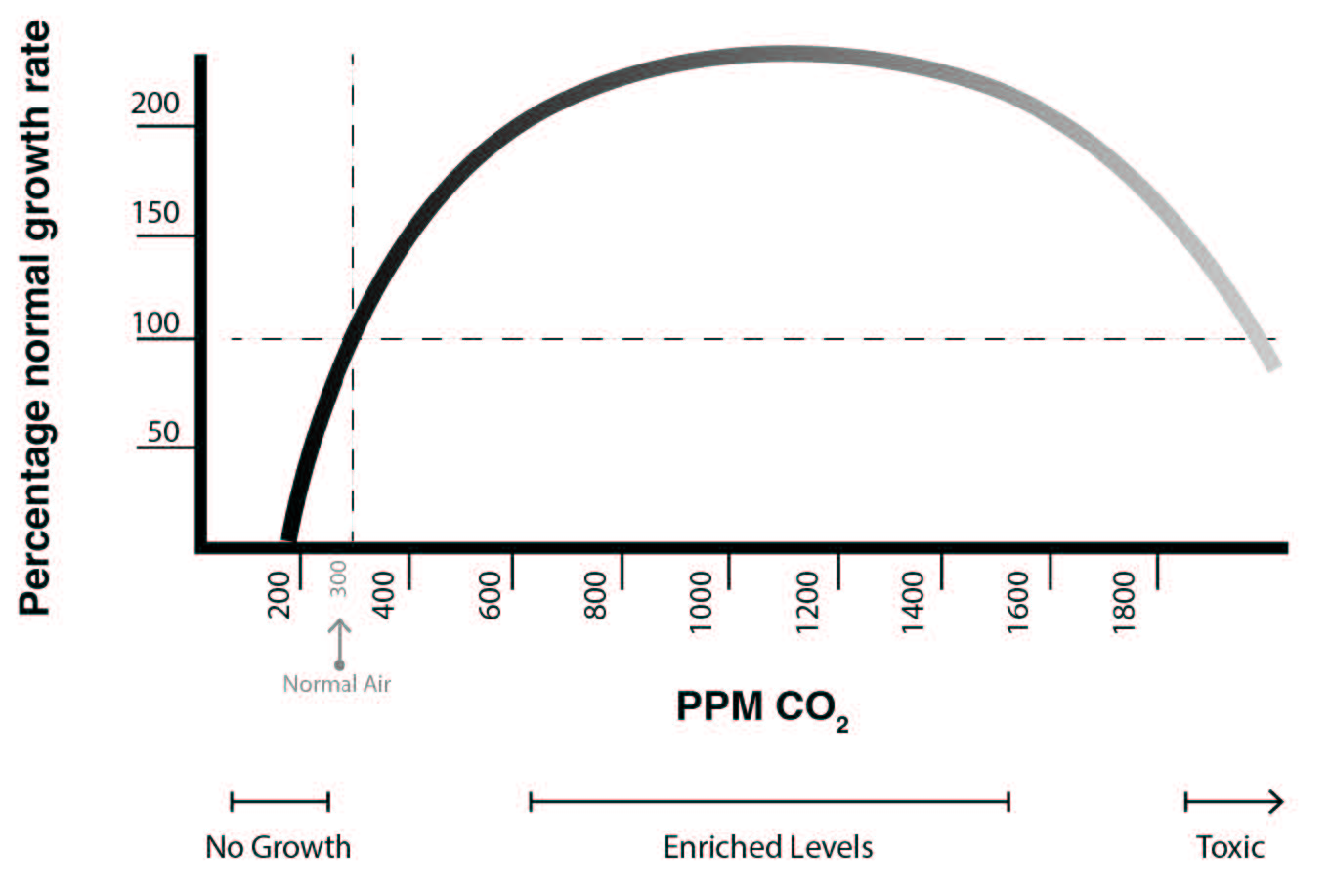
Greenhouse Carbon Dioxide Supplementation - Oklahoma State University
By Megha Poudel and Bruce Dunn. Learn about carbon dioxide, its concentration in relation to plants, supplementation, the effect of supplemental CO2 on different growing factors, sources of carbon dioxide and control and distribution of CO2.
 extension.okstate.edu

Yarddog
Diamond Member
- Jun 13, 2014
- 20,256
- 15,040
- 2,405
I knew it. They've been logging it at the Mauna Loa Observatory for decades.
I've also experimented with raising the ambient CO2 levels in grow rooms.
They were only there for the chocolate macadameas! obviously ...

Sunsettommy
Diamond Member
- Mar 19, 2018
- 16,287
- 14,005
- 2,400
Up to a point;
Greenhouse Carbon Dioxide Supplementation - Oklahoma State University
By Megha Poudel and Bruce Dunn. Learn about carbon dioxide, its concentration in relation to plants, supplementation, the effect of supplemental CO2 on different growing factors, sources of carbon dioxide and control and distribution of CO2.
This is truly stupid claim since many of the plants of today were around when the air was at "toxic" levels to the plant...
Plants show a positive response up to 700 to need of 1,800 parts per million, but higher levels of CO2 may cause plant damage (Figure 1).

ReinyDays
Platinum Member
I'm going with Fake News here ... the video doesn't name a single participant ... doesn't show any name plates ... go check C-SPAN right now ... see how everyone giving testimony has a name plate in front of them so everybody knows their name? ... this fake is way too sloppy to be AI generated ...
Mass is the primary objection to carbon dioxide's ability to change weather ... there's just not enough to cause any catastrophe ... and things only get worse on a molecular level ... it's "one photon, one molecule" in this universe ... mass is everything ...
There are far better reasons to conserve fossil fuels ... cutting Hamas' funding for starters ...
Mass is the primary objection to carbon dioxide's ability to change weather ... there's just not enough to cause any catastrophe ... and things only get worse on a molecular level ... it's "one photon, one molecule" in this universe ... mass is everything ...
There are far better reasons to conserve fossil fuels ... cutting Hamas' funding for starters ...
Old Rocks
Diamond Member
I see, so you also have a high degree in Paleobotany as well as those in Climatology and Atmospheric Physics. LOLThis is truly stupid claim since many of the plants of today were around when the air was at "toxic" levels to the plant...
ReinyDays
Platinum Member
I see, so you also have a high degree in Paleobotany as well as those in Climatology and Atmospheric Physics. LOL
I know S'Tommy lives in a paleobotony hot spot for Eocene through Miocene progression ... fossil beds all through that part of the country ... it's important to science since the latitude hasn't changed much since Pangaea came together ≈ 150 million years ago ...
I've driven through there once ... so I'm wondering how you didn't know this? ... it's not kept secret or anything ... it does refute everything you've ever posted about climate change but that shouldn't steer you away from truism ... not unless you're ignorantly stupid ... Homer J Simpson ...
Sunsettommy
Diamond Member
- Mar 19, 2018
- 16,287
- 14,005
- 2,400
You certainly do not and my post remains unchallenged.I see, so you also have a high degree in Paleobotany as well as those in Climatology and Atmospheric Physics. LOL
ReinyDays
Platinum Member
You certainly do not and my post remains unchallenged.
At least Homer finished high school ...
Mushroom
Gold Member
it's important to science since the latitude hasn't changed much since Pangaea came together ≈ 150 million years ago
Actually, the latitudes have changed a hell of a lot since the time of Pangea.
Latitudes then
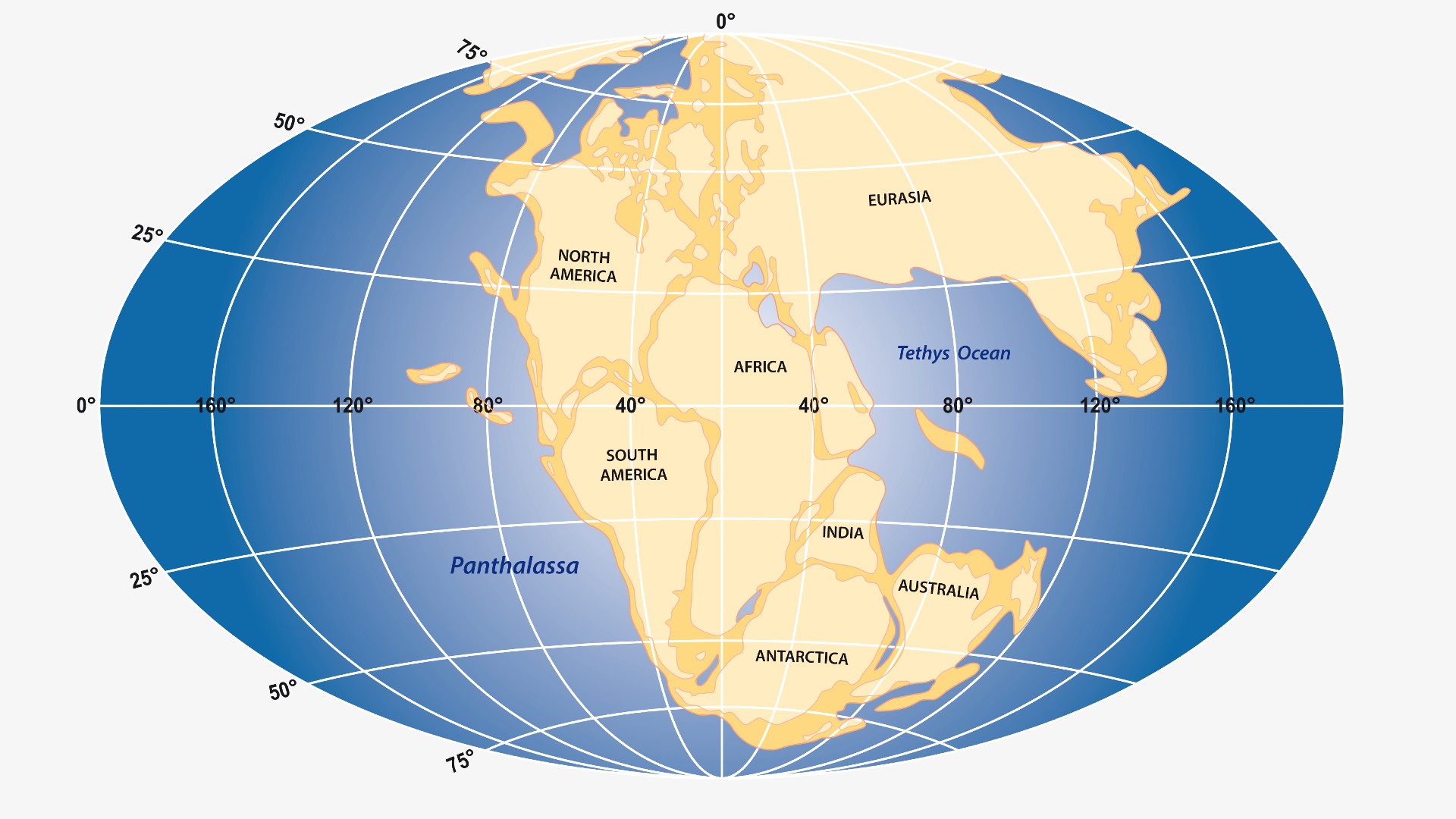
Just seeing that Florida is damned near sitting on the Equator should give a damned good idea how far south North America was during Pangea.
Latitudes now
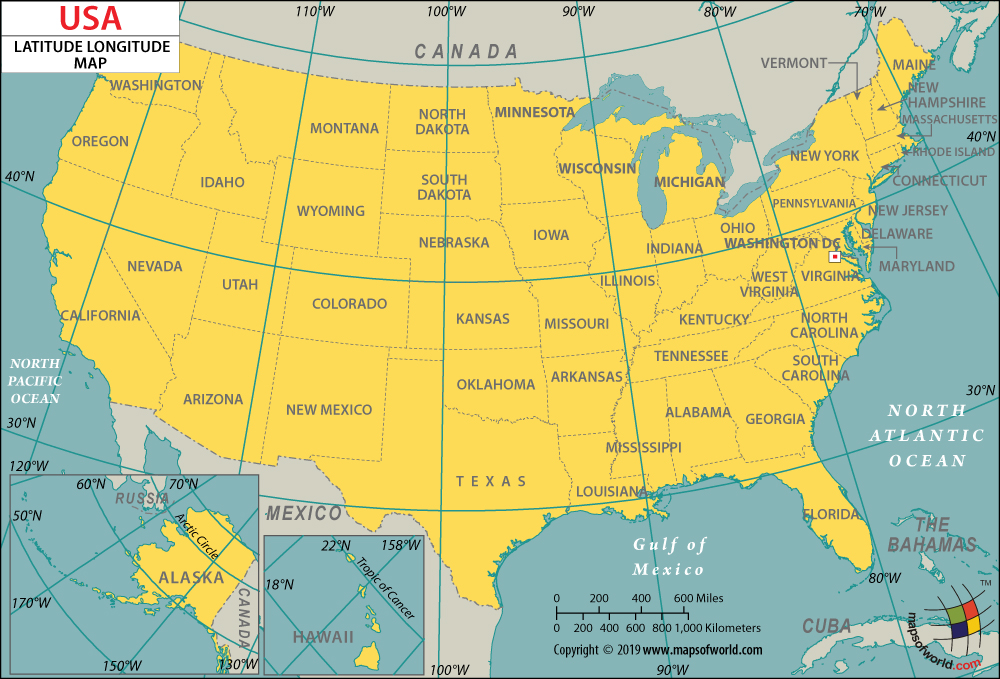
North America has shifted significantly farther North since Pangea. Somewhere around 30 degrees farther north.
But 150 mya? That is about 25 million years after Pangea broke up, Pangea dates to between 175 and 335 mya. North America for example had already shifted significantly farther north by that time.
This is what the planet looked like 150 mya.
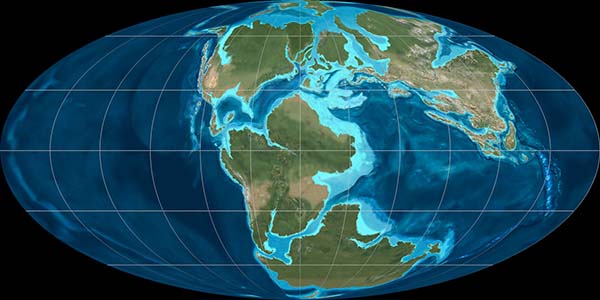
But the latitude has not a damned thing to do with climate. That is far more driven by ocean currents than latitude. 150 mya, there were no polar ice caps for example, and snow and ice on the planet were exceptionally rare because temperatures were between 13-15c warmer than they are today. Whenever there are large global oceans, temperatures are much higher than they are today. We are only in the cold climate conditions we are in now because instead of a large global ocean, they are broken up into three smaller oceans with very limited current interactions between them.
150 mya, northern Alaska had a clime much closer to that of Brazil today than anything else found in North America.
-shakes head and departs, mumbling about people simply making things up and never expecting somebody to be able to prove they are completely wrong-
Similar threads

- Replies
- 78
- Views
- 741
- Replies
- 62
- Views
- 771


- Replies
- 253
- Views
- 3K

- Replies
- 264
- Views
- 3K

New Topics
-
A curious attempt in Israel to snuff out a probe of 10/7
- Started by EMH
- Replies: 0
-
 Trump admin invokes Defense Production Act, directs oil company to restart California operations
- Started by 1srelluc
- Replies: 5
-

-

-
Southwest Airlines has announced that all flights out of two major travel hubs will be cancelled in June
- Started by 1srelluc
- Replies: 0


