What percent of the atmosphere is CO2?

This is truly stupid claim since many of the plants of today were around when the air was at "toxic" levels to the plant...

The problem is that they really do not understand what they are trying to use to back up their claims.

Just look at the reference they provided for example. And remember, the current level of CO2 is around 420 ppm.

The carbon dioxide level may drop to 150 to 200 parts per million during the day in a sealed greenhouse, because CO2 is utilized by plants for photosynthesis during daytime. Exposure of plants to lower levels of CO2 even for a short period can reduce rate of photosynthesis and plant growth. Generally, doubling ambient CO2 level (i.e. 700 to 800 parts per million) can make a significant and visible difference in plant yield.

An increase in ambient CO2 to 800-1,000 ppm can increase yield of C3 plants up to 40%-100% percent and C4 plants by 10%-25% while keeping other inputs at an optimum level. Plants show a positive response up to 700 to need of 1,800 parts per million, but higher levels of CO2 may cause plant damage (Figure 1).

In other words, plants thrive at CO2 levels of about double what they are at now. Now one has to ask themselves, does it make any sense for any living thing to thrive in conditions with a critical gas at levels significantly higher than it is now, unless that is actually the conditions they evolved around to thrive under?

Of course not, that is actually counter-science.

Now to start, flowering plants evolved around 150 mya. When the CO2 levels were at an absolutely insane level when compared to today. Not 420 ppm, but around 3000 ppm. Between 7-8 times higher than today.

Now here is another comparison to show exactly how this works. Almost all living creatures other than some bacteria and single celled organisms need oxygen to live. And a good example of this is humans. Without oxygen, we die. However, most people are not aware of things like oxygen toxicity. We thrive in the conditions of the last million years or so, Around 20% oxygen in the atmosphere and around 209k ppm. So if we were like plants, we should thrive at higher oxygen levels, right?

Wrong.

And this is where I often shake my head whenever a non-diver tries to say SCUBA divers have "oxygen tanks". We do not, we have air tanks. And in those tanks are the same air we breathe on the surface. Other than special air mixes for deep or long period diving that will replace nitrogen with other inert gasses (helium is a common one) as well as a reduced oxygen content. If a human tried to dive more than around 5-10 meters with a tank of oxygen, it would kill them. And diving deeper than about 60 meters with atmospheric levels of air in their tank it will kill them.

This is known as "oxygen toxicity". It's actually not a problem at sea level (most times), but increase the pressure at all (such as underwater or at some of the deepest places of the surface), and O2 becomes fatal. And even at sea level, too high of a level of oxygen is still fatal, because it will suppress the breathing reflex. Their body will force them to stop breathing because it senses there is too much oxygen in the bloodstream. And at the same time waste gasses are building up in the body and are not able to be expelled.

This is why the simple solution for hyperventilation (a case where a person enters that state in normal atmosphere by breathing too quickly) is to put a bag over their face. That forces them to take in higher amounts of CO2 and triggers the body to resume a more normal breathing pattern.

I wonder how many in here who are believing the anti-science things that many people scream are actually divers. I am no expert in how gasses affect the human body, but I have studied it a hell of a lot more than 90% of the people out here because this is actually something we have to study in order to get certified. Because failure to understand how nitrogen, oxygen and CO2 interact with the human body (especially under pressure) can be fatal.


I have actually seen people quit SCUBA training once they learn how much math and science is required in the training. If somebody decides to take up SCUBA, there is going to be a fair amount of science involved and you are going to be tested in it or you will not get certified.

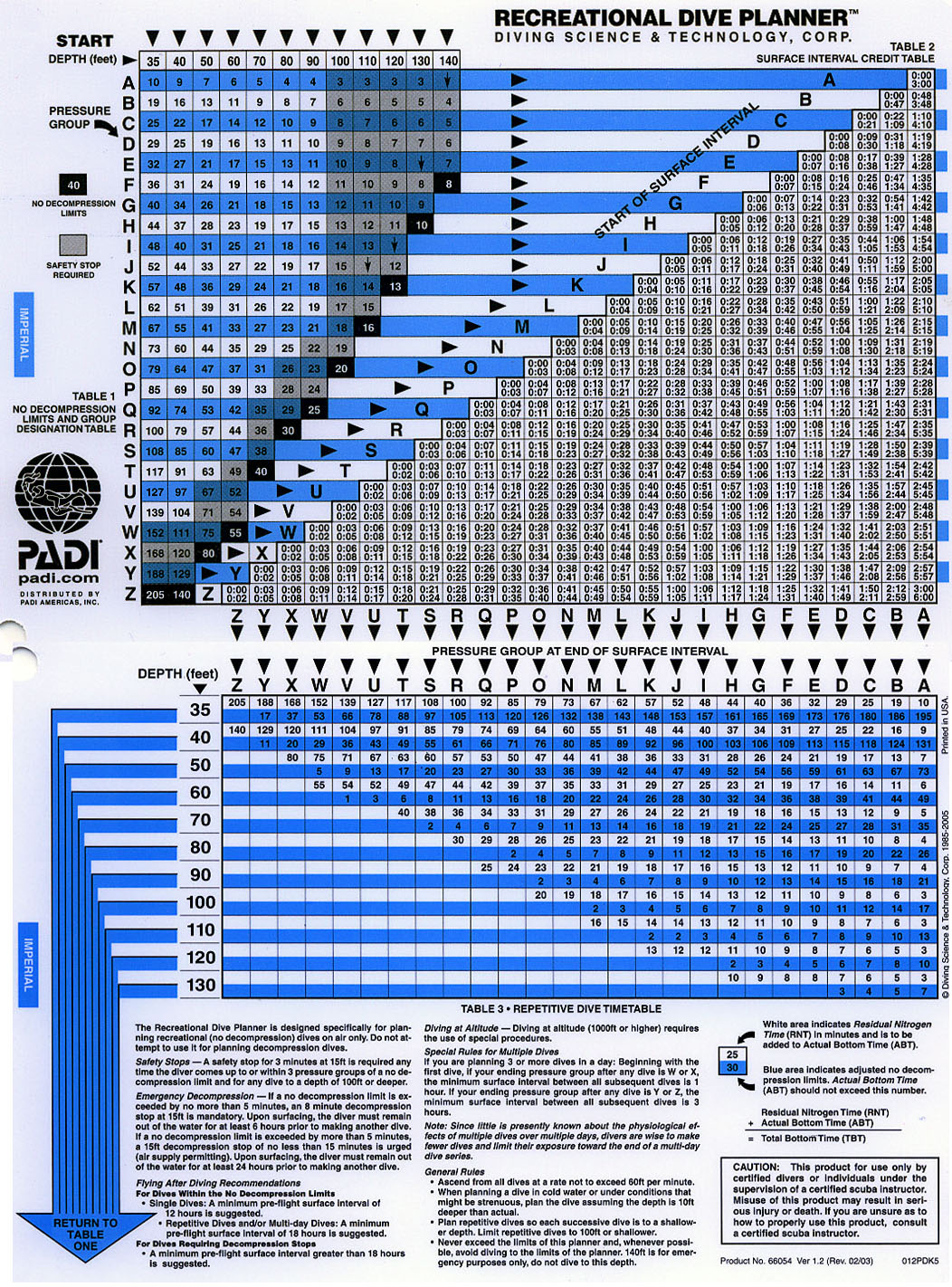
And this is the "simple" dive chart that all divers use.
dive_tables_PADI_front.jpg


And you have to be able to master this chart before you can dive. The only purpose in it is to help regulate the build up of gasses in the human body, as under higher pressures they can become fatal. So we have to limit how long we can dive if we are below 10 meters, and how long we can be there.

Here is a quick idea how the chart can work. The top-left at "start depth" is 35 feet. That is just over 1 atmosphere of pressure. And going down from A to Z is the length of time in minutes. And a human can safely be at 25 feet on air for 139 minutes, or just a bit over 2 hours. Longer than that, and then you have to kick in "safety stops" at various depths for periods of time to allow some of those gasses to leave the body. But don't be at that depth for more then 205 minutes (around 3.5 hours), as that will be fatal.

Now when I started diving, everybody used charts. Today we dive with computers to do all of this for us, but it remains the same. You can only do gown so far for so long, or the very gas we breathe on the surface will kill us.
 
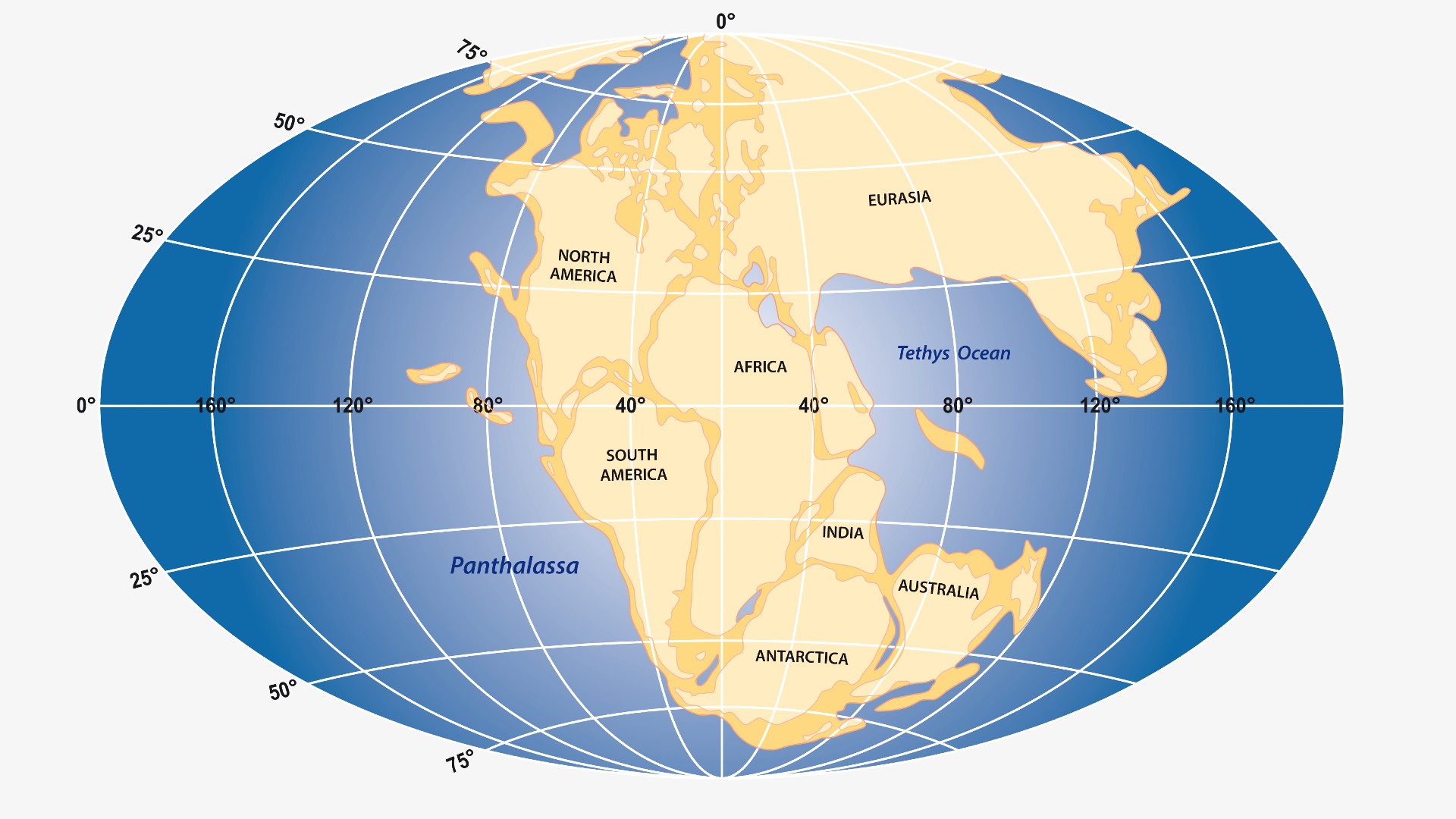
Actually, the latitudes have changed a hell of a lot since the time of Pangea.

Latitudes then

yzxGQrsNXDzWDcTKPFqFFf.jpg

Just seeing that Florida is damned near sitting on the Equator should give a damned good idea how far south North America was during Pangea.

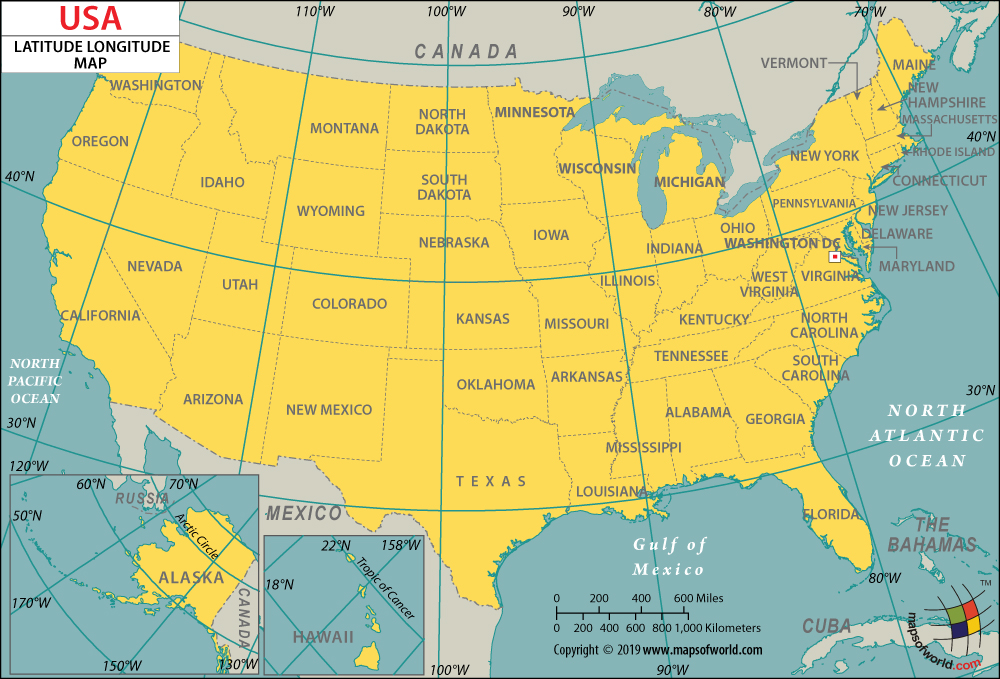
Latitudes now

usa-lat-long-map.jpg


North America has shifted significantly farther North since Pangea. Somewhere around 30 degrees farther north.

But 150 mya? That is about 25 million years after Pangea broke up, Pangea dates to between 175 and 335 mya. North America for example had already shifted significantly farther north by that time.

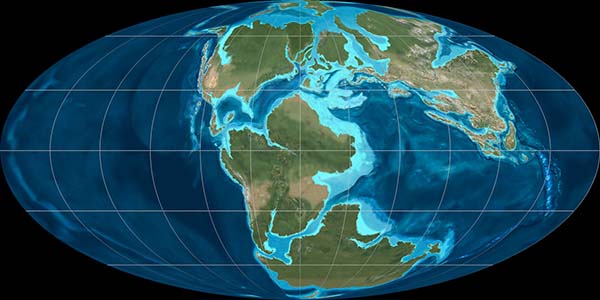
This is what the planet looked like 150 mya.

SIA3576.jpg


But the latitude has not a damned thing to do with climate. That is far more driven by ocean currents than latitude. 150 mya, there were no polar ice caps for example, and snow and ice on the planet were exceptionally rare because temperatures were between 13-15c warmer than they are today. Whenever there are large global oceans, temperatures are much higher than they are today. We are only in the cold climate conditions we are in now because instead of a large global ocean, they are broken up into three smaller oceans with very limited current interactions between them.

150 mya, northern Alaska had a clime much closer to that of Brazil today than anything else found in North America.

-shakes head and departs, mumbling about people simply making things up and never expecting somebody to be able to prove they are completely wrong-

About 5º ... that's not much ... these maps aren't showing the Rocky Mountains, let alone the volcanic arc ...

But the latitude has not a damned thing to do with climate.

You must not be familiar with the large scale circulation in the atmosphere ... climate has everything to do with latitude ...
 
When the CO2 levels were at an absolutely insane level when compared to today. Not 420 ppm, but around 3000 ppm. Between 7-8 times higher than today.


Not buying that. That's CO2 FRAUD trying to explain why Jurassic was warmer than now, and that's not the reason, that's the fudge job covering the reason. The reason why Jurassic was

Warmer
Wetter
Higher Surface Air Pressure

was all about not having land near the poles. Earth has 9 million cubic miles of ice now, 97% on the two land masses closest to the poles. When Earth has little to no land near the poles, it has little to no ice. No icebergs cooling oceans. All that compressed gas trapped on AA and Greenland released into atmosphere....


I bet no one here knew that, even the so called "experts" that are pushing the Climate Cult.

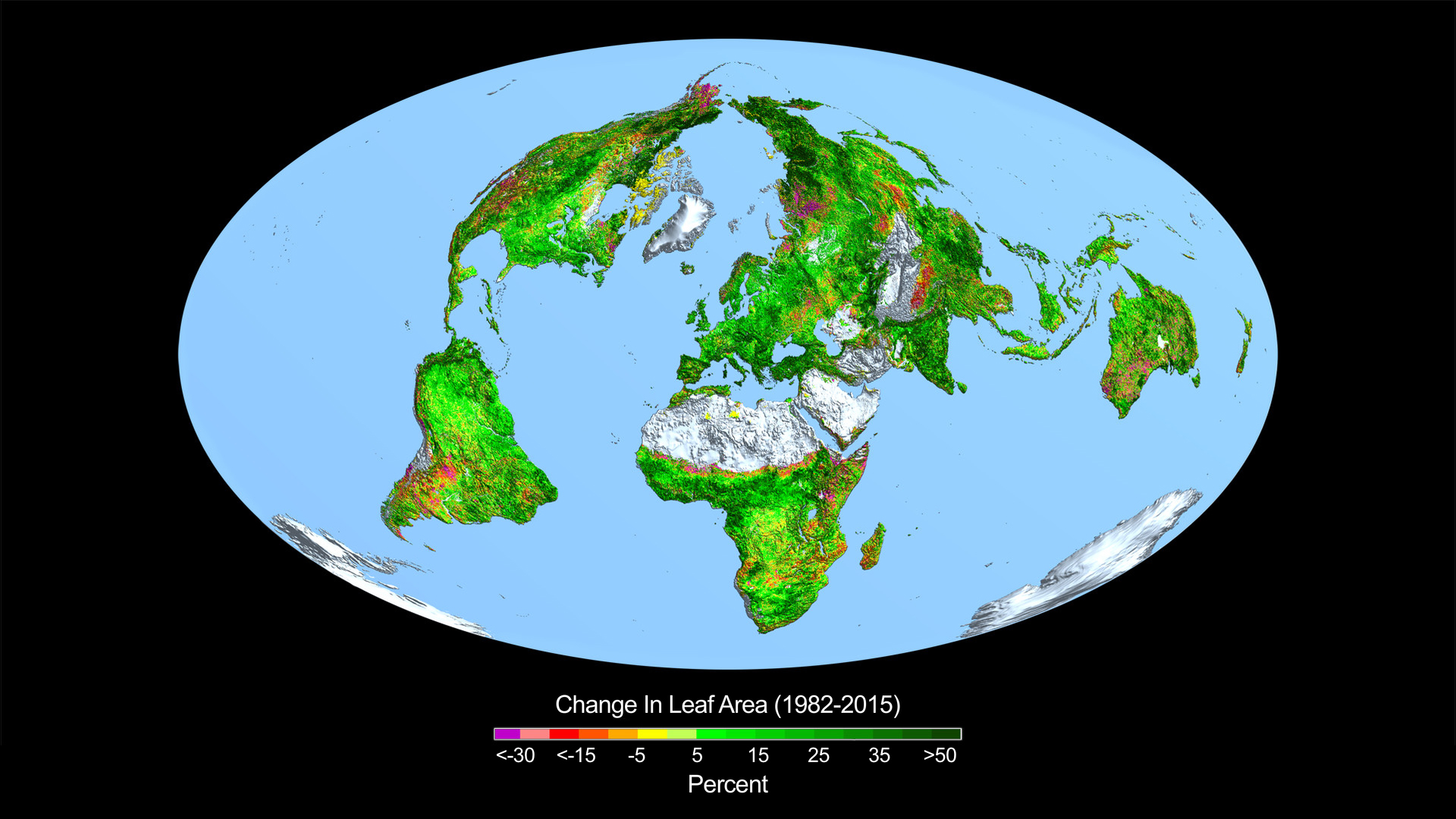
And here is another statistic that climate alarmists do not want to become common knowledge.

The somewhat increased levels of atmospheric carbon dioxide is resulting in a greener earth by pretty serious numbers.


We need more CO2 because we need oxygen
 
We need more CO2 because we need oxygen


Careful.

We actually get CO2 from O2.

CH4 + O2 = H2O and CO2 is the basic hydrocarbon burn equation.


But the answer to the question

is more CO2 in atmosphere good or bad


is clearly GOOD

no warming
more plants


within reason, we really do not want an atmosphere with 99% CO2, no...
 
Careful.

We actually get CO2 from O2.

CH4 + O2 = H2O and CO2 is the basic hydrocarbon burn equation.


But the answer to the question

is more CO2 in atmosphere good or bad


is clearly GOOD

no warming
more plants


within reason, we really do not want an atmosphere with 99% CO2, no...
Green plants need CO2 to make O2 Reduced CO2 you get less O2
Photosynthesis is the process used by plants, algae, and some bacteria to convert light energy into chemical energy, creating their own food (glucose) and releasing oxygen as a byproduct. This process uses carbon dioxide, water, and sunlight, and it occurs in two main stages: the light-dependent reactions, which produce energy carriers (ATP and NADPH) and oxygen, and the light-independent reactions (Calvin cycle), which use that energy to synthesize glucose from carbon dioxide.
Drill baby Drill
 
VERY MUCH RIGHT!!!
So then the last thing we should do is cut CO2 emissions because green plants increase their ability to convert it exponentially. We could never produce more then they can use.
 
Green plants need CO2 to make O2 Reduced CO2 you get less O2
Photosynthesis is the process used by plants, algae, and some bacteria to convert light energy into chemical energy, creating their own food (glucose) and releasing oxygen as a byproduct. This process uses carbon dioxide, water, and sunlight, and it occurs in two main stages: the light-dependent reactions, which produce energy carriers (ATP and NADPH) and oxygen, and the light-independent reactions (Calvin cycle), which use that energy to synthesize glucose from carbon dioxide.
Drill baby Drill

All correct .. just wanted to add that these are daytime processes ... at night, plants take in oxygen and "combust" the glucose they made during the day returning some of the carbon dioxide back to the atmosphere ... but not all ... a rather large part is made into structure proteins and is removed, at least for a few years, from the environment ...

Plants will benefit from the extra carbon dioxide ... but the other vital nutrients will need to be available, notably nitrogen ... c.f. Generators
 
So then the last thing we should do is cut CO2 emissions because green plants increase their ability to convert it exponentially. We could never produce more then they can use.


I am all for things like using desalination to make barren parts of land "green."

The full CO2 cycle is quite complex, but if we are to "help the environment" by making Earth more "green" as in more plant life then increasing CO2 makes sense.
 
Back
Top Bottom