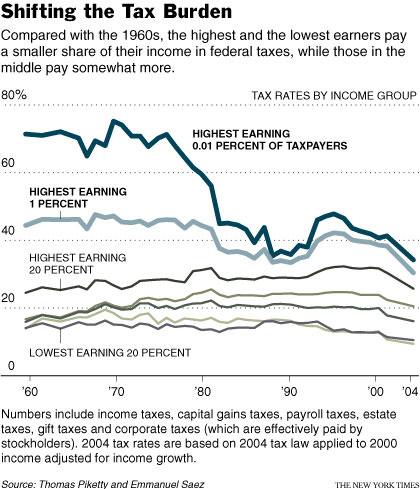
Who has the right to determine how mush is enough? O'bama? "Maybe you have earned enough" Government? The only legitimate concern of the government is how much you earned to determine how much you owe in taxes. Do you remember when the liberals (democrats) decided to gouge (tax) yachts at a exorbitant rate? What was the result? Less tax revenue, yacht builders closing, many Joe six-packs losing their jobs. Maybe it time to put a glass ceiling on taxation, 50% total of all taxes sounds good. Beyond that level the payee may just decide it not worth the effort. We should also put a floor on taxation. There is no free lunch, everybody should pay a share. While I certainly have little sympathy for someone being wealthy, I see no rationale for progressive taxation. That is simply greed, avarice, and envy. Our current system seems to punish success and reward failure. Great wealth is worthless if it is not used, if it is used it creates jobs, businesses, economic activity. That benefits all of us. If it is confiscated (taxed at high rates) it is removed from the market that feeds us all. Peace, Love, and Faith, Pappadave
Poor Americans Pay Double The State, Local Tax Rates Of Top One Percent
Nearly every U.S. state
taxes the poor more than the rich, according to a 2009 report by the Institute on Taxation and Economic Policy. Overall, the poorest 20 percent of households paid an average 10.9 percent of their incomes in state and local taxes in 2007, while the top 1 percent on average paid just 5.2 percent of their incomes in state and local taxes, according to the study.
Poor Americans Pay Double The State Local Tax Rates Of Top One Percent
It's the Inequality, Stupid
Winners Take All
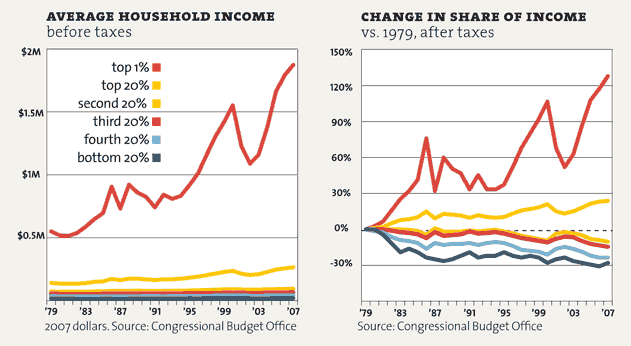
The superrich have grabbed the bulk of the past three decades' gains.
It s the Inequality Stupid Mother Jones
80% of the population owns 5% of the wealth.
Who Rules America Wealth Income and Power
The middle class has been eviscerated
"We can have democracy in this country, or we can have great wealth concentrated in the hands of a few, but we can't have both." - Louis D. Brandeis
Why Thomas Jefferson Favored Profit Sharing
By David Cay Johnston
The founders, despite decades of rancorous disagreements about almost every other aspect of their grand experiment, agreed that America would survive and thrive only if there was widespread ownership of land and businesses.
George Washington, nine months before his inauguration as the first president, predicted that America "will be the most favorable country of any kind in the world for persons of industry and frugality, possessed of moderate capital, to inhabit." And, he continued,
"it will not be less advantageous to the happiness of the lowest class of people, because of the equal distribution of property."
The second president,
John Adams, feared "monopolies of land" would destroy the nation and that a business aristocracy born of inequality would manipulate voters, creating "a system of subordination to all... The capricious will of one or a very few" dominating the rest. Unless constrained, Adams wrote, "the rich and the proud" would wield economic and political power that "will destroy all the equality and liberty, with the consent and acclamations of the people themselves."
James Madison, the Constitution's main author, described inequality as an evil, saying government should prevent "an immoderate, and especially unmerited, accumulation of riches." He favored "the silent operation of laws which, without violating the rights of property, reduce extreme wealth towards a state of mediocrity, and raise extreme indigents towards a state of comfort."
Alexander Hamilton, who championed manufacturing and banking as the first Treasury secretary, also argued for widespread ownership of assets, warning in 1782 that, "whenever a discretionary power is lodged in any set of men over the property of their neighbors, they will abuse it."
Late in life,
Adams, pessimistic about whether the republic would endure, wrote that the goal of the democratic government was not to help the wealthy and powerful but to achieve "the greatest happiness for the greatest number."
http://www.newsweek.com/2014/02/07/why-thomas-jefferson-favored-profit-sharing-245454.html