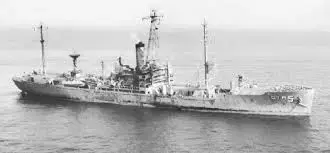
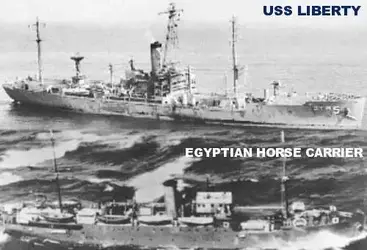
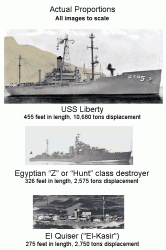
That doesn't really explain attacking at close range with torpedoes, cannon and machine guns without recognizing an American naval intelligence vessel. The large communications gathering equipment on huge lattice structures is kind of a dead give away. The USS Liberty looked nothing like any Egyptian ships.
Here are the US errors:
With the outbreak of war, Captain William L. McGonagle of the Liberty immediately asked Vice Admiral William I. Martin at the United States Sixth Fleet headquarters to send a destroyer to accompany the Liberty and serve as its armed escort and as an auxiliary communications center. The following day, 6 June, Admiral Martin replied: "Liberty is a clearly marked United States ship in international waters, not a participant in the conflict and not a reasonable subject for attack by any nation. Request denied."[16]
U.S. Ambassador Arthur Goldberg said to the Security Council that aircraft of the Sixth Fleet were several hundred miles from the conflict,[12] indicating that elements of the Sixth Fleet itself were far from the conflict. When the statement was made this was the case, since Liberty, now assigned to the Sixth Fleet, was in the central Mediterranean Sea, passing between Libya and Crete;[17] but she would ultimately steam to about 13 nmi (15 mi; 24 km) north of the Sinai Peninsula.[18] According to the Naval Court of Inquiry[20] (p. 23 ff, p. 111 ff) and National Security Agency official history,[21] the order to withdraw was not sent on the radio frequency that USS Liberty monitored for her orders until 15:25 Zulu, several hours after the attack, due to a long series of administrative and message routing problems. The Navy said a large volume of unrelated high-precedence traffic, including intelligence intercepts related to the conflict, were being handled at the time; and that this combined with a shortage of qualified Radiomen contributed to delayed sending of the withdrawal message.[20] (p. 111 ff)
Israeli errors:
As Commander Oren headed toward Arish, he was informed by Naval Operations of the reported shelling of Arish and told that IAF aircraft would be dispatched to the area after the target had been detected.[29]
Chief of Staff Yitzhak Rabin was concerned that the supposed Egyptian shelling was the prelude to an amphibious landing that could outflank Israeli forces. Rabin reiterated the standing order to sink any unidentified ships in the area, but advised caution, as Soviet vessels were reportedly operating nearby.[23]
At 1:41 pm, the torpedo boats detected an unknown vessel 20 miles northwest of Arish and 14 miles off the coast of Bardawil.[1][31] The ship's speed was estimated on their radars.[31] The Combat Information Center officer on T-204, Ensign Aharon Yifrah, reported to the boat's captain, Commander Moshe Oren, that the target had been detected at a range of 22 miles, that her speed had been tracked for a few minutes, after which he had determined that the target was moving westward at a speed of 30 knots. These data were forwarded to the Fleet Operations Control Center.[31]
The speed of the target was significant because it indicated that the target was a combat vessel.[31] Moreover, Israeli forces had standing orders to fire on any unknown vessels sailing in the area at over 20 knots, a speed which, at the time, could only be attained by warships. The Chief of Naval Operations asked the torpedo boats to double-check their calculations. Yifrah twice recalculated and confirmed his assessment.[23][31] A few minutes later, Commander Oren reported that the target, now 17 miles from his position, was moving at a speed of 28 knots on a different heading.[32] Bamford, however, points out that the Liberty's top speed was far below 28 knots. His sources say that at the time of the attack the Liberty was following its signal-intercept mission course along the northern Sinai coast, at about 5 knots speed.[30]
The data on the ship's speed, together with its direction, indicated that it was an Egyptian destroyer fleeing toward port after shelling Arish. The torpedo boats gave chase, but did not expect to overtake their target before it reached Egypt. Commander Oren requested that the Israeli Air Force dispatch aircraft to intercept.[23][31] At 1:48 pm, the Chief of Naval Operations requested dispatch of fighter aircraft to the ship's location.[33]
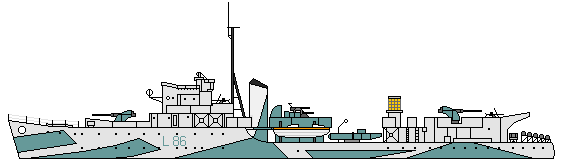
Hunt-class destroyer HMS Blean. The Egyptian Navy had Hunt-class destroyers in 1967
The IAF dispatched two Mirage III fighter jets that arrived at Liberty at about 2:00 pm.[34] The formation leader, Captain Iftach Spector, attempted to identify the ship.[34] He communicated via radio to one of the torpedo boats his observation that the ship appeared like a military ship with one smokestack and one mast.[35] Also, he communicated, in effect, that the ship appeared to him like a destroyer or another type of small ship.[35]
In a post-attack statement, the pilots said they saw no distinguishable markings or flag on the ship.[35]
Still waiting for any reason Israel would intentionally attack a US Ship. And looking at a ship from shore, or a photo thereof, is much different than when at sea...or so my father said, and he had 28-29 years at sea.