This ought to get interesting...
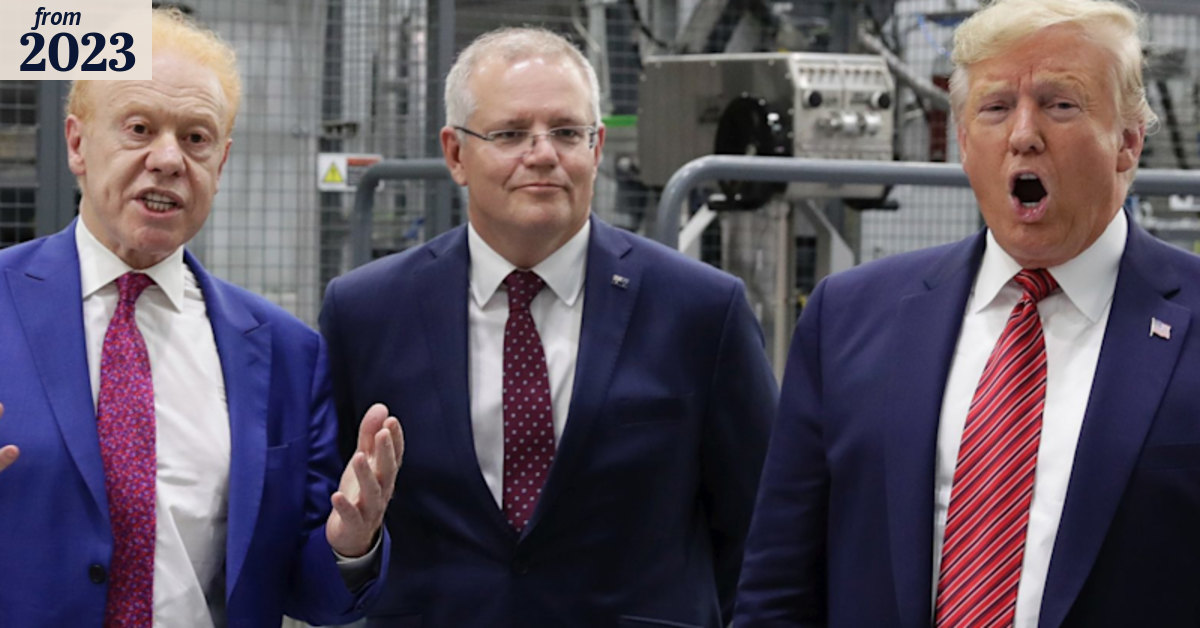
Former US president Donald Trump allegedly disclosed classified information on US submarines to Australian packaging mogul Anthony Pratt in April 2021, according to a report published by America’s ABC News.
It’s alleged that Pratt relayed the information to “scores of others” including “more than a dozen foreign officials, several of his own employees, and a handful of journalists”, ABC News reported.
“Pratt told Trump he believed Australia should start buying its submarines from the United States, to which an excited Trump – “leaning” toward Pratt as if to be discreet – then told Pratt two pieces of information about US submarines: the supposed exact number of nuclear warheads they routinely carry, and exactly how close they supposedly can get to a Russian submarine without being detected,” sources told ABC US.
Joe Hockey, who served as Australia’s ambassador to the US while Trump was in office, downplayed the seriousness of the alleged disclosures.

www.smh.com.au
That is pure bullshit. Australia is building their own Nuclear fleet of 8 submarines.
The September 2021 announcement of Australia’s transition to nuclear-powered attack submarines (SSNs) under the AUKUS program indicated that ‘at least eight’ would be acquired. More recently, the rhetoric has firmed up to eight, with the program director telling a
Senate committee in May that there would be three Virginia-class SSNs and five AUKUS SSNs. Vice Admiral Jonathan Mead implied that this was the full extent of the program and that decisions for what followed would be left for a future government.
A decision to stop at eight overlooks critical strategic, industrial and personnel considerations that determine the number of submarines Australia acquires.
Since the 2009 defence white paper,
successive reviews have affirmed the need for 12 submarines supported by a base on each coast providing specialised infrastructure, workshops and a submarine squadron staff. While nuclear propulsion provides much greater mobility, a submarine can only be in one place at a time. Once its position is revealed by counter-detection or its own offensive actions, uncertainty over its location is removed and with that, its deterrent value diminishes for a period. Added to the reality of our geography, a force able to deploy at least two submarines on each coast would require at least 12 SSNs to provide ongoing uncertainty (for an adversary) and, if needed, operational impact.
It takes three to four submarines to guarantee having one available for deployment. The ‘rule of three’ was validated by the
Coles review, but that doesn’t include any spare capacity to cope with
unexpected defects. The UK and French experiences confirm that four nuclear-powered ballistic missile submarines (SSBNs) are required to sustain one at sea—noting that SSBNs operate in a much lower mechanical and operationally stressed environment than SSNs.
Industrial issues are significant factors in the cost of ownership and effectiveness of the force. Australia intends to build the AUKUS SSNs in Adelaide. That is thoroughly commendable, but we should expect delays and difficulties as we learn how to do it. In all shipbuilding programs, the time and cost of successive vessels reduces as the workforce and processes are optimised. Typically, based on Australian (and global) experience, the third submarine
will cost some 40% less than the first, with much smaller reductions anticipated as later submarines are built.
This only works if the building program is continuous. Stop–start shipbuilding is a well-known recipe for prolonged delays and grossly inflated costs, as
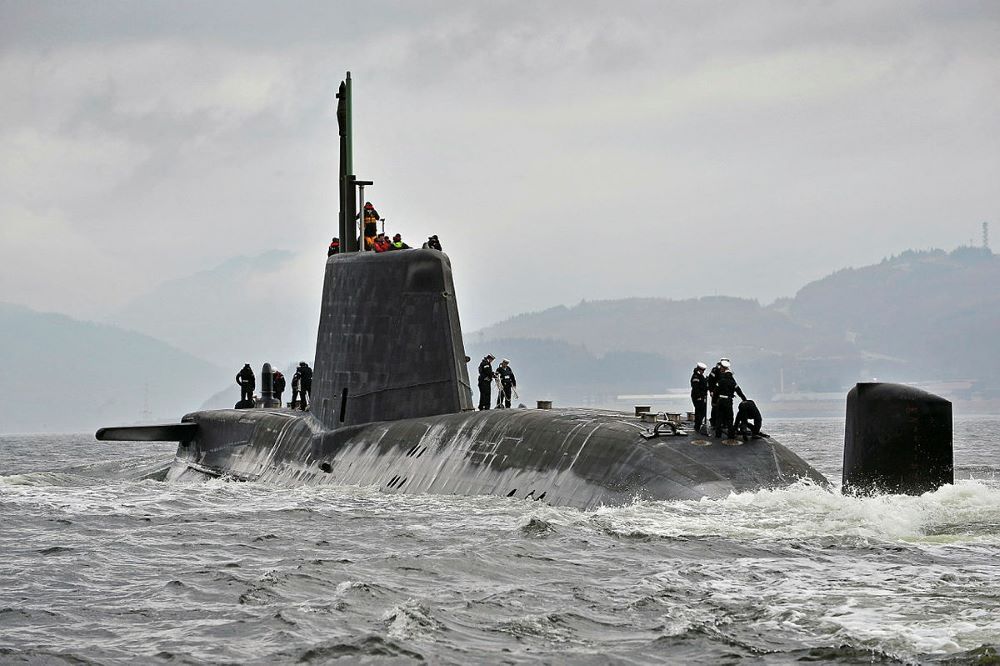
demonstrated by Britain’s Astute class, which, according to a House of Commons Defence Committee report in early 2010, was already by then 57 months late and 53% over budget.
Once we have mastered the complexities of building SSNs, as I am sure we will, we shouldn’t stop building.
The September 2021 announcement of Australia’s transition to nuclear-powered attack submarines (SSNs) under the AUKUS program indicated that ‘at least eight’ would be acquired. More recently, the rhetoric has firmed up to eight, with the ...

www.aspistrategist.org.au