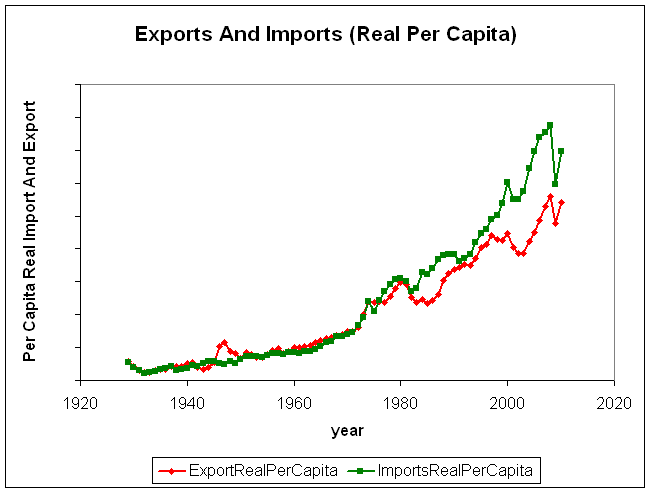
The only way I can proceed is upon the fundamentals that have been defined by the greater body of economics. Unless we accept them as basic fundamental definitions, we cannot begin to proceed forward without confusion. Every manner of utterance becomes confused as we make similar sounding statements that, in fact, have completely opposite meaning but for want of some underlying foundation.
I have no doubt that every manner of utterance by people is based upon a real observation and experience. Unfortunately, it is all to often in the underlying assumptions that define the language, the meaning of the words, that things get quickly confused.
From an individual business, even from a domestic market perspective, imports like steel and sugar import may affect domestic businesses by out competing them.
Unfortunately, business is not economics. One may get a degree in one, the other, or both. And while engineering economics melds into business economics, business economics shares much with micro economics, something goes quickly awry when going from micro economics to macro economics as the short term market forces do not play out well in the aggregate of long term macro economics. And while there are economists that enjoy some sort of position that seems to be as a philosophical antagonist with the may others, I would suggest that they are business economists, not marco economists. While the business of economics includes businesses, the businesses on businesses is not economics. The business of business is production and competition for consumer demand in the market place.
One thing to note is that, Editec pointed out, something suggests that short term macro economic gains in consumer consumption may have played out quite the opposite in the long term. (I caution him though that we may want to consider the causal chain of income, credit, demand, and imports that suggests that the initial issue in the causality was declining income and the availability of credit that allowed demand for imports, not imports that went the other way around. Then, as I will state later, causality is bi-direction in macro economics. So the question becomes where can chain be broken, not what was the initial cause).
So I have no doubt that there are all manner of observations that are true and correct. The trick is to figure out if they are simply isolated observations from the market place of it they do, in fact, have long term economic effects that we would rather not repeat.
Anyways, I digress.
There are a couple of points I would like to hammer home with regard to macro economic fundamentals. One is the meaning of value and the other is the assumption of unbounded consumption.
It is interesting how your vision of "value" and consumption leads you in one direction while mine leads me in the opposite.
I have addressed these fundamental definitions below along with some other points that your response elicited. I tried to rearrange them in a manner that flows better. I actually wanted to start out with something that wasn't a "disagreement" out of the starting gate, but relegated to putting the fundamental definitions, upon which I am working, up front.
Here is the short version.
Economics is a study of how society reallocates scarce resources. And in that term "scarce" lies a clue. Macro economics assumes unlimited consumption. As such, the introduction on an import into the market place will be entirely consumed without any decrease in the consumption of the existing domestic consumption. While that is not necessarily taken as foundational in micro economics, it is considered foundational in macro economics as labor simply shifts about to fill in where the demand is most needed.
And I can only speak to what the general macro economic fundamentals presents.
Value is not intrinsic to money. The number on it is a count of the bills, not value. Money has no value except that it is assigned a goods-value by two parties in the moment of the exchange. The rest of the time, it is valueless except in that it is assigned potential future value by it's owner and may be used as a proxy measure of the money used in exchanges by counting it's rate of change in money stocks.
When examining an exchange, going to Target and watching a transaction, the POS machine asks, "Do you want to put it all on your Target card or pay some in cash?" And with that, it is obvious that consumer revolving credit is a source of increasing the money supply used in exchanged of MV=PQ. Being sure to not double count stuff is the issue as the entire fractional reserve banking system relies on credit to increase the money supply and one man's savings is another man's credit. While I am still working on finding some way to combine the rate of change in consumer credit to the existing money stocks, it remains elusive for the reason stated.
Prices fall because demand falls for lack of money, not because of an increase in product. And, demand is unlimited. The existence of another product does not decrease demand for the first. It is, in fact, as noted by Hume in "On Money" that it is the rate of change of the money supply that causes demand/production to rise and fall. It is an interesting effect.
We have to be so careful with economics to be clear what is an immediate cross causal relationship as opposed to a secondary effect. The economic process is a closed feedback loop where causality goes in both directions. The elemental process of two people in an exchange is a negotiation with information moving in both directions. As well, goods move in one and money in the other. Causal in not uni-directional. In the bigger loop, a consumer connects to a sale, a sale connects to production, production connects to wages, wages connect to consumption, and around it goes. Goods, money and information flow in both directions around the loop. And while someone might note that a change in production is associated with a change in consumption, it is misleading because the there is causality in between.
As you note, imports also include the importers, the dock workers, etc.
What may be considered as a full body of formal economic terms remains elusive to me. It's easy with medicine, they are all Latin. It's easy with physics and engineering, the tend to be all mathematically defined measurements. Economics is young, not as mathematically defined, and of particular interest to everyone. So it's kind of hard to distinguish between formal terms, colloquial terms and whatever some writer needed to coin to get the idea across. Some seemingly formal definitions actually depend on who you ask that is aware of formal definitions. That whole MV=PQ thing is defined differently by Hume then it is used by the monetary guys. It seems that some things that were developed earlier and put into words without any fundamental measures and methods to define them mutated as the economists of one era adopted the economist terms from an earlier era. And there is the interesting thing that, for more then 200 years, inflation has meant price inflation yet some people will absolutely insist it has always meant monitary inflation. I believe that is a political effect. Everyone has there hand in the economics dictionary.
I've tried to detail this all out coherently, in relationship to your comments. Every time I do, I seem to see it just a tiny bit more clearly.
Later, please clarify
My knee jerk reaction is to reply "Supply AND Demand", not "vs."
Thanks.
______________________________________
"aggregate" total value remains the same; total consumption remains the same; half of the total value now buys imports, leaving
only half the total value for domestics. Prices fall, because demand for domestics has halved, cp. Supply vs.
Demand; and because equal demand, for imports, is comparably "weak".
Now, for "individual" consumers, their pocket-money could buy 2x domestics -- if-and-only-if-and-when everybody else is spending
half their money on imports. Again, when everybody else is "lured" to foreign products, remaining domestic products can command
only half-price, i.e. "they're now desperate for any buyer's business".
On the simplifications that we are using, [note_1]
a. the money supply remains the same from period one to period two,
b. there is no effect due to the effective relative rate of change in the money supply,
then;
It is clear, at this point, where you are in disagreement with macro economics. I can only speak to what the general macro economic fundamentals presents, and try to connect it into the larger picture.
______________________________________
You suggest that
total consumption remains the same
because demand for domestics has halved
"they're now desperate for any buyer's business"
because equal demand, for imports, is comparably "weak"
I previously noted that, macro economics concludes that;
That is the difference between what your considering and what the macro economics is presenting.
The assumption in macro economics that consumption and demand are unbounded. If you build it, they will buy it. That the same amount of domestic product is available and that the total amount of product has doubled given that imports are now adding the equivalent amount necessitates that consumption has doubled in the aggregate. It necessitates that each producer is selling everything they can produce.
The definition of the science of economics is the study of how society redistributes scarce resources. The key is in the term "scarce".
To borrow from the woodchucks, if a consumer can consume as much scarce resources as it can consume, how much scarce resources would a consumer consume? A consumer would consume as much scarce resources as it can consume if a consumer can consume scarce resources.
If we are not discussing "scarce resources" but talking about an over abundance of resources, then we are not technically discussing economics, by definition. And while I continue to question the validity of this assumption as universally applicable, I cannot speak to it.
The underlying assumption is that Q consumed is Q produced. Total consumption is driven by total production. That is, after all, Say's Law. Whether Democrat or Republican, "liberal" or "conservative", everyone seems to agree that, in the long run, Say's Law holds. The significant difference, between "supply side" and "demand side", an odd distinction given that supply and demand cannot be separated, seems to be in that "supply side" takes Q_consumed = f( Q_produced ) and "demand side" takes Q_consumed = f( Q_produced, Income, time, whatever other factors can be identified that have the whole thing stuck at Q_consumed < Q_produced ).
______________________________________
You suggest that;
aggregate" total value remains the same;
I did point out that macro economics defines;
We are using "value" differently.
The money stocks represent a potential for money to be used in MV in representing the value of PQ. The first point is that M1 represents the potential for money used in MV. The second part is the value is in PQ, not in M. Money has no intrinsic value. It has no assigned value until it is assigned that value in the moment that it is mentally attached to the product q just before the purchaser puts that money "on the barrel head".
Technically, value is measured by the equivalent quantity of stuff, a standard basket of goods. If the standard basket of goods is doubled, then value doubles. We can infer that this is one of those formal definitions. It is also why others point out that we have to look at the goods, not the money. Money does not have intrinsic value. In fact, nothing has intrinsic value. Value is a subjective quality that is an attribute of the individual and is individually assigned to the money and good. The Consumer Price Index and similar indexes are the technical definition, the mathematical expression applied in the practice of measuring aggregate value. Each month, the BEA assigns a Consumer Price Index number to a standard basket of goods that defines that months aggregate value of money as it has been demonstrated in the aggregate behavior of all of the economic agents in the economy. It measures how much value each dollar has in terms of a standard value unit, a standard basket of goods. The unit of value is a standard unit of goods. An amount of money isn't a measure of value without the every changing conversion factor of the consumer price index. Of course, these are aggregate averages, both the consumer price index and the standard basket. There are numerous indexes, including PCE, CPI-U, CPI-W, and others. Each individual has there own personal standard basket and individual price index that they could measure by examining their own purchases.
As I sit in my house with an amount of money sitting on the table, it has no value. As I consider tomorrows shopping and subsequent purchases, I imagine the value that it will have at that later time. I think of the things that I need, recall the prices I paid before, and I assign a value to my money in terms of the products I need and estimate how I will divide up that money. It still has no intrinsic value because the other half of the exchange is missing, the vendor. At the same time, in a store a mile away, the store keeper is considering how much money he still needs to balance his monthly books, what he will need to buy at a later date, and goes around marking the products on the shelf. He is estimating what I will be willing to pay when I arrive the next day. His product has extrinsic value, intrinsic to him, in that he has plenty and sees the opportunity to exchange it for money.
When I arrive at the store in the morning, I may find that the prices I expected are, in fact, not the same as the prices that the vendor has marked on his products. I do some recalculations, reconsider the quantities that I need, and my estimation of what store keeper puts on my good will. With my future basket of goods in hand, I meet with him at the cash register and we discuss how much I am willing to pay and how much he is willing to sell for. We begin bargaining on the finer point of precisely what value this basket of goods has and what value money has in terms of this basket of goods. The extrinsic and momentary value of the money is a function of my standard basket of goods, his standard basket of goods, our estimate of what these will be at some later date when we enter into other transactions, the rate of flow of money into and out of our individual wallets, and any other factors that we each find relevant in assigning standard-basket-of-goods-value to the money that I expect to give up and he expects to receive. At the moment when we have come to a mutual agreement, then and only then does the money in my pocket have an extrinsically assigned potential for goods-value. I put the money on the counter. He picks it up, and like making a chess move, the moment he touches the money, it suddenly has an assigned value. And in that moment, as I no longer care about the money, now in possession of the thing that has real value to me, the goods, the money no longer has value. The assigned standard-goods-value came and went in the smallest increment of time, a moment.
Money has no intrinsic value. Goods have value. Money has the potential for value. Money is assigned an accurate but imprecise estimated and potential goods-value by each party in the earlier times leading up to the exchange. In the short time just before the exchange, both parties negotiate the potential goods-value that the money will have at the moment of the exchange. The estimated potential value becomes precise when the negotiation has concluded. Then, in that moment, the money inherits the estimated goods-value that was agreed upon. At the moment that the vendor accepts the money in exchange for the goods, the money then inherits the assigned value, going from potential to real, the real value of the goods. And in but the single tick of the clock of the universe that is time passing as moments are created and destroyed, one upon the other, that value disappears again, leaving only the remnants of that exchange, a proxy measure of accounting, the otherwise useless pieces of paper that are so plentiful and such supply that toilet paper has more value and people will happily part with it in exchange for toilet paper. The only "value" that money has is in it's potential for being exchanged for something of value and how much of it exists compared to all those things of real value.
And I speak of this, not in any personal authority, but in passing on the authority of the observable nature of physical reality. While we may not be able to look into the cranium of those busy little bees that buzz about the shopping mall, making every manner of exchanges, we can infer much from watching their behavior. And curiously, there seem to be more of them willing to part with money, that they seem to have in short supply, relative to the fewer shop keepers that are collecting that same money and putting it into draws replete with similar paper. In the oddest sort of fashion, the money seems to collect into plentiful piles, in complete opposition to the natural laws of thermodynamics while the goods disseminate, becoming further disorganized in exactly the fashion that we expect of a thermodynamic process. While people a plenty seem to be somehow attracted towards the goods while they have some modest quantity of money in their possession, the money is repelled from them in the opposite direction.
There is an oddity in these processes where, as entropy (the thermodynamic measure of randomness) of goods increases, money seems to move from lots of small quantities to piles of larger quantities. And where entropy of goods decreases, becomes organized into products that seem to be of later value, the money moves from larger quantities and disseminate into smaller quantities. As the entropy of the goods increases, the entropy of the money decreases and vis a vis.
We might, I suppose actually create a formal definition out of this, I hope the point is clear. There is every reason to conclude out of observation that money has no value. We get use to perceiving it as such because, from out subjective position, we assign it value quite naturally. And, since the our first paper route or recycling of glass bottles, we are simply use to it. But in objective examination, it is an illusion of our own devices.
And, you will find every manner of well versed economist that will insist that money has no value, the value is the goods. Even then, the goods have value only as we assign it as such. As they say, on man's trash is another man's treasure. And while some may be willing to pay enourmous sums for a collector baseball card, gold coins, or a diamond, we cannot help but recognize that, if stranded on a desert island, food and water are far more valuable than any trinkets.
It isn't, as is often misquoted, money that is the root of all evil. It is that "The love of money is the root of all evil." And that alone, a statment that echos from early history, makes it clear that money is only in that it is perceived as money. It is the love, intrinsic to human nature, that is the object and assigns value, quite erroneously in this case, to the otherwise useless object that we use as money.
______________________________________
Curiosly, you say;
Prices fall, because demand for domestics has halved
Macro economics say that;
Given that M is constant, and assuming that all other things balance out then where
MV= P(t=1) Q(t=1) = P(t=2) Q(t=2),
if
Q(t=2) = 2 * Q(t=1)
then
P(t=1) Q(t=1) = P(t=2) *2 * Q(t=1)
P(t=1) = P(t=2) *2
Therefore
P(t=2) = P(t=1)/2
Which says that price has fallen simply because the same money must be utilized for twice as may products.
(Now, the fact that the money supply has fallen relative to the total number of goods will initiate Hume's notable rate of change in the money supply effect. But I am not considering that we are discussing that one.)
______________________________________
what isn't in that MV=PQ, is that, in fact, it isn't just currency, it's revolving credit.
In fact, it is (M+C)V=PQ and the reason Q fell was because consumer credit fell...
so "consumer credit" (
C) is "instant inflationary money", that tends to increase the effective
money supply (
Meff = M+C), tending to increase prices (
Meff ~ P, for constant
V,Q) ?
Well, if you agree, that will be two of us.
Just to be clear, when I speak of the money supply, M, I use Hume's initial definition and the definition as the equation of exchange would have it defined as a real physical process. Unless otherwise stated, I don't mean the monetary base, M1, M2 or MZM which the Federal Reserve bank uses as a proxy measure to the real physical money used in the exchange. There can be some confusion over that as, since they figured out that they can use the rate of change of the monetary base as a proxy for the rate of change of the real dynamic money supply, macro guys tend to think of it only in terms of the monetary base. Being of a physics and engineering background, I am familiar with physical reality standing as an authority. And seeing as we can walk down to the store and watch an exchange in process, a real physical process, we can use it as an authority for defining M. V is, of course, a real physical process of the frequency of money flowing in the economy and is dependent on the physical processes like walking money from the cash register, to the accounting office then down to the bank or the time it takes for the debit card swipe to register in the POS machine and then show up on the banks computer system.
So we can get a lot of traction out of that fundamental model of the physical process that is precisely and accurately modeled by MV=PQ.
We know that the professional economists track consumer credit and spending as an indicator of demand and economic health. So that's a clue that validates our perception. We hear that in the headline constantly.
We can simply go to Target and make a purchase to validate that the exchange is driven by the combination of cash and credit as the POS machine asks, "Would you like to pay for part of your purchase with cash?" That doesn't simply validate it, it demonstrates it. M, modified by V, is the sum of all those exchanges, including that Target purchase.
To be very clear, M is not the amount noted on my Target credit card bill. That is an accounting of what pq was at the moment of the exchange. pq actually existed only in the moment of the exchange, being spontaneously created out of the actions of myself and the clerk, then dissipating like some transitory elementary particle that leaves tracks in the bubble chamber of a particle collider in the moments after a the beam has smashed into the target. It is there and gone, leaving only a record of it's existence in the flipping of little digital bits that stream down the data wires. And if pq was created out of the potential for it's existence in the availability of revolving credit, and is track-able by the change in the aggregate sum of revolving credit on my credit card bill, in the Target bank computers, and eventually in the accounting of total consumer credit by the Fractional Reserve Bank, then we know that revolving credit is, in fact, part of M. The increase in revolving credit as it is created when that credit card is swiped is an increase in the M that accounts for all the pq's in the exchanges. (There is a formal term in economics, the exchange, the moment of the transaction between a buyer and a seller when money flows in one direction and a good flows in the other.)
We should take extreme care in considering that an ".. economy's money supply (M) represents the "value" in that economy; availability of foreign "exotic novelties" spreads M more thinly, over more products." The money stocks, M_b, the monetary base, and other measures such as M1, M2 and MZM do not represent the economy's value. I say this on two counts, which I will combine into one. The money stocks represent a potential for money to be used in MV in representing the value of PQ. The first point is that M1 represents the potential for money used in MV. The second part is the value is in PQ, not in M. Money has no intrinsic value. It has no assigned value until it is assigned that value in the moment that it is mentally attached to the product q just before the purchaser puts that money "on the barrel head". ( I explain this in more detail below.)
We tend to think of money as those pieces of paper that reside in our wallet. And they are "money", but they are not "the money in M". They are only the representation and potential for the money in M. They are the money in M only in the moment that they move from my wallet to your wallet. Once that has occurred, we can back into what must have transpired by comparing the change in the money in my wallet to the change in the money in your wallet. Mine went down, yours went up, and the amount by which they both changed is a proxy measure, an accounting of what pq must have been that is part of the larger M.
In the same fashion, we know that the change of my credit card balance with Target Bank is an indicator that some pq transpired.
In fact, the very nature of the fractional reserve system and the endogenous creation of money through business loans necessitates that the expansion of M itself be the result of some sort of credit as some initial point. And we know that it must be continuously refreshed in order to maintain M at it's current level.
We can infer that, in the macro accounting of the monetary base (M_b), M1, M2 and MZM, the Federal Reserve surveys the static balance of accounts at some point in time and uses the results of those surveys in some calculation such that they are a proxy measure of the money after it was created rather then an actual tracking of the money as it is being created.
As one macro economics professor was fond of saying, "If you buy that, then you have to agree that ...."...
... consumer credit is just the economic natural evolutionary outcome of that fractional reserve banking process finally getting down to the point of the individual. Somewhere, money was borrowed in the the banking system to invest in the creation of "value" in a business and flowed about in the economy, finally coming to rest in a reserve account of Target National Bank such that it was available for me to borrow against in my creation of money during an exchange of money for goods with the clerk at Target Store down the street from my house.
The trick is to not count anything twice in later attempting to account for the money of the exchanges.
As long as we don't count things twice, in the accounting of M, we get
M_exchange * V_exchange = PQ
= Σ( p q )
= Σ{( cash plus credit ) * q }
= (M_other + M_consumer revolving credit this month) * V_exchange
= M_b * V_b (monetary base)
And given this, do you agree that
"consumer credit" (C) is "instant inflationary money", that tends to increase the effective money supply
?
I can find no reason that it isn't.
______________________________________
imports that were resulting in relative decline in some micro economic domestic production of a similar product or
"crowding out" of even unrelated products.
i gather "
displacement" & "
crowding out" are synonymous formal terms ?
I doubt that. As far as I've seen, economics has few truly formal definitions, compared to physics, engineering, medicine, biology, chemistry, etc. It is, after all, a social psychological science and like any psychological sciences everyone "understands" it because everyone is involved in it in their day to day lives. Social psychology and individual psychology seem to have about as many formal definitions as economics.
Obviously, it's impossible for any one person to have a PhD in everything so I can only speak from what I know, not definitively. Like, I'm no medical doctor but I think we all know how formal medicine is in it's language of Latin names for everything. One would almost expect different formal terms for a fungus on the big toe and a fungus on the little toe. That is exactly how they name stuff. Dermatitis is literally, "an abnormality on the skin". The hippocampus is named for it looking like a hippopotamus. Of course, one misspoken word in medicine and the nurse or another doctor amputates the guys foot instead of removing his gall bladder. Then medicine has the whole medical billing and coding issue to deal with. Medicine has formal terms. Indeed, now that I think about it, the very use of Latin assures that the terms remain formal even when they do become part of common usage.
Physics and engineering has been around for as long so it enjoys much of the same formality. It's formality isn't so much for the same reason as medicine. It is similar in that ordering materials necessitates it. Misspeak and use milli- instead of micro and you end up with a thousand times as material as you need and the purchasing agent spend a thousand time as much money as you wanted to. And the nature of physics seems to lend itself well to maintaining the formality. It actually suffers from a bit of "corruption" because terms like "precise" and "accurate" are used commonly and incorrectly. Everyone thinks they understand what they mean. In the sciences, especially engineering, "precise" and "accurate" have very accurate and precise meaning that can be expressed mathematically in terms of variance and average. Commonly, they are used accurately but imprecisely. It's like there terms "law", "theory" and "hypothesis" which are commonly used inaccurately.
The psychologies, social, individual and economics are all fairly new having been effectively born out of the era of the Great Wars and the Great Depression. Maybe it's more accurate to analogize them going through their teen years then. And, of course, everyone thinks they understand economics and psychology. We all to, after all, live it. Every businessman thinks he understands economics. And half the politicians like make this claim, that because they ran a business, they understand economics very well and can run a country. That's like saying that because I once played an airline pilot as an actor in a movie I can fly an airplane. Or because I have children, I understand pediatric medicine. But the voters buy it.
Economics, being rather young, has adopted much of its terminology from other sciences and coined others from common usage. I'm not even sure if there is anything that one might consider as technically a professional economist. A "professional engineer" is a legally defined term requiring licensing. A medical doctor, M.D. requires a license as does the whole body of physical and psychiatric medicine. Even the practice of business has licensing like a tax preparer, a CPA, real estate brokers, and financial consultants. Things become formal when the legal profession, licensed to practice law, gets involved. I've never heard of a license to practice economics. If lawyers can't tie it directly to personal loss of life or money, it doesn't need to be so formal.
So, things like my using "displaced" and "crowded out" are just because it seemed like the best descriptive term.
[note_1] There are additional over simplifications made here. We haven't added in the increase in money supply, as noted.
But more importantly, if domestic prices fall, to match the money supply, then domestic income must fall to match the prices at the same quantities. As well, half that money is going to foreign manufactures. Unless we wrap that back in again, by including exports and government sales of treasury certificates plus government spending, then, things don't exactly become 1/2 or doubled.
It's is a goal seeking problem. To properly get what that goal seeking finds necessitates also changing the money supply we are oversimplifying in not noting that, in fact, if M_domestic is half it was, then I_domestic must become half.
There is actually, two processes to deductive reasoning that has played out historically. One is to find a simplified model that captures all the essential elements and leads to the generally correct, accurate conclusion. As Einstein said, "When solving a problem, it helps to know what the answer is."
The second part, that has played out historically, is that the model is then added to, refined so that it goes from simply accurate to precise.
Physics mechanics was generally correct. Then Newton devised calculus and made physics mechanics far more precise. Then Einstein devised relativity and made physics, including mechanics, even more precise.
Adam Smith made economics generally correct, then the Great Depression happened and it wasn't precise enough. Then Keynes made it even more precise. Then Nash came along and demonstrated that equilibriums occur which are different then the equilibriums that were previously understood.
In order to get to what imports do, we really need to add in the income side of consumers, exports, the increasing money supply, government securities, the government deficit, and the public debt. Then we have a closer model with the full number of constraints that can lead to a goal seeking problem. And, with the exception of those government securities, we still haven't accounted for the financial process that is suppose to be moving money, and thus resources, to where they are suppose to do the most good.
A complete model then becomes a closed loop and has to reach an equilibrium.
At that point, the very nature of "causality" becomes a mute point as demand causes sales, sales causes production, production causes income, and income causes demand. Even imports cause services, "via wages paid, to dock-workers & port-authorities, in unloading cargo ships? foreign trade represents "(global) transportation employment". And those cause income which in turn causes demand which stimulates more sales and production, whether it be domestic or foreign.
And in the balance of things, without being able to get down to the point of counting stuff, we are completely unable to distinguish what force dominates it's opposing force in the aggregate effect.
______________________________________