Ya know what they AREN'T you stupid sock?
Something Americans reference...
Liar.
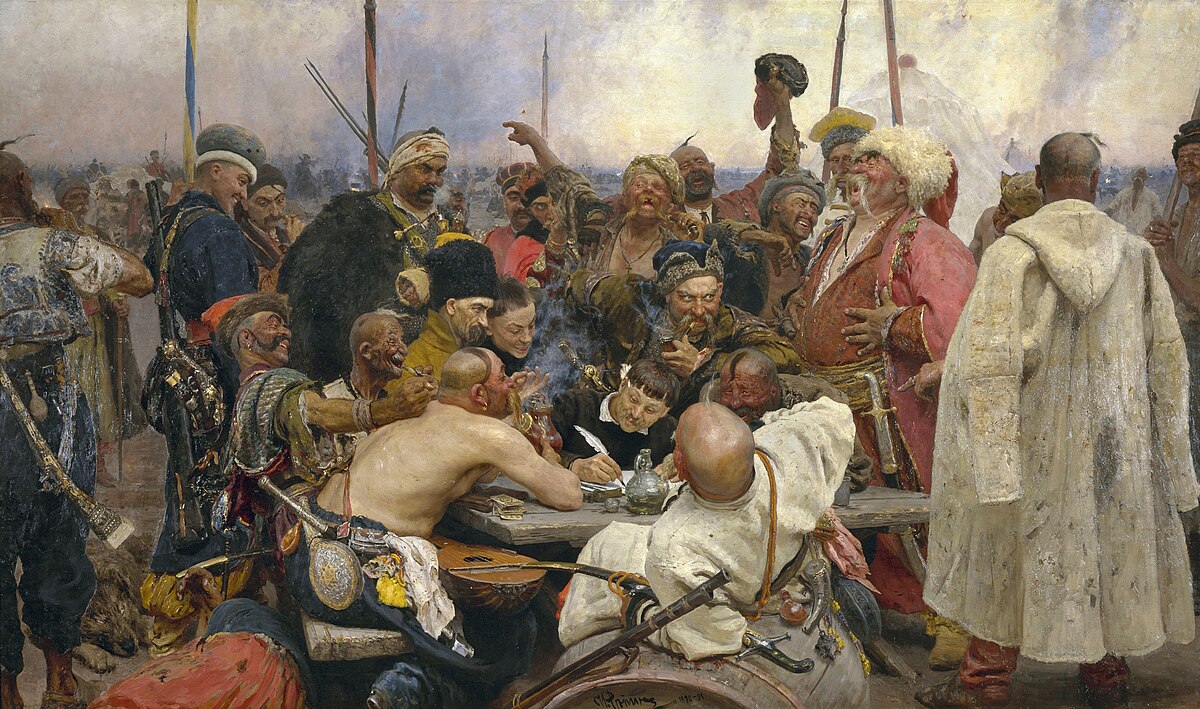
Everyone knows the Cossacks are not and never were Russian.
They were always Ukrainian, Khazar, Scythian, Mongol, Moghul, etc. from the Balkans.
All you needed to do was at least watch the movie on "Taras Bulba" with Yule Brenner.
The fact the Tzars hired Cossacks, does not make them Russian, but anti-Russian.
The Ukrainians are notoriously anti-Russian, like Demjanjuk guarding the WWII death camp, at Sobibor.
{...
As early as the 15th century, a few individuals ventured into the
Wild Fields, the southern frontier regions of Ukraine separating Poland-Lithuania from the Crimean Khanate. These were short-term expeditions, to acquire the resources of what was a naturally rich and fertile region teeming with cattle, wild animals, and fish. This lifestyle, based on
subsistence agriculture, hunting, and either returning home in the winter or settling permanently, came to be known as the Cossack way of life.
[23] The
Crimean–Nogai raids into East Slavic lands caused considerable devastation and depopulation in this area. The
Tatar raids also played an important role in the development of the Cossacks.
[24][25][26]
Ottoman Turks in battle against the Cossacks, 1592
In the 15th century, Cossack society was described as a loose
federation of independent communities, which often formed local armies and were entirely independent from neighboring states such as Poland, the Grand Duchy of Moscow, and the Crimean Khanate.
[27] According to
Hrushevsky, the first mention of Cossacks dates back to the 14th century, although the reference was to people who were either Turkic or of undefined origin.
[28] Hrushevsky states that the Cossacks may have descended from the long-forgotten
Antes, or from groups from the Berlad territory of the
Brodniki in present-day
Romania, then a part of the Grand Duchy of Halych. There, the Cossacks may have served as self-defense formations, organized to defend against raids conducted by neighbors. By 1492, the Crimean Khan complained that Kanev and Cherkasy Cossacks had attacked his ship near
Tighina (Bender), and the Grand Duke of Lithuania
Alexander I promised to find the guilty party. Sometime in the 16th century, there appeared the old Ukrainian
Ballad of Cossack Holota, about a Cossack near
Kiliya.
[29][30]
In the 16th century, these Cossack societies merged into two independent territorial organizations, as well as other smaller, still-detached groups:
- The Cossacks of Zaporizhia, centered on the lower bends of the Dnieper, in the territory of modern Ukraine, with the fortified capital of Zaporozhian Sich. They were formally recognized as an independent state, the Zaporozhian Host, by a treaty with Poland in 1649.
- The Don Cossack State, on the River Don. Its capital was initially Razdory, then it was moved to Cherkassk, and later to Novocherkassk.
There are also references to the less well-known
Tatar Cossacks, including the
Nağaybäklär and
Meschera (mishari) Cossacks, of whom Sary Azman was the first Don
ataman. These groups were assimilated by the Don Cossacks, but had their own irregular
Bashkir and Meschera Host up to the end of the 19th century.
[31] The
Kalmyk and
Buryat Cossacks also deserve mention.
[32]
...}

en.wikipedia.org