
Technical papers on the ocean causing abrupt climate changes.The role of CO2 in climate change isn’t just based on models. It’s grounded in physical chemistry and radiative physics. Carbon dioxide absorbs infrared radiation, which traps heat in the atmosphere. This has been measured and quantified in laboratories for over a century. Models aren’t the source of the effect; they’re a tool to integrate observed physics and feedbacks across the global climate system.
Navigation
Install the app
How to install the app on iOS
Follow along with the video below to see how to install our site as a web app on your home screen.
Note: This feature may not be available in some browsers.
More options
Style variation
You are using an out of date browser. It may not display this or other websites correctly.
You should upgrade or use an alternative browser.
You should upgrade or use an alternative browser.
The warming of Greenland progressing more rapidly than predicted
- Thread starter Old Rocks
- Start date

Anomalism
Diamond Member
- Dec 1, 2020
- 11,853
- 8,964
- 2,138
What you’re doing here is collapsing several distinct concepts into one bucket and then calling the whole thing flawed. The ~1°C per doubling is the no-feedback radiative forcing in a toy atmosphere. The moment you admit the real climate has water vapor, clouds, ice, oceans, and circulation, you’ve already left that toy model behind. The higher sensitivity doesn’t come from assuming all warming is CO2. It comes from measuring how the system actually responds when it’s perturbed. Paleoclimate isn’t being ignored; it’s one of the main constraints. Ice cores, the Eemian, the Pliocene, even glacial–interglacial transitions all show that when CO2 rises, temperature response is several times larger than the raw forcing alone. That’s empirical climate sensitivity.Yes, 1C per doubling of CO2 is grounded in science. 3.5 to 4.5C is not. That is a result of a flawed computer model which assumes all warming is due to CO2. Which ignores the vast and overwhelming evidence from the geologic record that the planet's temperature naturally fluctuates within glacial periods and interglacial periods. Not to mention the fact that the current interglacial period is 2C cooler than previous interglacial periods despite having 120 ppm MORE CO2.
My problem isn't with the instantaneous GHG effect of CO2 which is well established at 1C per doubling of CO2. It's with their flawed models and doomsday predictions of catastrophic climate change. The only catastrophic climate change in our future will be when the gulf stream switches off.
And the “interglacials were warmer with lower CO2” line is a category error. Past interglacials were warmer because orbital forcing injected more solar energy into the system, not because CO2 was irrelevant. Different forcing, same physics. Today the orbital forcing is basically flat; the new energy input is radiative, from greenhouse gases. You’re comparing a system pushed by the Sun to a system pushed by atmospheric opacity and acting like the response should look identical. That’s the core logical slip. The fact that climate can change naturally does not imply it cannot change artificially. It just means the climate system is sensitive to forcings. The argument you’re making would also disprove volcanoes because the Earth was hot before humans existed.
The only thing I am calling flawed are the ridiculous feedbacks. I'm perfectly fine with the direct radiative forcing of CO2. You are assuming the climate is sensitive to CO2. Data from the geologic record shows that it is not. If it were as you claim, the planet would have never cooled for millions of years with elevated levels of CO2.What you’re doing here is collapsing several distinct concepts into one bucket and then calling the whole thing flawed. The ~1°C per doubling is the no-feedback radiative forcing in a toy atmosphere. The moment you admit the real climate has water vapor, clouds, ice, oceans, and circulation, you’ve already left that toy model behind. The higher sensitivity doesn’t come from assuming all warming is CO2. It comes from measuring how the system actually responds when it’s perturbed. Paleoclimate isn’t being ignored; it’s one of the main constraints. Ice cores, the Eemian, the Pliocene, even glacial–interglacial transitions all show that when CO2 rises, temperature response is several times larger than the raw forcing alone. That’s empirical climate sensitivity.
Show me.And the “interglacials were warmer with lower CO2” line is a category error. Past interglacials were warmer because orbital forcing injected more solar energy into the system, not because CO2 was irrelevant. Different forcing, same physics. Today the orbital forcing is basically flat; the new energy input is radiative, from greenhouse gases. You’re comparing a system pushed by the Sun to a system pushed by atmospheric opacity and acting like the response should look identical. That’s the core logical slip. The fact that climate can change naturally does not imply it cannot change artificially. It just means the climate system is sensitive to forcings. The argument you’re making would also disprove volcanoes because the Earth was hot before humans existed.

EMH
Diamond Member
- Apr 5, 2021
- 32,870
- 19,261
- 2,788
Even if Greenland gets new snow every winter, if it loses more ice through melting and iceberg calving than it gains, the ice sheet is shrinking.
Yes there is iceberg calving, and south of Arctic Circle Greenland ice melts in the Summer. You have no evidence of ice shrinkage on either Greenland or AA.
Greenland's ice age is very easily documented. It started up northernmost 1-2 million years ago.
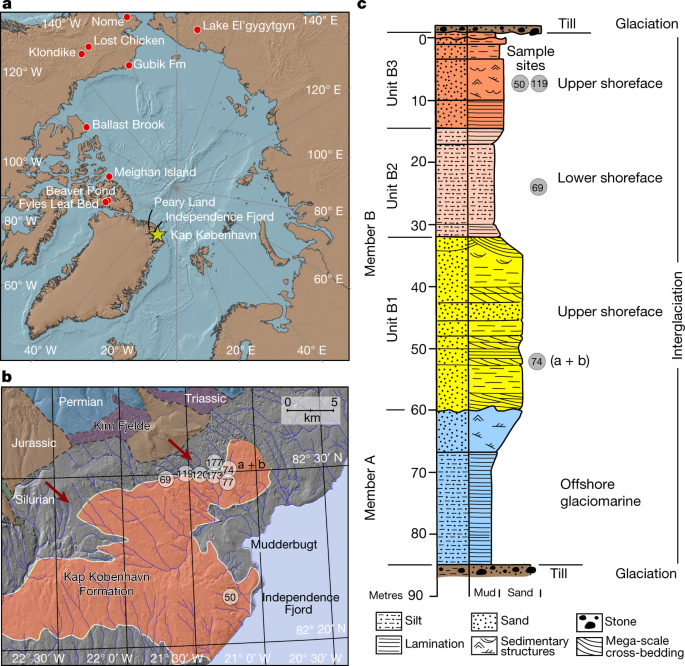
A 2-million-year-old ecosystem in Greenland uncovered by environmental DNA - Nature
Analysis of two-million-year-old ancient environmental DNA from the Kap København Formation in North Greenland shows there was an open boreal forest with diverse plant and animal species, of which several taxa have not previously been detected at the site, representing an ecosystem that has no...
 www.nature.com
Center Greenland went from forest to ice age 450-800k years ago.
Ancient Greenland Was Actually Green
Greenland was once carpeted in lush forests, a new study shows.
 www.livescience.com
and when the Vikings first settled in Greenland, the whole southern tip was green, why they called it GREEN land until they were frozen off in the 1400s.

What is an ICE AGE?
Most apparently still believe it is a terrifying horror movie event where Earth all at once freezes up. The data has never supported such a scenario. Since 2010, there has been a massive effort to re-write Earth climate history into a series of rapid "glaciations" and ice retreats, as if "Day After Tomorrow" movie is accurate... LOL!!! What was North American Ice Age before 2010 is now spun into a series of rapid "ice ages" where it took a mere 75k years for the "ice age" to start in Northern Canada and put 2.5 mile thick glaicers on Chicago. This is "Milankovich"...
Most apparently still believe it is a terrifying horror movie event where Earth all at once freezes up. The data has never supported such a scenario. Since 2010, there has been a massive effort to re-write Earth climate history into a series of rapid "glaciations" and ice retreats, as if "Day After Tomorrow" movie is accurate... LOL!!! What was North American Ice Age before 2010 is now spun into a series of rapid "ice ages" where it took a mere 75k years for the "ice age" to start in Northern Canada and put 2.5 mile thick glaicers on Chicago. This is "Milankovich"...
- EMH
- Replies: 448
- Forum: Environment


Anomalism
Diamond Member
- Dec 1, 2020
- 11,853
- 8,964
- 2,138
What you’re pointing to, Earth cooling for millions of years despite high CO2, is a matter of timescale and competing forcings, not a failure of CO2 sensitivity. Over geological timescales, slow moving factors like continental drift, ocean gateways, mountain building, and orbital cycles dominate climate. CO2 responds as a feedback in many of those periods.The only thing I am calling flawed are the ridiculous feedbacks. I'm perfectly fine with the direct radiative forcing of CO2. You are assuming the climate is sensitive to CO2. Data from the geologic record shows that it is not. If it were as you claim, the planet would have never cooled for millions of years with elevated levels of CO2.
Today, we’re in a situation where those slow geophysical forces are essentially static, but CO2 is increasing extremely rapidly due to human emissions. That rapid forcing is what makes the system sensitive on human timescales. Ice cores, the Eemian, and other paleoclimate data show that when CO2 rises quickly, temperatures respond several times more than the raw 1°C per doubling estimate, exactly what feedback physics and empirical measurements indicate. The geologic record doesn’t contradict CO2 sensitivity; it shows how context and rate of change matter.
Either the climate is sensitive to CO2 or it isn't. But if you disagree, feel free to use this annotated oxygen isotope curve to explain what you believe happened.What you’re pointing to, Earth cooling for millions of years despite high CO2, is a matter of timescale and competing forcings, not a failure of CO2 sensitivity. Over geological timescales, slow moving factors like continental drift, ocean gateways, mountain building, and orbital cycles dominate climate. CO2 responds as a feedback in many of those periods.
Today, we’re in a situation where those slow geophysical forces are essentially static, but CO2 is increasing extremely rapidly due to human emissions. That rapid forcing is what makes the system sensitive on human timescales. Ice cores, the Eemian, and other paleoclimate data show that when CO2 rises quickly, temperatures respond several times more than the raw 1°C per doubling estimate, exactly what feedback physics and empirical measurements indicate. The geologic record doesn’t contradict CO2 sensitivity; it shows how context and rate of change matter.
Prior to the industrial revolution CO2 lagged temperature. In other words, CO2 was a function of temperature. Temperature was not a function of CO2. That ought to tell you something. Or would you like to explain why CO2 and temperature correlated before the industrial revolution and explain that mechanism.
Anomalism
Diamond Member
- Dec 1, 2020
- 11,853
- 8,964
- 2,138
What you’re describing, the historical forested periods in Greenland and the Viking era settlement, doesn’t contradict modern ice sheet shrinkage. Ice sheets are mass balance systems, meaning they grow if snow accumulation exceeds ice loss, and shrink if melting plus iceberg calving exceeds accumulation. Southern Greenland may have had seasonal ice free periods or local forests in the past, but that’s a regional and temporal snapshot, not the total ice sheet mass.Yes there is iceberg calving, and south of Arctic Circle Greenland ice melts in the Summer. You have no evidence of ice shrinkage on either Greenland or AA.
Greenland's ice age is very easily documented. It started up northernmost 1-2 million years ago.
A 2-million-year-old ecosystem in Greenland uncovered by environmental DNA - Nature
Analysis of two-million-year-old ancient environmental DNA from the Kap København Formation in North Greenland shows there was an open boreal forest with diverse plant and animal species, of which several taxa have not previously been detected at the site, representing an ecosystem that has no...
Center Greenland went from forest to ice age 450-800k years ago.
Ancient Greenland Was Actually Green
Greenland was once carpeted in lush forests, a new study shows.
and when the Vikings first settled in Greenland, the whole southern tip was green, why they called it GREEN land until they were frozen off in the 1400s.
What is an ICE AGE?
Most apparently still believe it is a terrifying horror movie event where Earth all at once freezes up. The data has never supported such a scenario. Since 2010, there has been a massive effort to re-write Earth climate history into a series of rapid "glaciations" and ice retreats, as if "Day After Tomorrow" movie is accurate... LOL!!! What was North American Ice Age before 2010 is now spun into a series of rapid "ice ages" where it took a mere 75k years for the "ice age" to start in Northern Canada and put 2.5 mile thick glaicers on Chicago. This is "Milankovich"...
- EMH
- Replies: 448
- Forum: Environment
Today, satellite and field measurements show that Greenland is losing ice overall: the net mass balance is negative. This includes increased melting, calving into the ocean, and thinning at lower elevations. Individual historical warm periods don’t negate the fact that over the last few decades, Greenland’s ice sheet is shrinking, contributing to global sea level rise. So yes, Greenland’s climate has varied, and it was greener in some periods, but current trends are measured and global in scope, not anecdotal snapshots from Vikings or 2 million year old forests. The distinction is between local/regional conditions and the net ice sheet mass.
EMH
Diamond Member
- Apr 5, 2021
- 32,870
- 19,261
- 2,788
doesn’t contradict modern ice sheet shrinkage
It actually does. During the past 10k, 20k, 1 million years
GREENLAND FROZE while NORTH AMERICA THAWED
and you can't refute one word of that.
Anomalism
Diamond Member
- Dec 1, 2020
- 11,853
- 8,964
- 2,138
Yes, Greenland’s climate has varied over thousands of years and parts of Greenland were ice free during past warm periods. For example, studies show that a part of Greenland’s ice sheet completely melted about 6,000–8,200 years ago during the early Holocene warm period, leaving former bedrock exposed before ice re‑formed later.It actually does. During the past 10k, 20k, 1 million years
GREENLAND FROZE while NORTH AMERICA THAWED
and you can't refute one word of that.
That historical variability doesn’t contradict what we see today. Modern observations, based on satellite gravimetry (GRACE/GRACE‑FO), altimetry, and surface studies, all show that the Greenland ice sheet is currently losing mass overall, not just at the edges, but in net global balance. Greenland has lost hundreds of billions of tons of ice per year on average over recent decades.
So yes, Greenland froze and thawed at different times in the geological past, but today it is shrinking in net mass, sustained over decades and directly measured, not inferred from local anecdotes or isolated warm episodes.
Past warm periods show that climate can vary naturally; modern measurements show that right now, Greenland is losing more ice than it’s gaining.
Those two statements can both be true without contradiction.
They were always slow moving. Even when the planet was transitioning from a greenhouse state to an icehouse state which occurred while CO2 levels were elevated compared to today. The other difference is that the planet is much much colder now but according to climate scientists an incremental 120 ppm of atmospheric CO2 has pushed us beyond the point of no return and we are doomed for climate catastrophe. Right?Today, we’re in a situation where those slow geophysical forces are essentially static

toobfreak
Tungsten/Glass Member
- Apr 29, 2017
- 102,097
- 109,215
- 3,615
Wait, ice melts? Holy shit! My whole world is upside down now!
Apparently not so well in Greenland.
Not only is 90% of the country buried in mile deep solid ice, but even the few, narrow, livable strips of dry land along the coast are not much free of snow and ice except for a few weeks in their summer.
Anomalism
Diamond Member
- Dec 1, 2020
- 11,853
- 8,964
- 2,138
You’re conflating two different regimes of climate behavior. Pre industrial CO2 lagging temperature is entirely consistent with CO2’s role as both a feedback and a forcing, depending on context. During glacial-interglacial cycles, orbital changes initiated warming; as ice sheets partially melted, CO2 was released from oceans and permafrost, amplifying the warming. That’s why CO2 lagged initially. It was a feedback, not a trigger. The correlation appears because temperature drove CO2 at first, but the feedback amplified the signal, making subsequent warming stronger than the orbital forcing alone could explain. Ice core records consistently show this pattern.They were always slow moving. Even when the planet was transitioning from a greenhouse state to an icehouse state which occurred while CO2 levels were elevated compared to today. The other difference is that the planet is much much colder now but according to climate scientists an incremental 120 ppm of atmospheric CO2 has pushed us beyond the point of no return and we are doomed for climate catastrophe. Right?
Today’s situation is fundamentally different. We are injecting CO2 directly into the atmosphere at rates orders of magnitude faster than anything seen in the paleoclimate record. The initial trigger is anthropogenic, not orbital. The system still responds with feedbacks, but because the forcing is fast and global, CO2 now acts as the primary driver. That’s why incremental CO2 today matters: it’s no longer a slow feedback; it’s a rapid, externally imposed forcing that overwhelms the slow, background natural variability.
Past lag of CO2 = feedback. Present rapid rise = forcing. Both are consistent with physics, but context and rate determine which role dominates. The oxygen isotope curve shows feedbacks and natural variability, not a refutation of CO2 sensitivity today.
EMH
Diamond Member
- Apr 5, 2021
- 32,870
- 19,261
- 2,788
parts of Greenland were ice free during past warm periods.
bullshit.
zero evidence of that. the ice cores completely disprove all of that. If the ice grew a new layer of ice, it was not "ice free." Duh...
The evidence is that the current Greenland ice age started 1-2 million years ago up north, as that land got within 600 miles of North Pole. The DNA found is 2 million years old. The question is whether layers existed on top of that which got "scraped off." But no doubt that 2 million years ago Greenland was completely green save mountain tops, and there is ZERO evidence of any ice on Greenland prior to that, because Greenland has been moving NW, closer to North Pole, due to the angle of the fault at the center bottom of the Atlantic.
And that's why Greenland froze while North America thawed... NA moving SW... duh...
EMH
Diamond Member
- Apr 5, 2021
- 32,870
- 19,261
- 2,788
Greenland froze and thawed at different times in the geological past
A COMPLETE AND TOTAL CO2 FRAUD LIE. THERE IS NO EVIDENCE TO SUPPORT IT. ALL "unfudged" EVIDENCE REFUTES IT.
Do you believe that 120 ppm of incremental CO2 has pushed us beyond the point of no return? Is this catastrophic?You’re conflating two different regimes of climate behavior. Pre industrial CO2 lagging temperature is entirely consistent with CO2’s role as both a feedback and a forcing, depending on context. During glacial-interglacial cycles, orbital changes initiated warming; as ice sheets partially melted, CO2 was released from oceans and permafrost, amplifying the warming. That’s why CO2 lagged initially. It was a feedback, not a trigger. The correlation appears because temperature drove CO2 at first, but the feedback amplified the signal, making subsequent warming stronger than the orbital forcing alone could explain. Ice core records consistently show this pattern.
Today’s situation is fundamentally different. We are injecting CO2 directly into the atmosphere at rates orders of magnitude faster than anything seen in the paleoclimate record. The initial trigger is anthropogenic, not orbital. The system still responds with feedbacks, but because the forcing is fast and global, CO2 now acts as the primary driver. That’s why incremental CO2 today matters: it’s no longer a slow feedback; it’s a rapid, externally imposed forcing that overwhelms the slow, background natural variability.
Past lag of CO2 = feedback. Present rapid rise = forcing. Both are consistent with physics, but context and rate determine which role dominates. The oxygen isotope curve shows feedbacks and natural variability, not a refutation of CO2 sensitivity today.
But no, I'm not conflating anything. I'm using the climate evidence from the geologic record. Maybe if the climate scientists had history matched from before the little ice age to the beginning of the industrial revolution we wouldn't be having this debate. But they didn't do that. Why not?
Anomalism
Diamond Member
- Dec 1, 2020
- 11,853
- 8,964
- 2,138
You’re conflating new ice layers forming with the overall state of the ice sheet over time. Geological and paleoclimate evidence shows that parts of Greenland were ice free or had significantly reduced ice during past warm periods, especially in the Eemian (~115–130 kya) and earlier interglacials. Environmental DNA, sediment cores, and ice sheet modeling all indicate that ice coverage was partial and dynamic, not static for millions of years. Ice cores record local accumulation, not necessarily total ice sheet extent across all of Greenland.A COMPLETE AND TOTAL CO2 FRAUD LIE. THERE IS NO EVIDENCE TO SUPPORT IT. ALL "unfudged" EVIDENCE REFUTES IT.
The fact that Greenland’s ice advanced or retreated at different times than North America doesn’t invalidate CO2 forcing. Regional differences arise from orbital configurations, ocean currents, and topography, but CO2 acts globally. Rapid modern CO2 increases are unlike anything seen in those past periods: they inject radiative forcing faster than the slow regional processes that controlled glacial cycles, so the system responds differently today. Saying “all CO2 climate science is a fraud” ignores both the physical chemistry of greenhouse gases and the wealth of independent paleoclimate data confirming CO2’s influence on temperature.
Anomalism
Diamond Member
- Dec 1, 2020
- 11,853
- 8,964
- 2,138
No, 120 ppm of CO2 alone doesn’t automatically push the climate past a point of no return. What matters is the rate of change, the existing baseline, and the cumulative forcing from all greenhouse gases combined. The modern system is sensitive because the CO2 increase is rapid and global, unlike the slower natural rises of the past. “Catastrophic” is subjective; what physics shows is that continued rapid CO2 increases will produce far faster warming than ecosystems and human systems can adapt to, which carries risk, not inevitability. This is where I seriously diverge from most left wingers on this issue. I have no doomday narrative.Do you believe that 120 ppm of incremental CO2 has pushed us beyond the point of no return? Is this catastrophic?
But no, I'm not conflating anything. I'm using the climate evidence from the geologic record. Maybe if the climate scientists had history matched from before the little ice age to the beginning of the industrial revolution we wouldn't be having this debate. But they didn't do that. Why not?
Regarding the geologic record: it is incorporated into climate science. Paleoclimate reconstructions cover hundreds of thousands of years, and climate models are tested against them. The history matching you mention isn’t ignored; it’s used to constrain climate sensitivity and feedbacks. The difference today is that humans are injecting CO2 externally, at rates far beyond natural variability, which is why modern warming can’t be explained by post-little ice age trends alone.
And on that note, goodnight! I'll revisit this later.

EMH
Diamond Member
- Apr 5, 2021
- 32,870
- 19,261
- 2,788
Geological and paleoclimate evidence shows that parts of Greenland were ice free
That you claim that is not evidence. It is a CO2 FRAUD liar spouting bullshit.
Ice cores record local accumulation, not necessarily total ice sheet extent across all of Greenland.
Correct, but the evidence of Greenland's non stop ice age glacier advance over the past 1 million years includes carbon dating of DNA and pinecones etc. What that documents is that the ice age started up north and moved south, at about a mile every thousand years, the true "speed" of ice age glacier. You've been shown that evidence and you completely deny it without a shred of evidence refuting it, because you aren't interested in truth, you are interested in pushing CO2 FRAUD.
The fact that Greenland’s ice advanced or retreated
THERE IS NO EVIDENCE IT HAS RETREATED IN THE PAST MILLION YEARS, NONE, NO MATTER HOW MANY TIMES YOU REFUSE TO ACCEPT THE ACTUAL DATA PROVING THAT.
Anomalism
Diamond Member
- Dec 1, 2020
- 11,853
- 8,964
- 2,138
You’re making a basic category error by treating “ice has existed somewhere on Greenland” as equivalent to “the Greenland ice sheet has never retreated.” Ice cores only tell you that snow kept accumulating at the specific drill site; they do not measure total ice sheet extent. You can have continuous ice in central Greenland while the margins retreat hundreds of kilometers, and that is exactly what the geological evidence shows. We have direct physical evidence, not models, not CO2 theory: marine sediments beneath present ice margins, cosmogenic isotope dating of exposed bedrock, and soils and plant material found under today’s ice.That you claim that is not evidence. It is a CO2 FRAUD liar spouting bullshit.
Correct, but the evidence of Greenland's non stop ice age glacier advance over the past 1 million years includes carbon dating of DNA and pinecones etc. What that documents is that the ice age started up north and moved south, at about a mile every thousand years, the true "speed" of ice age glacier. You've been shown that evidence and you completely deny it without a shred of evidence refuting it, because you aren't interested in truth, you are interested in pushing CO2 FRAUD.
THERE IS NO EVIDENCE IT HAS RETREATED IN THE PAST MILLION YEARS, NONE, NO MATTER HOW MANY TIMES YOU REFUSE TO ACCEPT THE ACTUAL DATA PROVING THAT.
These independently show that large parts of southern and western Greenland were ice-free during warm periods like the Eemian (~125k years ago) and parts of the early Holocene.
The 2 million year DNA finding proves Greenland was once green, not that it has been continuously ice covered since. In fact, it implies massive changes in ice extent over time.
Your argument only works if you redefine retreat to mean “every last molecule of ice on the entire island disappears” which is not how glaciology works and never has been. Ice sheets advance and retreat at their margins while cores persist in the interior; regional asynchrony is normal in glacial systems. So the claim “there is ZERO evidence of retreat” is simply false. The evidence exists in the field, in the rocks, in the sediments, and it has nothing to do with climate models or CO2 narratives.
Similar threads


- Replies
- 10
- Views
- 275


- Replies
- 54
- Views
- 1K


- Replies
- 59
- Views
- 874


- Replies
- 4
- Views
- 304
New Topics
-
 If space is curved, allegedly causing gravity, a question arises
- Started by Robert W
- Replies: 0
-

-
Victor Davis Hanson excellent lecture on naval power for nations
- Started by Robert W
- Replies: 2
-

-


