I'm not asking about the record. I'm asking about a hypothetical mechanism during the Mesozoic that could produce a CO2 and temperature surge analogous to the current surge.
Whether or not it is unprecedented is technically irrelevant but if you want to cast it up against the deniers claiming that the amount of CO2 we've added couldn't possibly affect anything or that a 1 degree change is trivial or that it simply isn't worth the money it will cost to mitigate, feel free. And, unless you can identify a plausible mechanism by which CO2 and temperatures COULD have surged as much as the current situation and then vanished again without a trace, I'm going to have to say that you have thrown no shade at all on my contentions. There are numerous scholarly articles stating that the rate of change now is many, many times higher than anything seen for many millennia. Such as:
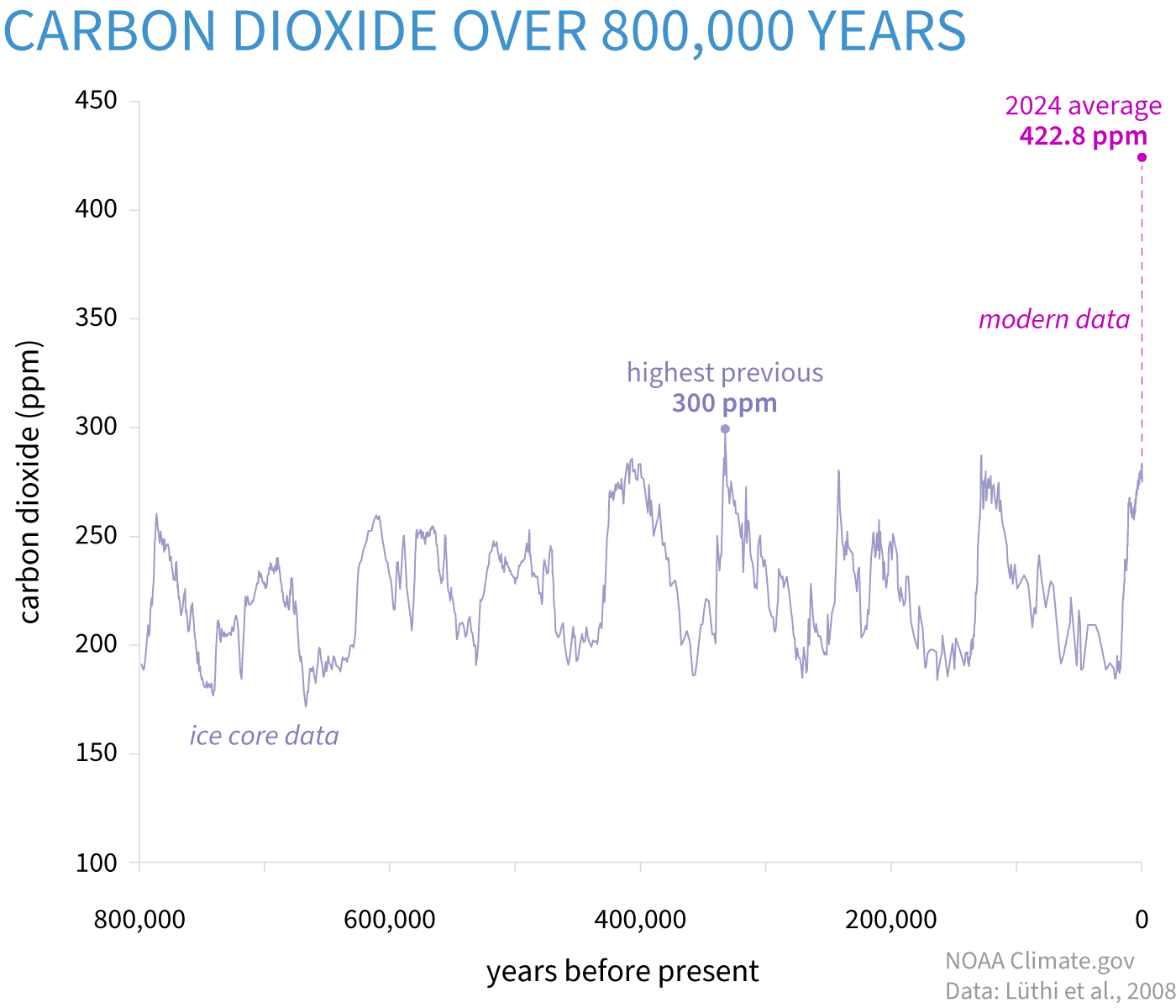
" The annual rate of increase in atmospheric carbon dioxide over the past 60 years is about 100 times faster than previous natural increases, such as those that occurred at the end of the last ice age 11,000-17,000 years ago."
In the past 60 years, carbon dioxide in the atmosphere has increased 100-200 times faster than it did during the end of the last ice age.

www.climate.gov
"While Earth’s climate
has changed throughout its history, the current warming is happening at a rate not seen in the past 10,000 years."
"Earth's climate has changed throughout history. Just in the last 800,000 years, there have been eight cycles of ice ages and warmer periods, with the end of the last ice age about 11,700 years ago marking the beginning of the modern climate era — and of human civilization. Most of
these climate changes are attributed to very small variations in Earth’s orbit * that change the amount of solar energy our planet receives."
Earth's climate has changed throughout history. Just in the last 800,000 years, there have been eight cycles of ice ages and warmer periods, with the end of

science.nasa.gov
* - and which establish the rate of forcing change
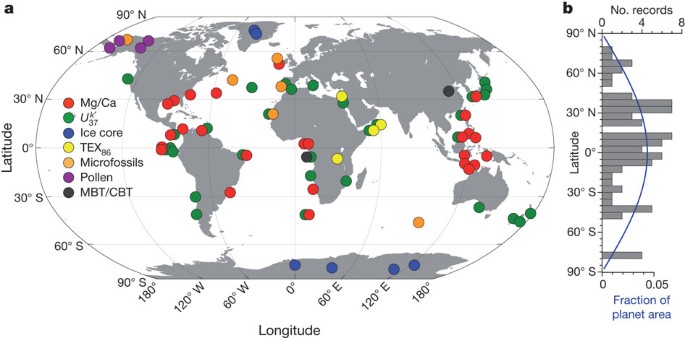
Ice cores drawn from Greenland, Antarctica, and tropical mountain glaciers show that Earth’s climate responds to changes in greenhouse gas levels. Ancient evidence can also be found in tree rings, ocean sediments, coral reefs, and layers of sedimentary rocks. This ancient, or paleoclimate, evidence reveals that current warming is occurring roughly 10 times faster than the average rate of warming after an ice age. Carbon dioxide from human activities is increasing about 250 times faster than it did from natural sources after the last Ice Age.
3
3. IPCC Sixth Assessment Report, WG1, Chapter 2
Vostok ice core data; NOAA Mauna Loa CO2 record
O. Gaffney, W. Steffen, "The Anthropocene Equation."
The Anthropocene Review 4, issue 1 (April 2017): 53-61.
https://doi.org/abs/10.1177/2053019616688022.
Earth's climate has changed throughout history. Just in the last 800,000 years, there have been eight cycles of ice ages and warmer periods, with the end of
science.nasa.gov