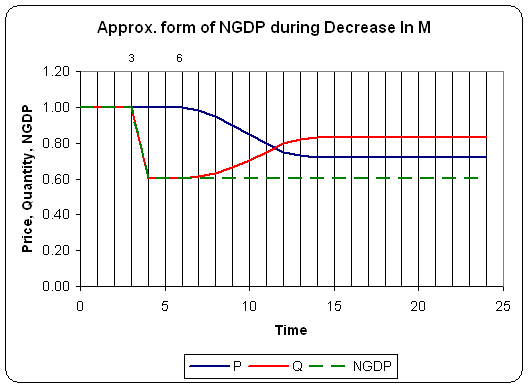
A fall in nominal spending - be it because of a contraction of the money supply or an increase in the demand for money - means that nominal wages and prices must fall. But stickiness of those variables causes output to fall instead in the short run, until nominal variables fall to restore equilibrium.
Nice summary
I was reminded of David Hume's On Money (1752);
"A nation, whose money decreases, is actually, at that time, weaker and more miserable than another nation, which possesses no more money, but is on the encreasing hand. This will be easily accounted for, if we consider, that the alterations in the quantity of money, either on one side or the other, are not immediately attended with proportionable alterations in the price of commodities. There is always an interval before matters be adjusted to their new situation; and this interval is as pernicious to industry, when gold and silver are diminishing... The workman has not the same employment from the manufacturer and merchant; though he pays the same price for every thing in the market. The farmer cannot dispose of his corn and cattle; though he must pay the same rent to his landlord. The poverty, and beggary, and sloth, which must ensue, are easily foreseen."
Mathematically, for
NGDP(ΔM<0) = NGDP(ΔM>0)
P(ΔM<0) > P(ΔM>0)
therefore
Q(ΔM<0) < Q(ΔM>0) .
It is nice and concise, that is the attraction. Though, admittedly, it seems like a little bit of an abuse of notation. There must be a better way but damned if I can think of it. It is also missing the "short run" vs "long run". Any mathematicians in the house? Is there an appropriate way to express price stickiness in mathematical notation?
With a little playing around, it became clearer that the short run vs long run response is as shown:
http://i776.photobucket.com/albums/yy42/thefitz3/NGDPwF1.gif
On the falling side, where money supply is contracting, NGDP is falling. Price lags behind quantity.
Time 0 : Money supply, price and quantity are stable.
Time 3 : Money supply falls to new level
Quantity falls with M=NGDP = P0*Q
Time 5 : Production is ahead of sales so stock
is increasing due to previous sales projection.
Time 7 : Price begins to fall to unload excess stock.
With price falling, quantity increases with constant M=NGDP
Time 8+: Price continues to fall and quantity rises
until stability is reached.
The curves were built by choosing the price at each time and letting Q fall from M=NGDP/P. This makes sense and P becomes nothing more then the decision of sales decision.
Where the quantity and price are shown in the diagram may be "flipped", that is with price settling higher and quantity lower. It is only an approximation at the long run equilibrium point as it is all a factor of the the bidding in the market.
At a macro level, it is the aggregate of all the production markets, so is no clear equilibrium point.
At a micro level, it is the processes that effect the supply and demand curve. The final level of price and quantity is a function of additional factors including production and demand parameters.
Tracing it upward through the supply chain it is demand shifting demand as it proceeds upward. Demand shift at the consumer level causes demand to shift all the way upstream. At each supply level, production falls and, surely layoffs occur (sloth, as Hume puts it).
That is as much as I can say definitively. Other things, like if the supply curve is forced to shift temporarily to make up for losses incurred do to the initial unloading of stock as below production costs is a bit tricky. There are options that can be taken including shorting supply and under producing which can help increase prices. And, of course, there is a natural tendency for efficiency to increase when NGDP falls. We saw that during the Dec 2007 recession. Taking RGDP/(employment) proves that. So the supply curve does shift a bit to the left.
That quantity overshoot and settling is much as a critically damped feedback system performs. The price acts as an over damped feedback system does. I suppose, if we want to go further, we can note that the NGDP and M are a Heaviside step function. Springs with shock absorbers are mechanical equivalents. Electrical control circuits do the same. The economy at both a micro and macro level is certainly a feedback system, though I don't see any utility in anything more then just recognizing the obvious similarities.
I can't get anything more out of it. Any reason to conclude it is otherwise?