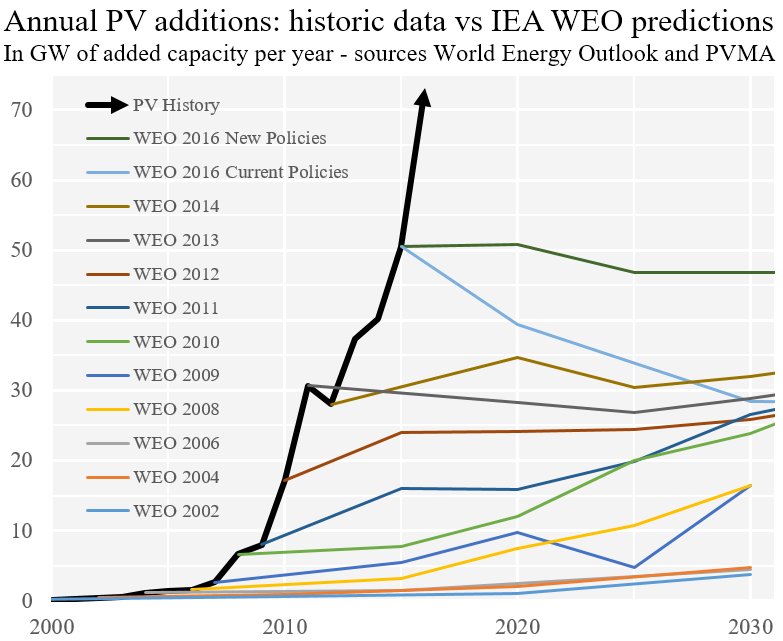
The rate of actual adoption of solar energy is vastly outstripping the IEA's predictions
lughnasadh
Quote
This is a
fascinating graphic
Source is
Auke Hoekstra, a Dutch renewables researcher.
I'm guessing many countries use the International Energy Agency data & it's woefully underestimating the reality of a huge speed up in the switch to renewables.
This must scare the petro-nations.
This blows the shit out of skookerballs little graph!
Unlimited free clean energy. The rest of the world has figured it out.
You think solar energy is free? First, it is far from free. The panels are very costly.
2017, most homeowners are paying between
$2.87 and $3.85 per watt to install solar, and the average gross cost of solar panels before tax credits is
$16,800. Using the U.S, average for system size at 5 kW (5000 watts), solar panel cost will range from
$10,045 to $13,475 (after tax credits).
If you spend 100/month on you electric bill, It will take over 12 years to recoup the investment if you get all your electric power from the array, which you won't, and hopefully the panels will still be fully functional after those years.
The raw materials required to build solar panels are expensive and finite.
Solar Panels
Zehner estimates that powering the world with solar panels would cost upwards of $64 trillion plus an additional $694 billion per year of maintenance expenses. The GDP of the United States is only worth about $14 trillion (Zehner 9). Even with improvements in technological advances and economies of scale, the California Energy Commission claims that cheaper photovoltaic cells will not offset non-technological costs such as insurance, warranties, materials, transportation, labor, and environmental externalities. Zehner concludes that the environmental and economic benefits of solar cells are “insignificant compared to the expense of realizing them” (Zehner 30). Despite high praise from scientists, environmentalists, and politicians alike, the future looks bleak for the solar industry.
Solar has the potential to provide a part of the world energy requirements, but it is not the panacea many believe it to be. I apologize for introducing you to reality.