does not make your declaration be true.
As for the Brady bill's impact on mass shooting events, well, at least looking at the charts below, it looks like that legislation had an impact. The options pertaining to whether it did or didn't are the same as those noted above re: homicides in general:
- Ascribe preponderantly to the Brady bill the dip in mass shooting events between 1994-2004, or
- Ascribe the dip in mass shooting events between 1994-2004 to the Brady bill and other things, or
- Ascribe preponderantly to other causes the dip in mass shooting events between 1994-2004.
And, as with homicides in general:
- If one chooses the second option, one must also identify and soundly show what, along with the Brady bill, effected the dip.
- If one chooses the third option, one must soundly identify (1) how the Brady bill had no impact on the trend/dip, (2) what did cause the dip, and (3) show how in fact it did.
To folks who say the Brady bill had no impact on mass shootings:
- What that came into being around 1994 and ceased to exist sometime around 2004 that caused the increase in mass shootings? Show a sound basis for agreeing with whatever be the asserted cause.
- Why not re-implement, reinforce or in some other way boost the effectiveness of whatever that "thing(s)" or phenomenon(-a)?
I can identify something that definitely didn't cause the dip in mass shootings: an increase in gun ownership. Why can I say that? Because between 1994 and 2004, both
the rate of household gun-non-ownership and the quantity of household gun-non-ownership generally increased between 1994 and 2004. [1] It wasn't a generally huge increase, but that non-ownership rates increased at all means that "more guns" couldn't have been a causal factor in the dip in mass shootings during the same period. So, while I can't say the Brady bill was solely or preponderantly causal in mass shooting incident decreases, I know that far more likely was it causal than was increased gun ownership, which is a phenomenon that didn't in the bill's tenure happen.
Indeed, even the most cursory glance at the trend of mass shootings, not to mention closer consideration, shows that with regard to the central objective of reducing mass shooting events/deaths, during the Brady bill's effectivity period (1994-2004), the annual mass shooting rate decreased by ~22%. Moreover, in the decade following the Brady bill's effectivity period, the annual mass shooting rate increased by ~261%.
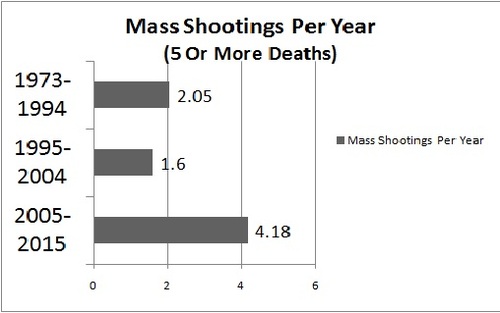

Furthermore, not only did the annual mass shooting
rate drop during the tenure of the Brady bill, after the Brady bill, the quantity of mass shooting deaths soared.
If,
as the Washington Post did, one considers the period from 1900 to 2004 (104 years), there were 118 mass shootings. That's an average of 1.13 mass shooting incidents per year. In the eight years following the Brady bill's expiration, there were 28 mass shooting events. That equals an average of 3.5 a year -- an increase of over 200 percent. That is a startling jump, by any measure. Even considering a shorter time window -- 1982 to 1994 (12 years) -- one observes that there were 19 shootings, an average of 1.5 shootings a year.
The preceding informs us that something happened in the early-1980s [2] that catalyzed a material uptick in the incidence of mass shootings, and that something. One can infer as much from the first chart in this post wherefrom it's clear that 1982 marked the end of