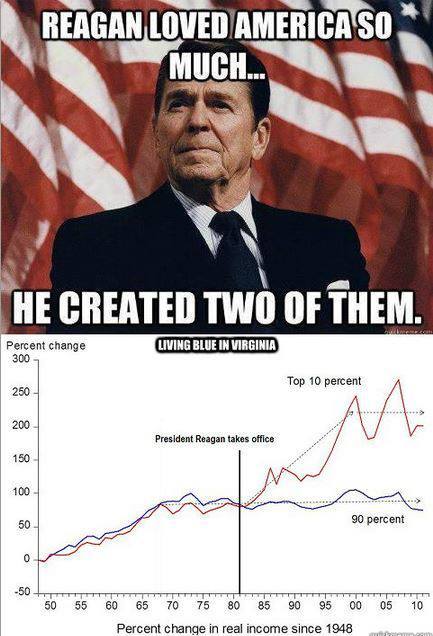
At what point will you admit unregulated free market trickle down capitalism doesn't work?
At what point will you admit that flush toilets don't work?
You pose insanely stupid questions that are dishonest in construct.
I'm just saying when the gap keeps getting bigger and bigger at what point would you say your way isn't working. I'll tell you when. If you are a libertarian, never. The answer from them is always "we didn't deregulate enough" Why didn't GW Bush do well? He didn't go far enough. That's what RWNJ's are convinced.
The Real Reason for the Growing Gap Between Rich and Poor
so still no solution to offer eh? My you sure ***** a lot about something you have no idea about.
1. Break down the social barriers
One of the reasons income inequality persists is that people don't realize how wide the gap between rich and poor has become. A solution: We should get out of our collective comfort zone and create conversations across the income divide.
2. Improve public schools; unify them
There's no surer ticket out of poverty than a solid education. But that education has to be affordable (
modern college isn't) and it has to be equally distributed. It would be impossible to argue that's true of America's public schools, which are supported by property taxes. Big houses equal better schools. And poorer kids, of course, lose out. That's a tragedy, and leads,
according to a recent Stanford study, to poorer students who are years behind their richer peers.
In Lake Providence, richer kids go to a private school, which has no formal scholarship program. Poorer students go to a public school that does not perform as well. Education should be a great equalizer, not a source of division. The community would benefit from closing its private school, Briarfield Academy, and creating a shared asset in the public school system. Right now, as some locals explained it to me, the business community and richer families have almost no reason to fully invest in the public schools.
3. Raise the minimum wage to 1960s levels, at least
The fast-food workers are right: It's impossible to live on today's minimum wage, which is substantially lower,
when adjusted for inflation, than it was in the late 1960s. I'm not sure what the magic number should be, but I know I met several people in Lake Providence who live at or slightly above the federal minimum of $7.25 per hour and who can't pay their bills. It's not even close. One woman, Delores Gilmore, 44, works overnight as a prison guard making $8.50 per hour. She has to choose which bills to pay. At previous jobs, she was not always able to afford underwear for her children because money was so tight.
The U.S. minimum wage is worth less now than it was in the 1960s.
It's convenient for employers to argue they can't pay higher wages. Their profits indicate otherwise. The American dream is to work hard and get ahead. That is not a reality today, even for people who are working full-time.
4. Tax the rich at a reasonable rate
Tax rates on the very rich are so low that
billionaire Warren Buffett says he pays a lower tax rate than his secretary. That has not always been the case.
The top marginal tax rate has dropped considerably since the late 1970s, according to the Tax Policy Center.
It's clear the rich are getting a big break on their taxes and should be paying more. The idea isn't to take so much money that taxation, in and of itself, closes the income gap. It's to use that tax money to fund programs, like public education, that could give everyone a fair shot at success in an economy that only serves the very wealthy.
5. Give workers a voice in their companies
Union membership is way down since more equal times. In the early 1960s, nearly 35% of workers were members of unions, according to
data compiled by the Economic Policy Institute. By 2008, that number had plunged to less than 15%. As union membership declined, workers' voices shrank to a whisper. Meanwhile, the economy, over that same period, pushed a greater and greater share of money to the richest Americans.
A narrow majority -- 51% -- of Americans view unions in a favorable light,
according to a Pew Research Center survey from June 2013. That number is up compared to previous surveys, and that's good news. But for those who continue to see unions as inefficient or annoying, there are other ways to give workers a voice, such as supporting employee-owned companies. Publix Super Markets, for example, employs more than 160,000 people and made
$27.5 billion in retail sales in 2012. It's also
owned by its employees, which means they are involved in decisions about how the company is managed.
6. Reign in crazy-huge donations to political campaigns
Rich people these days have the ability and access to essentially buy -- or heavily influence -- political campaigns. Take a look at the recent numbers:
Elections in the United States are more expensive now than before, giving greater sway to the rich.
Limits on campaign spending would help level the playing field, ensuring that the majority of the people -- not the minority of the rich -- elect our representatives.
7. Give money to the poor -- maybe at random
When I was in Lake Providence, a man who lives on the richer side of the lake told me you could drop millions on the poorer side of the lake, come back in a year, and absolutely nothing would have changed.
Poor would blow it on drugs and cars, he said.
Turns out, randomly giving poorer people cash as a form of charity may not be such a bad idea. A nonprofit called Give Directly, which recently was
featured on NPR's "This American Life", is experimenting with the concept and seeing promising results. So far, the group's experiment is limited to Kenya, and there's no precedent for giving money at random to poor people in the United States, one of its founders told me. But, on its website,
Give Directly presents a compelling case for help by lottery. "Cash transfers" have been shown, for instance, to reduce HIV infection rates in Malawi and reduce the incidence of low birth weight in Uruguay. The point to me is not exactly how a program like this should work but that when we trust people -- when we see them as equals -- they can succeed.
In 2013 America, and in Lake Providence, we've stopped seeing each other that way. We see rich and poor. We assume that these divisions are inevitable.
They don't have to be.