Link
They Became Symbols for Gazan Starvation. But All 12 Suffer from Other Health Problems.
A Free Press investigation found that the viral photos lacked important context: The subjects have cystic fibrosis, rickets, or other serious ailments.
A photographer points his camera at a child in Gaza on July 24, 2025. (Khames Alrefi / Anadolu via Getty Images)
By
Olivia Reingold and
Tanya Lukyanova
08.18.25 —
Israel and Antisemitism
For the past several weeks, critics have fumed at
The New York Times over a misleading photo of an 18-month-old boy in Gaza on its front page. It turns out that Muhammad Zakariya Ayyoub al-Matouq, who was a symbol for a story about
widespread hunger in Gaza, wasn’t simply suffering from malnutrition. He had preexisting health issues “affecting his brain and his muscle development,” according to an updated version of the story. But that detail didn’t find its way into print.
When the so-called paper of record updated its story with
an editors note four days later, it also quietly deleted the mother’s claim that her son was “born a healthy child.” There was still no mention of the boy’s brother, who appears healthy in the background of
another photo that appeared online.
This incident wasn’t just a one-off.
An investigation by
The Free Press reveals that at least a dozen other viral images of starvation in Gaza also lacked important context: The subjects of those photos have significant health problems. Those appeared all over social media, in the reports of leading international aid organizations, and on some of the most prestigious news outlets in the United States, including CNN, NPR, and the
Times—without disclosing the complicated medical histories that help explain their stark appearances.
It’s not that there isn’t hunger in Gaza.
There is. The World Health Organization
reported 63 deaths from malnutrition last month alone, including 25 children. Some of them might have been sick or worse even if there was no war. In 2022, about 50 Gazans under the age of 20 died from malnutrition, according to
the Palestinian Ministry of Health.
Yannay Spitzer, an economist at Hebrew University of Jerusalem who has been tracking food prices in Gaza during the past few months, said hunger in Gaza is largely declining since Israel
resumed aid deliveries in
late May after its nearly 80-day blockade. In mid-July, prices for basic necessities like flour skyrocketed by 4,000 percent, according to his review of data from the Gaza Chamber of Commerce and the World Food Programme.
“If a situation like that lasts more than a few days, a lot of people will go hungry but not starve to death en masse. That’s the beginning of a process, which the media portrayed as already at the catastrophic end stage,” Spitzer said, before pausing. “But it never happened.”
Still, he said, food prices are “15 times higher than peacetime,” but are nowhere near their high point earlier this summer. “It’s very different from these Ethiopian-like famine pictures that readers in the West were led to believe in.”
But those photos have helped convince a growing number of Americans that Israel has induced famine and is committing war crimes in Gaza.
In a poll this month from the progressive Data for Progress..
Images like these have turned the tide against the only Jewish nation in the world—and are pressuring policymakers to isolate Israel. Anti-Israel activists recently splattered
red paint on Rep. Alexandria Ocasio-Cortez’s campaign office over her decision to back an amendment supporting Israel. A
sign placed at the office said: “AOC funds genocide in Gaza.”
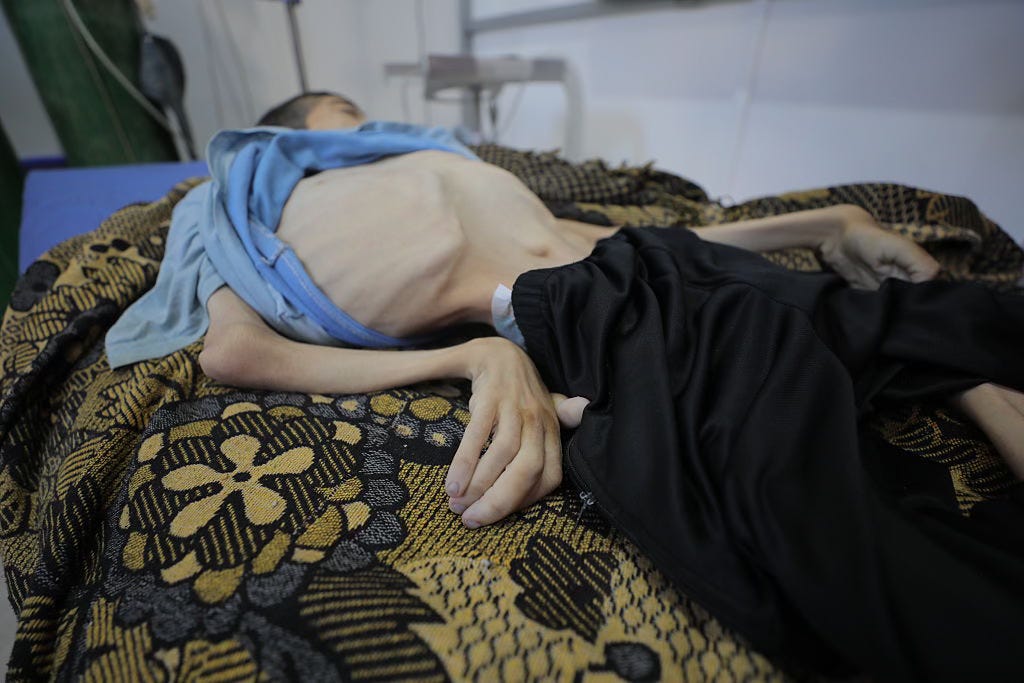
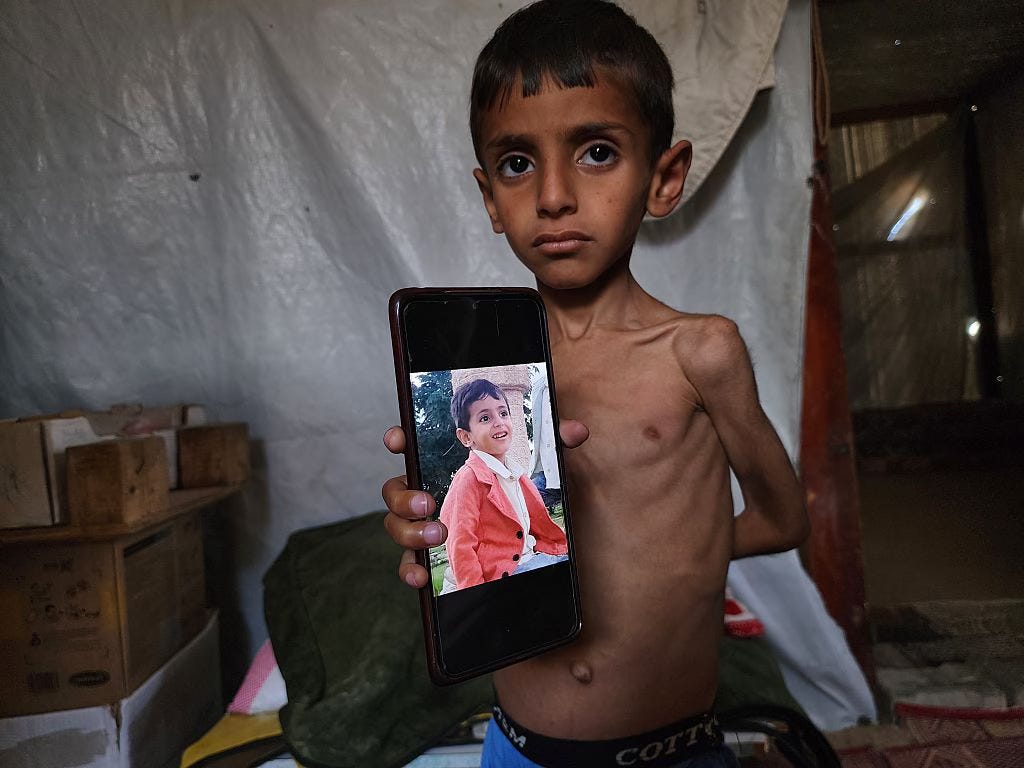
The children in all of the images reviewed by
The Free Press were either sick or facing death at the time their images circulated online, according to local reports in Arabic. Their situations were dire. But in every instance, they were already facing grave situations because of their health, irrespective of any third-party action.
Here are more details about the viral images:
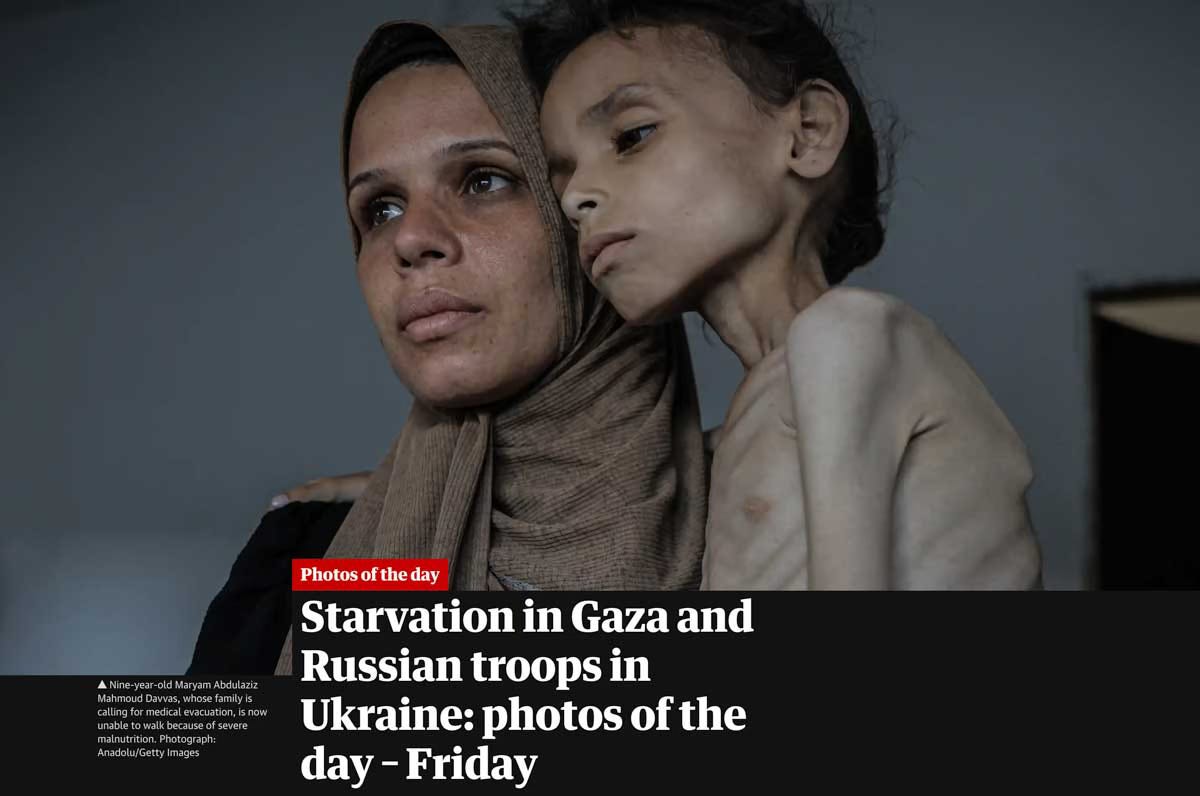
Maryam Dawas
In a
UNICEF ad soliciting donations, Maryam Dawas, a 9-year-old girl, sits on a hospital bed staring off into space. Her collarbone protrudes underneath her pink T-shirt. When she takes a deep breath, she darts her eyes around as if strained.
“Maryam has been suffering from malnutrition for a year and a half,” the girl’s mother tells the camera. “And I have been suffering along with her.”
Then this message flashes on screen in big, bold letters: “All children under five in the Gaza Strip are at risk of acute malnutrition.”
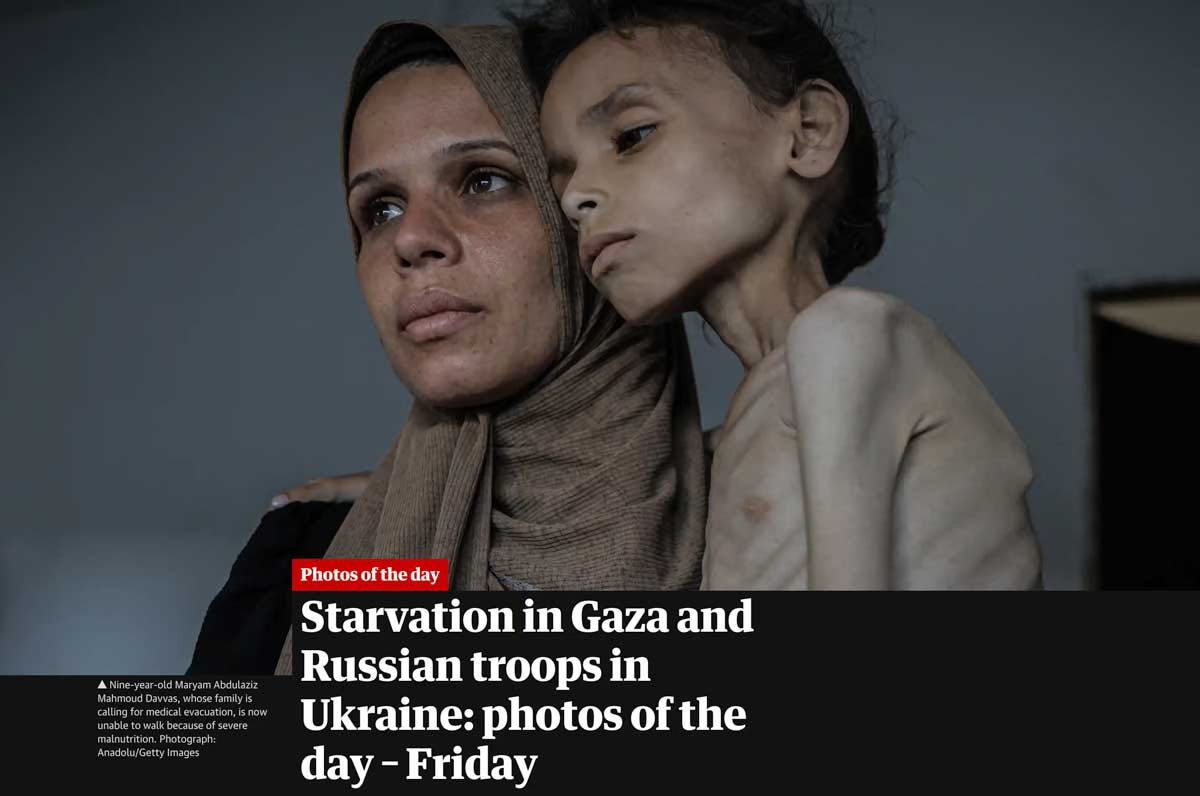
Maryam Dawas (via theguardian.com)
But Dawas is not typical of the average child in Gaza. In fact, her mother suspected that her daughter was suffering with a serious illness that local doctors were struggling to diagnose. She spoke about her battle to get answers about her daughter’s health
in a video uploaded to
@translating_falasteen, an Instagram account with more than half a million followers.
“I suspect that Maryam has another problem besides malnutrition,” she said in Arabic in the video, adding that she had taken her daughter to multiple doctors in search of a diagnosis. “I suspect that my daughter has a condition that no one understands here in Gaza.”
In an interview with
The Palestine Post, an Arabic outlet
focused on raising “awareness of the Palestinian cause,” the mother said that her daughter has been struggling with “chronic diarrhea.” She said that she had taken her daughter to a gastroenterologist during the war but that all the tests had come out “perfectly clean.”
The story of her malnutrition also appeared in the
Los Angeles Times,
The Telegraph, and
The Guardian. In an
Instagram post of Dawas that was liked nearly 100,000 times, the comments included “Israel!!! You’ll pay the price one day!!!” and “STOP TERRORIST ISRAEL.” The
LA Times article included authoritative and definitive language regarding her health, without attribution.
“Maryam Abdulaziz Mahmoud Davvas,” the article said, “has become unable to walk due to severe malnutrition in Gaza City, Gaza, on Thursday. Hospital tests revealed no underlying medical condition, and doctors confirmed that her condition is solely the result of hunger and malnutrition.”
The
LA Times did not respond to a request for comment.
Youssef Matar
On July 29, subscribers of
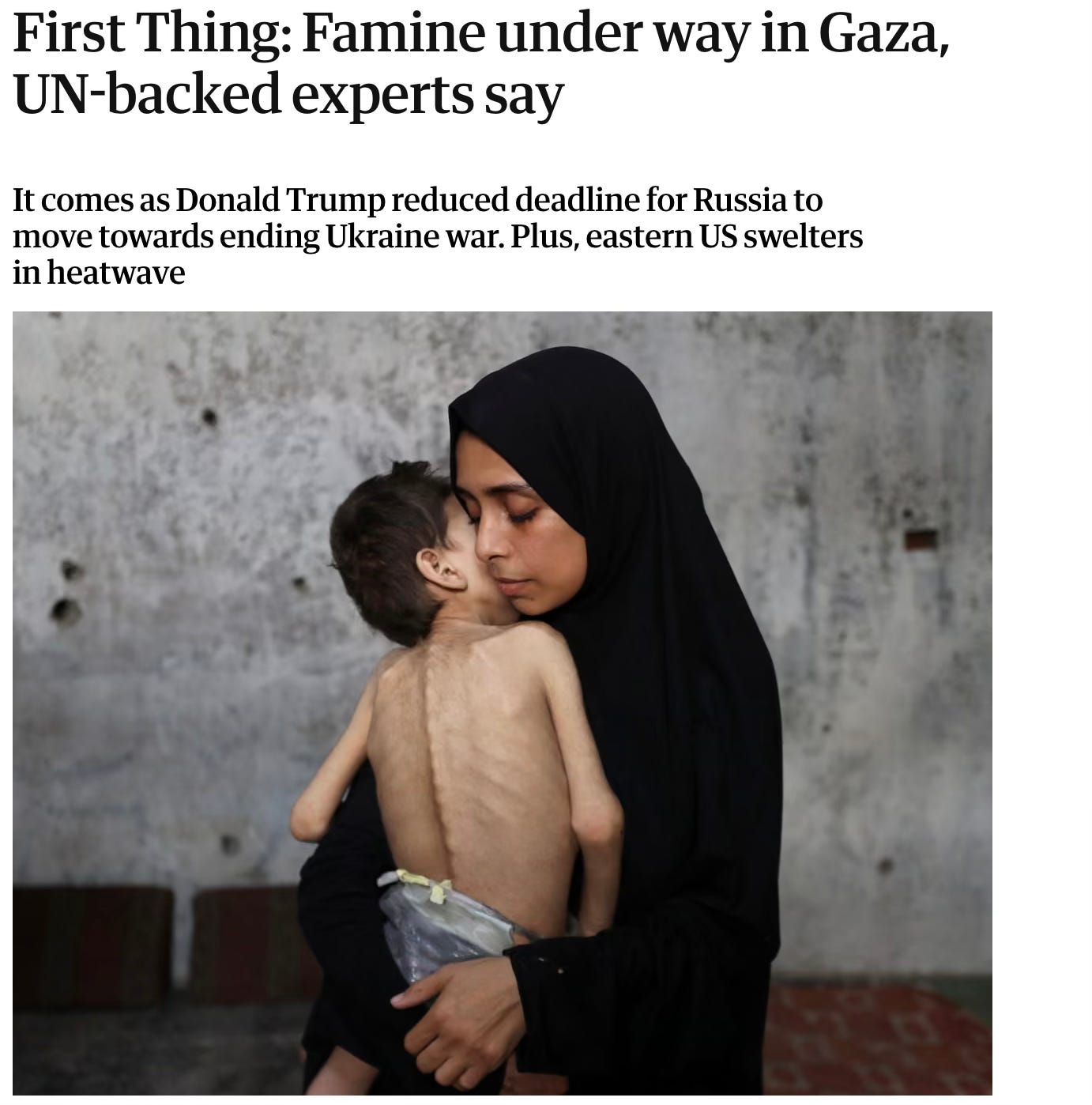
The Guardian’s morning newsletter woke up to an image of the bony spine of toddler Youssef Matar as he was cradled by his mother. “Famine Under Way in Gaza, UN-Backed Experts Say,”
the headline said.
The caption said: “Displaced Palestinian mother Samah Matar holds her malnourished son Youssef, in Gaza City.”
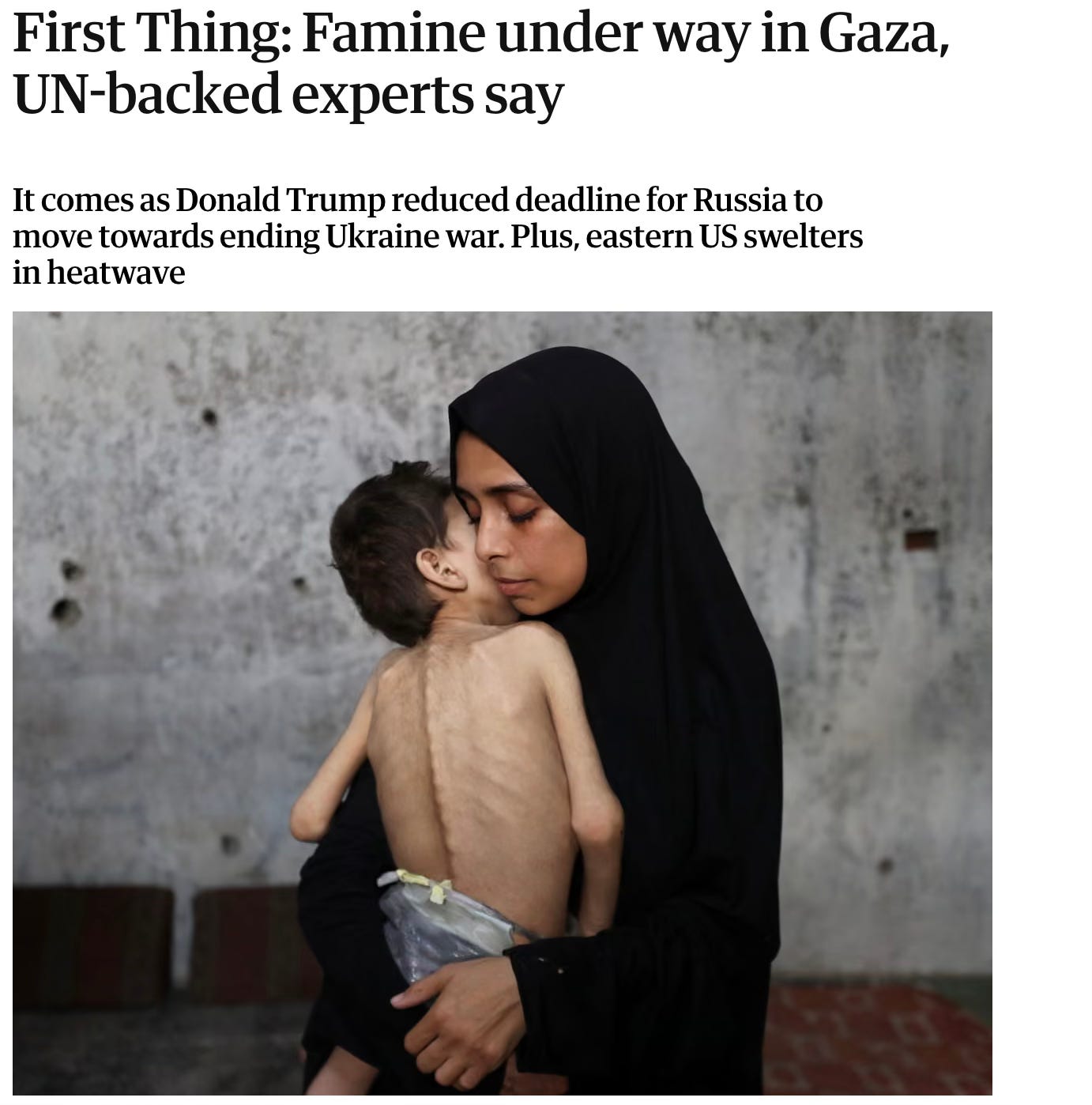
Youssef Matar. (Image grab via
www.theguardian.com)
A few days before, Reuters published the same image
on its own website, and the caption’s text included several crucial words that weren’t part of
The Guardian’s caption. We marked those words in italics: “Displaced Palestinian mother Samah Matar holds her malnourished son Youssef,
who suffers from cerebral palsy, at a school where they shelter amid a hunger crisis, in Gaza City.”
When asked for comment, a
Guardian spokesperson said that
The Free Press could file a complaint “directly to the readers’ editor,” providing a general email address. “The vast body of our reporting on the conflict—which is led by journalists working on the ground across the Middle East with deep expertise in the region—speaks for itself,” the
Guardian spokesperson said.
Hamza Mishmish
To accompany the July 29
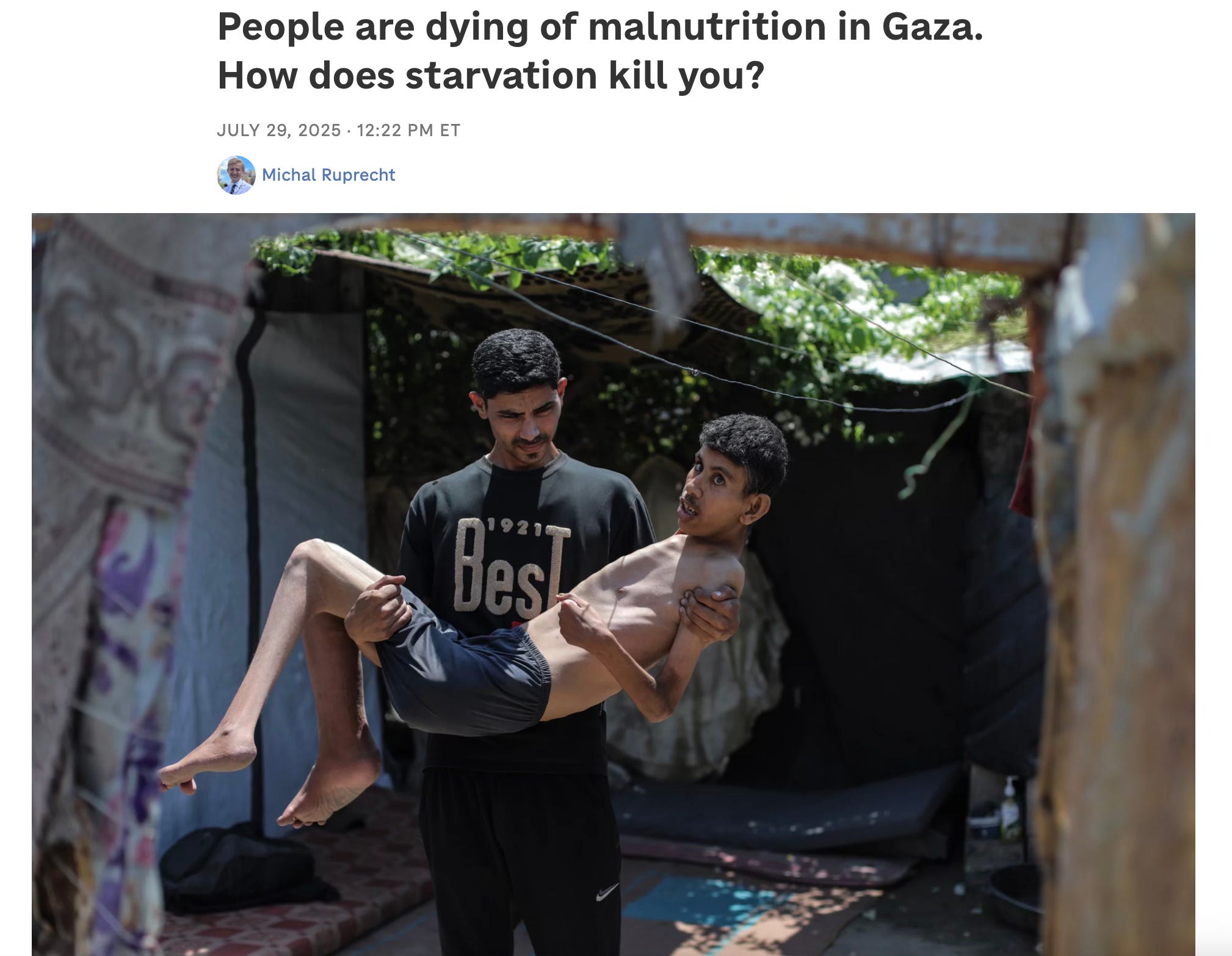
NPR article headlined “People Are Dying of Malnutrition in Gaza. How Does Starvation Kill You?” the news outlet selected a photo of an emaciated man carried like a child in the arms of another Gazan.
The caption identifies him as 25-year-old Hamza Mishmish and says that he shows “signs of severe malnutrition and bone loss in the Nuseirat refugee camp amid worsening hunger in the region.”
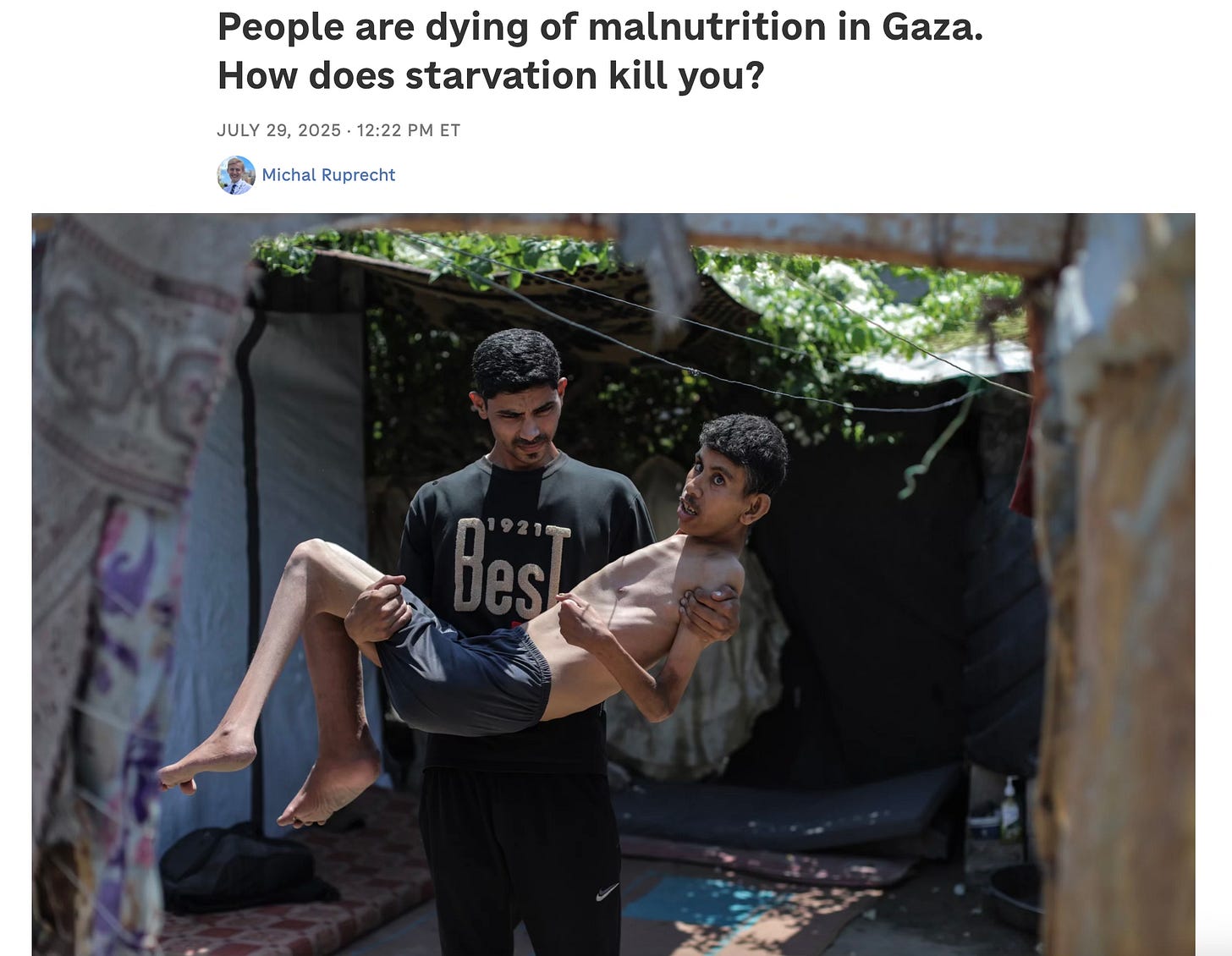
Hamza Mishmish (via
www.npr.org)
The implication is unmistakable: Mishmish is being carried because he cannot walk, and he cannot walk because he is being starved.
Though his condition may have been made worse by food scarcity in Gaza, a woman who claims to have helped care for Mishmish said that he has long struggled with his health.
“He has, of course, had a disability since birth—he has cerebral palsy and suffers from many countless illnesses,” the woman said in
a July 30 video published by the state-run news agency of the Palestinian National Authority. “Everything with him is worsened because he has no immunity at all. His immune system is extremely, extremely weak.”
NPR did not respond to a request for comment.
Najwa Hussein Hajjaj
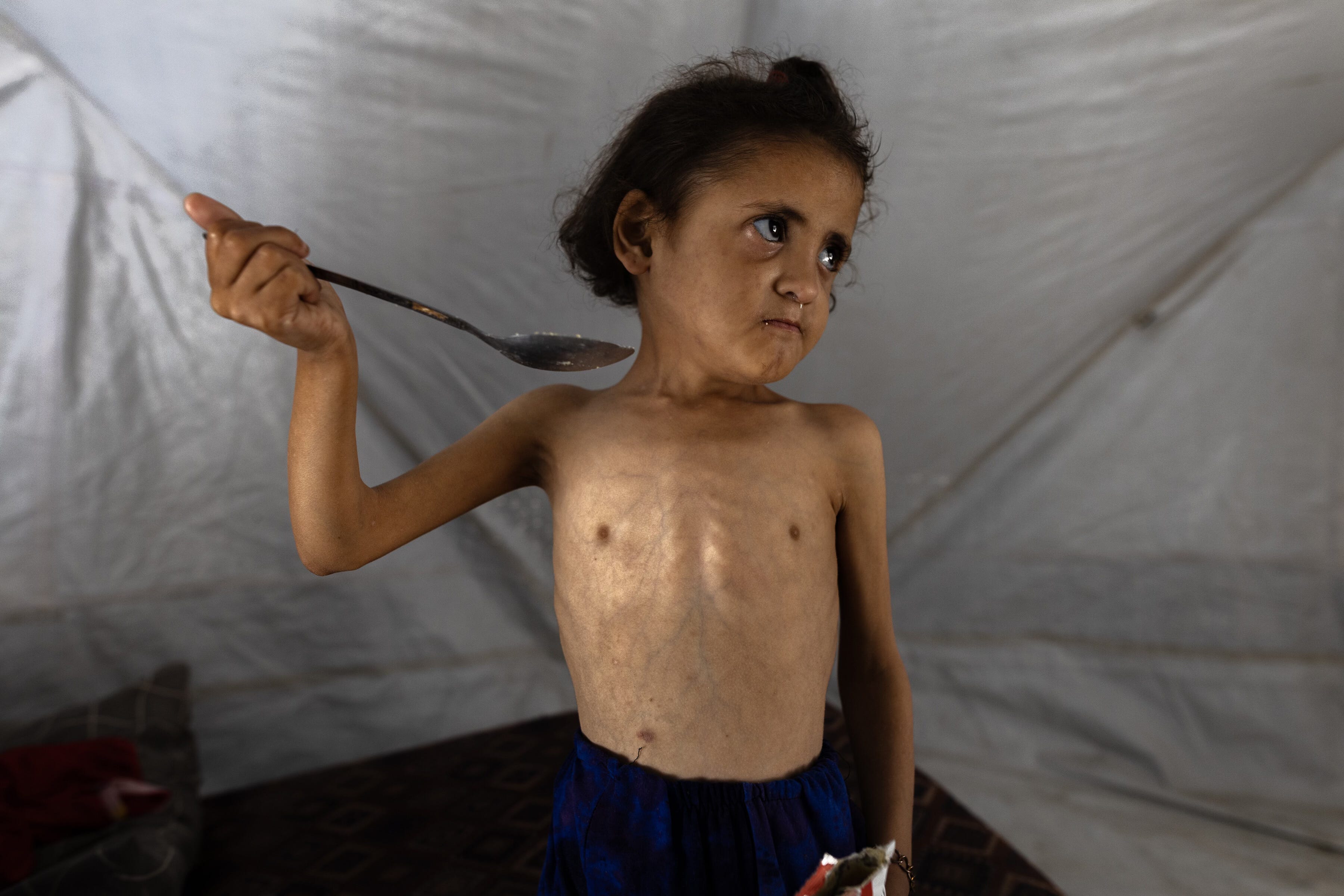
According to CNN, Hajjaj was a 6-year-old girl “suffering from severe malnutrition in Gaza City.” Her image appeared in a multimedia article titled “
Starvation in Gaza,” with an editors note at the top: “This gallery contains disturbing images. Viewer discretion is advised.”
Sandwiched between images of Gazans begging with tin bowls and airdrops falling from the sky, Hajjaj appears against a white background holding a spoon nearly as wide as her frail frame. The original version of the article missed one crucial detail: She suffers from an “esophagus condition,” according to her father.
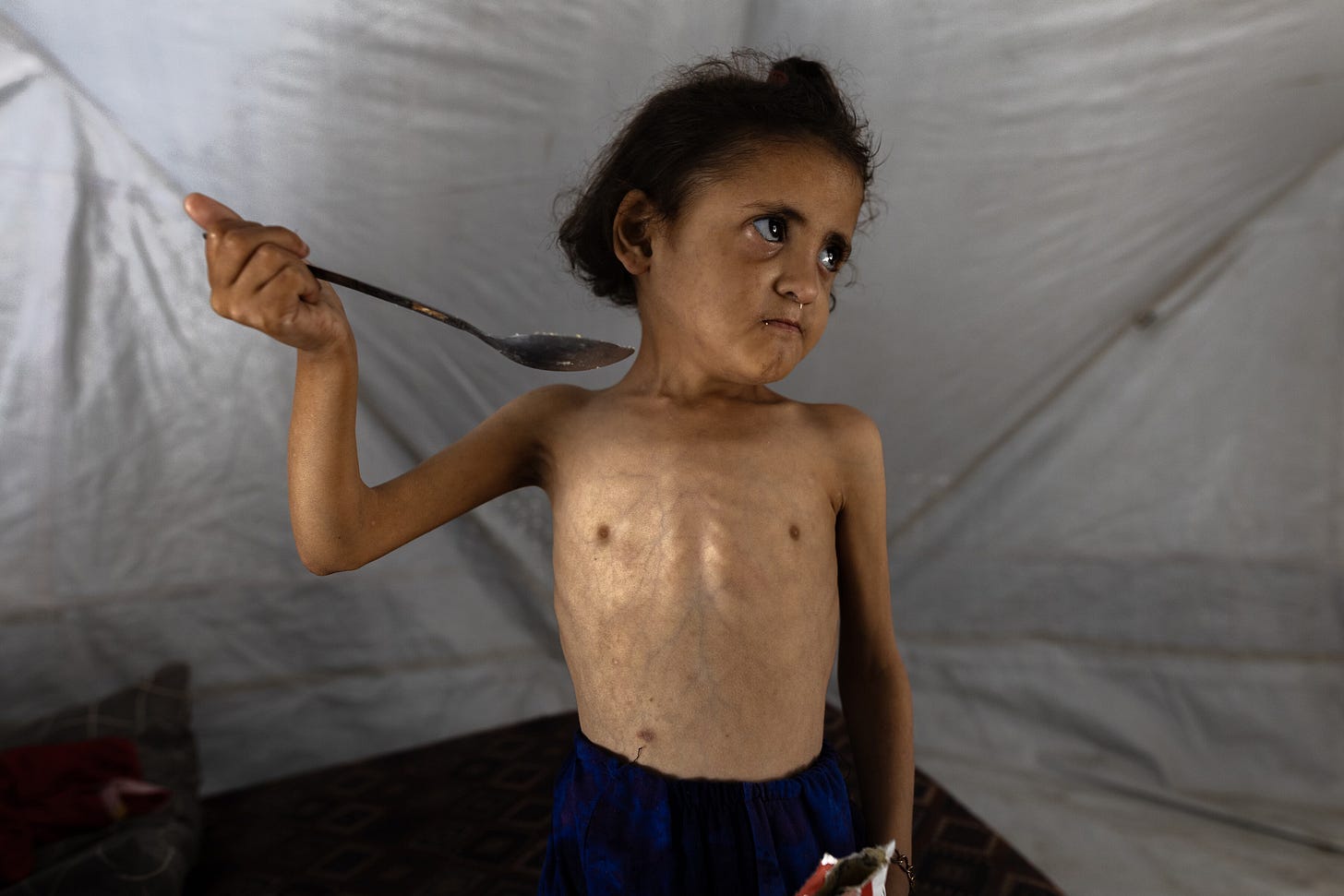
Najwa Hussein Hajjaj, in Gaza City, May 25, 2025. (Saher Alghorra / The New York Times / Redux)
In an interview with
Al-Araby Al-Jadeed, a
Qatar-backed Arabic outlet, the girl’s father said that her disorder results in “constant vomiting.”
“This condition has accompanied her throughout her life," her mother, Islam Hajjaj,
told Al-Araby Al-Jadeed in May, adding that she has suffered from “several ailments since birth.”
When
The Free Press sought comment from CNN, it said that it would add “additional details to these photo captions” but not issue a correction.
“This information does not change the fact that the children depicted in this story are suffering from malnutrition due to the difficulties they face accessing aid in Gaza, as reported,” a CNN spokesperson told us.
Mosab al-Debs
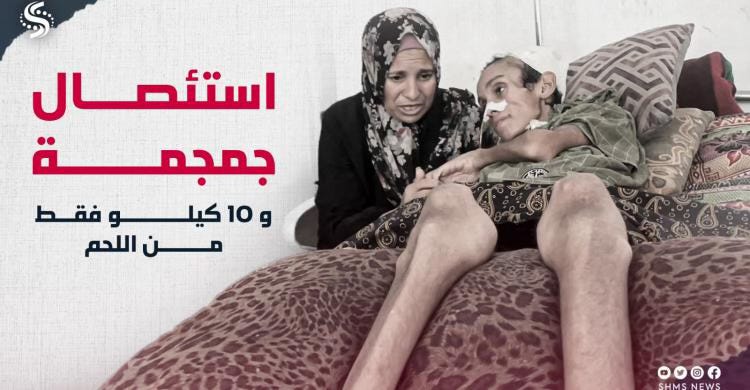
The 14-year-old boy was featured in the same CNN story as another child “suffering from malnourishment.” The original caption didn’t mention that last May, he sustained a traumatic head injury amid what SHMS News Agency, a Gaza-based outlet, called “
an Israeli shell” explosion.
“My son was injured in the head,” his mother explained. “Part of his skull was removed.”
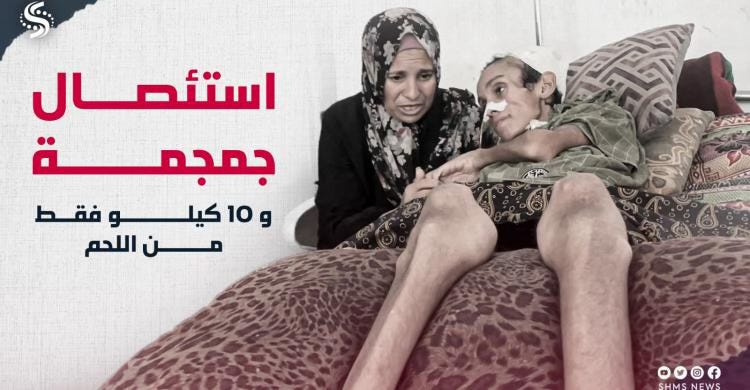
Mosab al-Debs (Image grab via shms.ps)
An
Instagram post uploaded to
@translating_falasteen said that he had suffered “severe brain hemorrhaging, leaving him completely paralyzed.”
These details did not appear on
Reuters,
Al Jazeera, and
other news organizations, which used his image in their coverage of the “mass starvation” in Gaza, in the words of
the BBC, which also ran his image.
After we contacted CNN, it added two lines to its story, including that the boy “needs a special nutrient formula for tube feeding that the hospital doesn’t have.” But the CNN spokesperson was unapologetic.
“Like other international news organizations, CNN is unable to report independently from inside Gaza, despite multiple and ongoing requests to be granted access. As such we are reliant on agencies and local journalists working inside the enclave.”
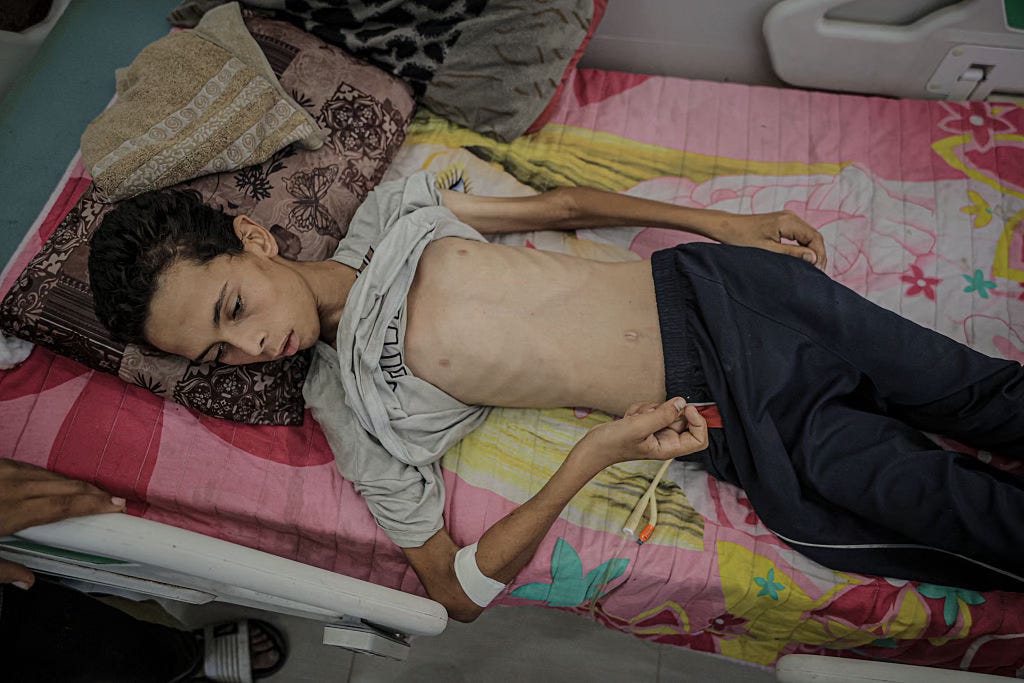
Atef Abu Khater
On July 24,
The New York Times article “
Gazans Are Dying of Starvation” opened with a description of Atef Abu Khater, a 17-year-old boy “who was healthy before Gaza was gripped by war,” according to
The Times. The article said that he was “suffering from severe malnutrition.” But it didn’t mention the “mysterious illness” that the boy’s father detailed just a few days earlier in an interview with
Al Jazeera Mubasher, the network’s Arabic TV channel.
“We did every possible test, but to no avail,” said the father, who did not cite malnutrition as a possible cause. “His condition keeps deteriorating, and the doctors are unable to determine what the illness is or what caused it.”
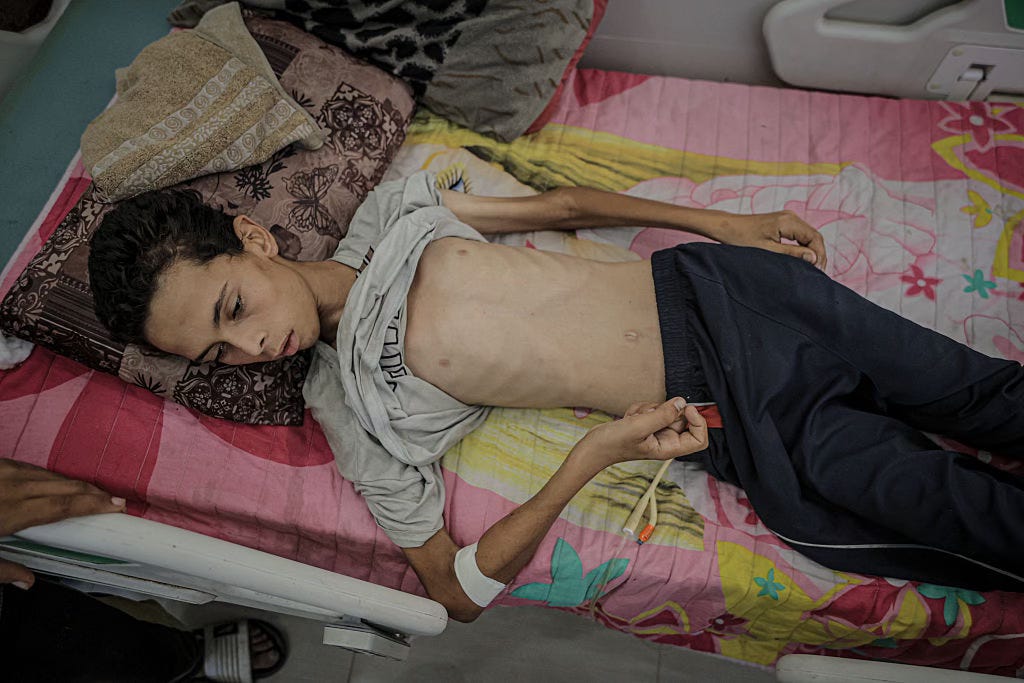
Atef Aid Abu Khater, at Al-Shifa Hospital in Gaza City, Gaza on July 25, 2025. (Ahmed Jihad Ibrahim Al-arini via Getty Images)
In another interview with
Al Jazeera Mubasher published late last month, the father said his son had not been the same after receiving burns on his toe and hand at a soup kitchen.
“He stopped eating and drinking and wouldn’t even open his mouth,” the father said, noting that a hospital had recently installed a feeding tube. “He’s like someone completely paralyzed.”
The photojournalist behind some of the viral images of Khater’s condition
posted on X that the boy “suffered a psychological shock after being burned inside one of the shelters in the Gaza Strip.”
When approached for comment, a spokesperson for
The New York Times replied that they were “confident” in their reporting.
“Our interviews and reporting found that no matter what else may have affected Atef’s life, he lacked sufficient access to food and nutrition during the war, suffered from hunger, and died from severe malnutrition after the publication of our story,” the spokesperson replied, adding that “The
Times has seen an official report that lists the cause of his death as severe malnutrition.”
The spokesperson did not respond to questions from
The Free Press about the nature of the “official report,” including whether it was stamped by the Hamas-controlled Gaza Ministry of Health.
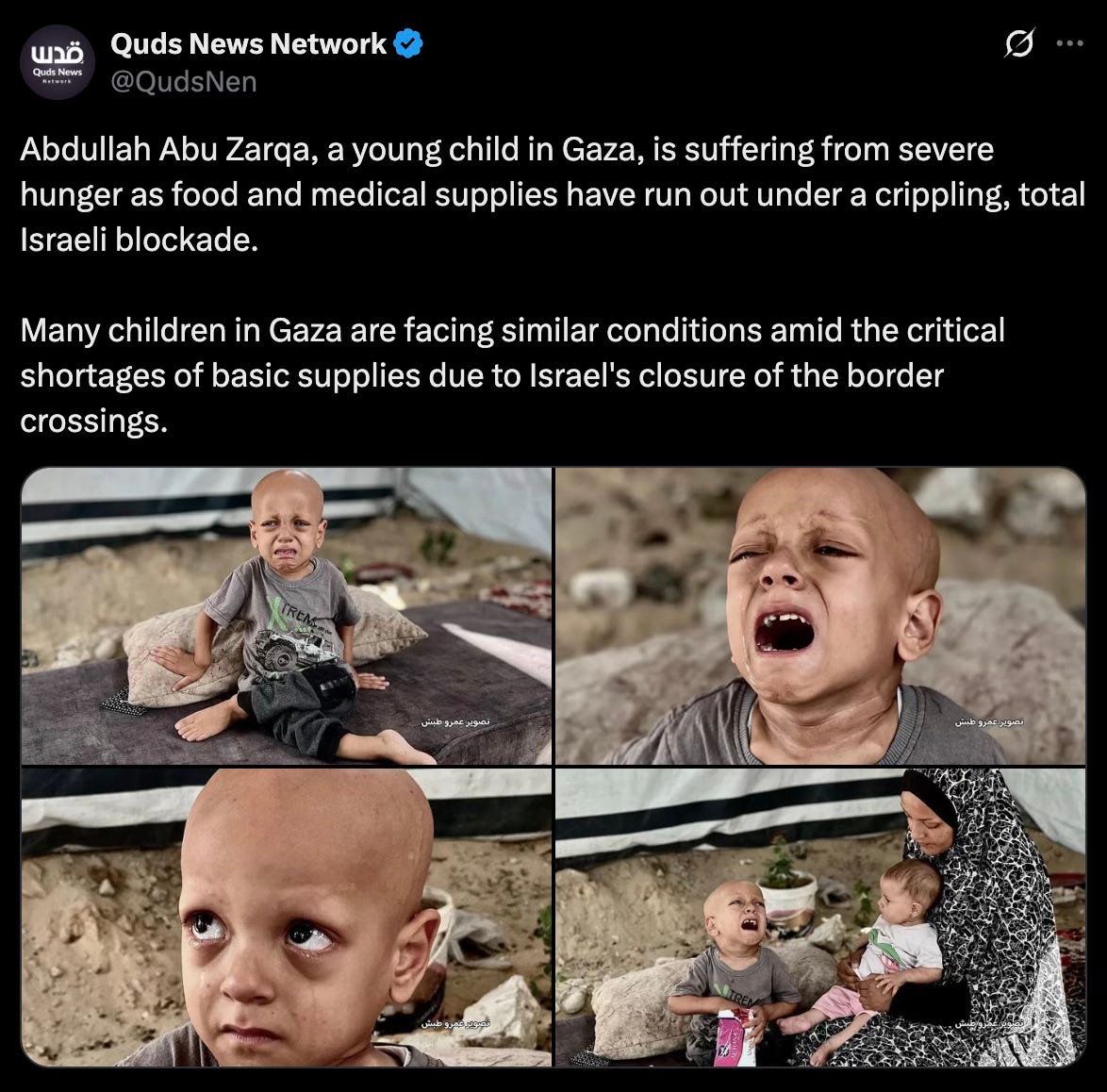
Abdullah Hani Muhammad Abu Zarqa
In late July, images of bald and emaciated 4-year-old Abdullah Abu Zarqa began circulating on Hamas-affiliated social media accounts, including
Quds News Network. A video of the boy wailing and telling the camera, “I’m hungry” received over 23,000 likes
on Instagram. The comments included “Allah will never forgive Israel and Netanyahu” and “ISRAEL, AMERICA, WHY DO YOU ENJOY DOING THIS.”
But in a
video interview with Al Jazeera Mubasher, the boy’s father shared that his son’s health problems dated back to before the war’s start and included joint pain since age two.
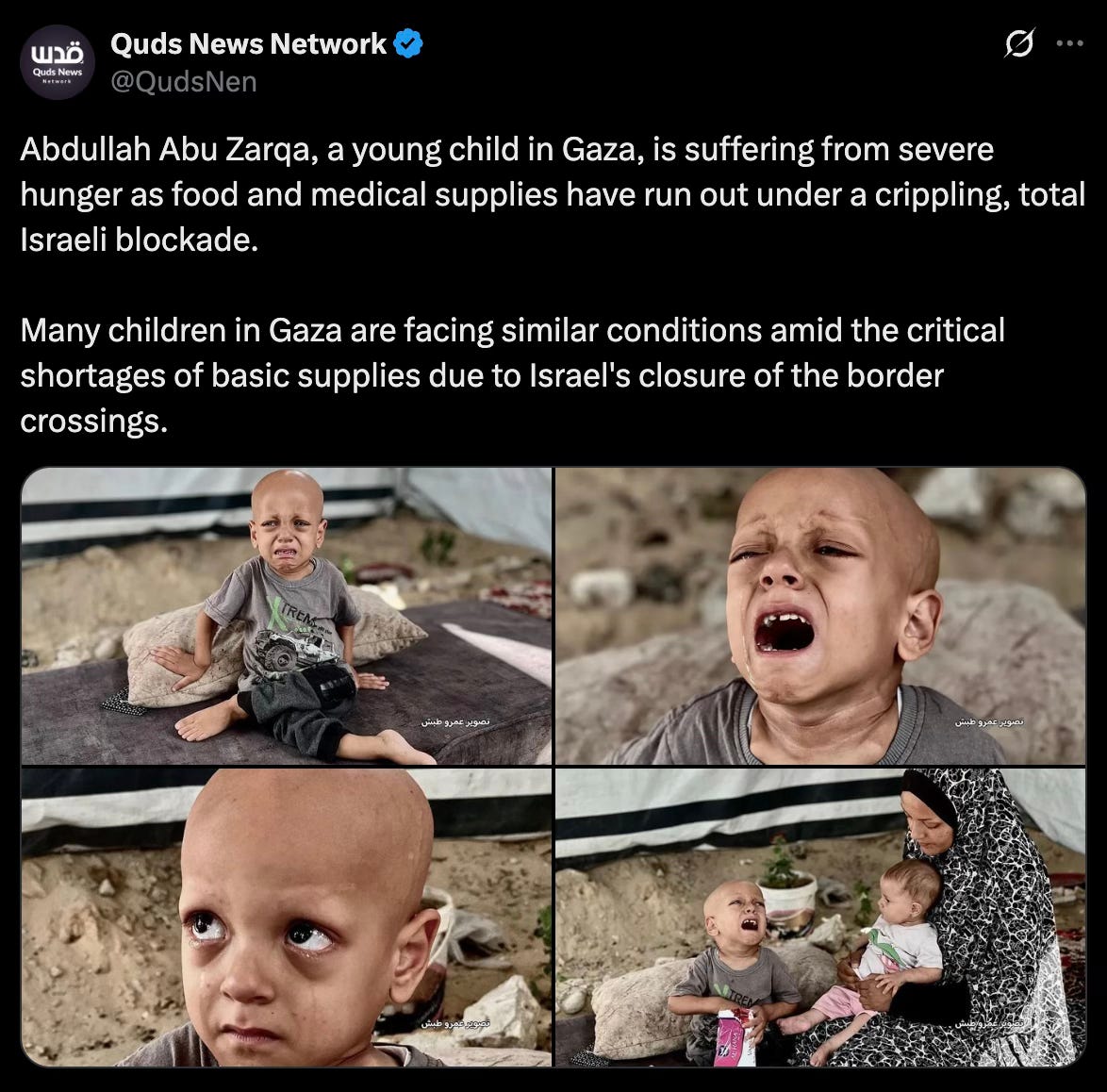
Abdullah Abu Zarqa (via @QudsNen/X)
“The doctors said they suspected he might have rickets or a muscle problem,” the father said in the interview.
A review by Israel’s Coordinator of Government Activities in the Territories, the agency that oversees humanitarian aid to Gaza, reached a similar conclusion. The agency’s investigation, which it said was done to counter “Hamas’s ‘Starvation Campaign,’ ”
found that the boy “suffers from a genetic disease causing vitamin and mineral deficiencies, osteoporosis, and bone thinning.”
The Israeli agency said that the boy traveled with his mother to East Jerusalem to receive care in 2023. A
photograph of his medical records, written in Hebrew and shared online by the Coordinator of Government Activities in the Territories, lists his diagnosis as “Rickets, active.”
Karam Khaled Al-Jamal
“Al Jazeera has aired a harrowing report from central Gaza, where a 27-year-old man has died of starvation caused by the ongoing Israeli blockade.” Thus begins the caption of a
July 31 Instagram post from Middle East Eye, a UK-based media company, featuring a subtitled video report from Al Jazeera. “Medical sources at Al-Awda Hospital confirmed the cause of death was famine and lack of proper nutrition,” the caption adds.
The lengthy post, which has collected nearly 3,000 likes on Instagram alone, never mentions that Karam has suffered from muscular atrophy and partial paralysis since childhood—conditions that rendered his body unable to digest food—according to
the Arabic edition of Anadolu, Turkey’s state-run news agency.
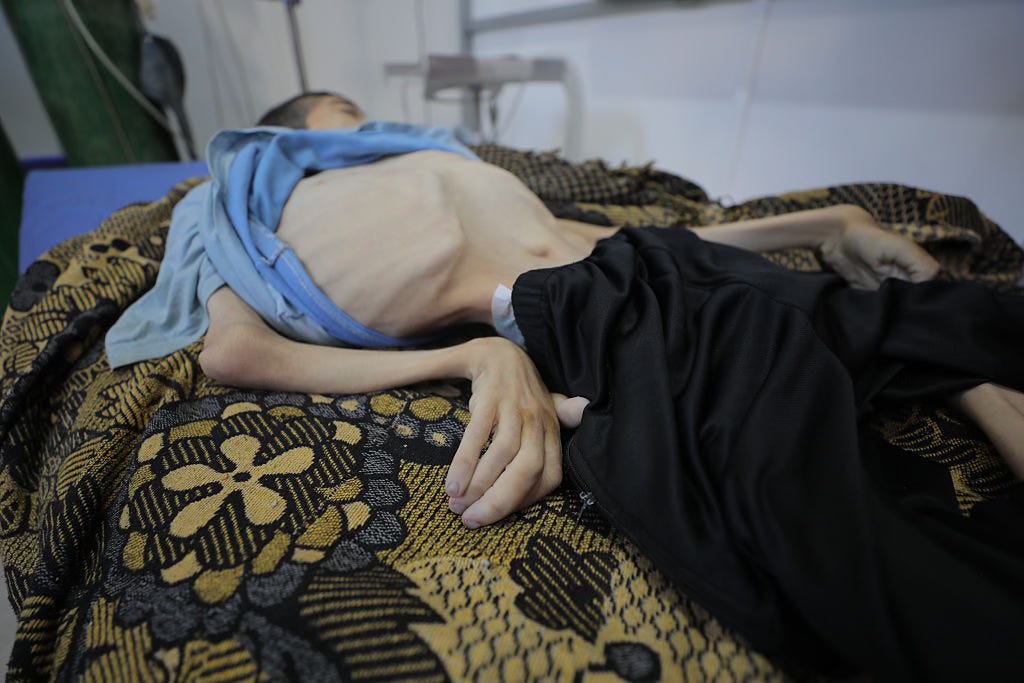
Karam Khaled al-Jamal, in al-Awda Hospital at Nuseirat Camp in Gaza City, Gaza on July 31, 2025. (Hassan Jedi via Getty Images)
Belal Abu Amer, a Gaza-based photojournalist who filmed the viral video, didn’t include any of
those details, either, blaming the man’s death solely on “malnutrition” and “the famine imposed on the residents of the Gaza Strip.”
Al Jazeera did not respond to our request for comment.
Osama Al-Raqab
The photos of an emaciated 5-year-old illustrated stories about the Gaza hunger crisis in
The Guardian,
CBC,
Al Jazeera, and the
Financial Times, among other news outlets. The English edition of Anadolu Agency published a
video report about the boy’s plight, calling his condition “a stark symbol of crisis under Israel’s genocide.”
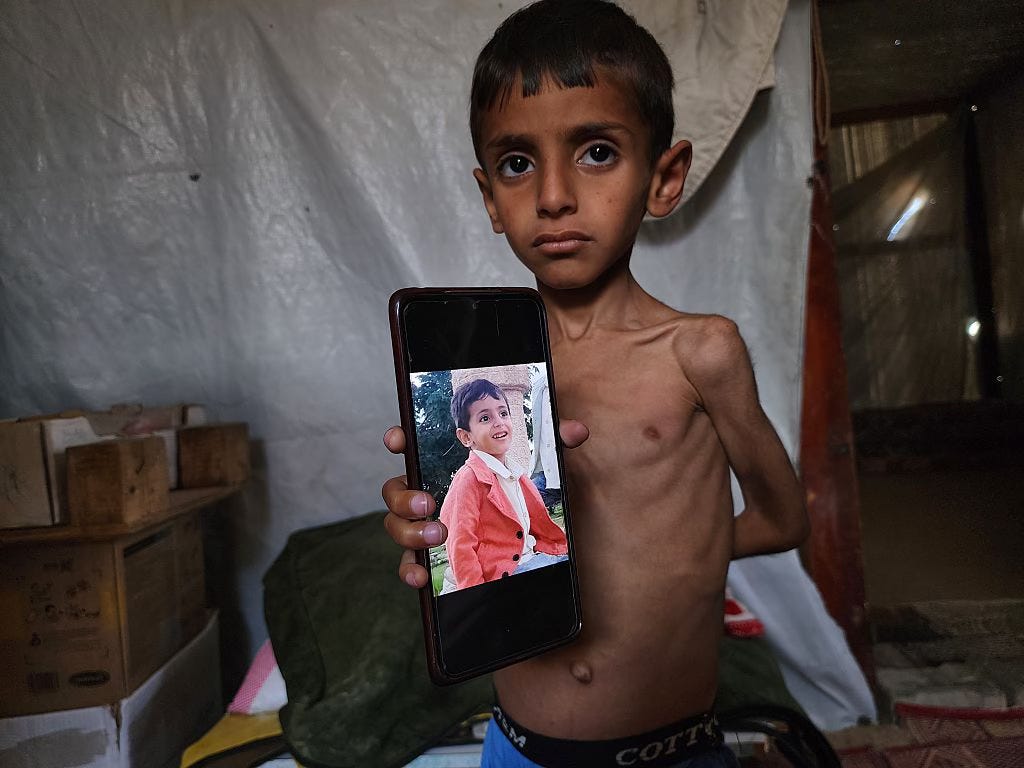
Osama Kamal Al Rakab, in Khan Yunis, Gaza on April 14, 2025. (Hani Alshaer via Getty Images)
None of these reports mentioned the fact that Osama also suffers from cystic fibrosis—the detail one could learn without even having to read in Arabic, as the information is readily available in English-language reports like
this AP story.

These omissions—whether deliberate or negligent—have appeared in some of America’s most prestigious newsrooms, including
The New York Times, CNN, and NPR.
Uncovering this missing context didn’t require in-depth, on-the-ground reporting—or months of investigative work. It took minutes, and required nothing more than a computer with a stable internet connection. We simply ran the story subjects’ names through Google Translate to get the Arabic spelling, then searched those names in Arabic-language media. Even a quick scan of the results revealed that many of these children suffer from muscle atrophy, head injuries, or other serious medical conditions that help explain their emaciated appearance. (In some cases, the relevant information was available in English, too.)
A
new report from Network Contagion Research Institute (NCRI) documents other instances of what it calls “journalistic malpractice,” including one instance in which
The Washington Post published a year-old photo in an article arguing that a “worst-case scenario is finally unfolding” in Gaza. A
Post spokesperson replied that it issued a correction to reflect that the photo was taken in June 2024.
“These stories were not just shaped by omission: They were laundered from unverified or partisan Arabic- and Turkish-language sources, while being presented as credible journalism to Western audiences,” the report said. “The resulting journalistic products resemble propaganda more than neutral reporting.”
Olivia Rose, NCRI’s extremism researcher, added that Hamas has an incentive to spread panic about alleged famine. That narrative undercuts one of its biggest threats: the Gaza Humanitarian Foundation, which Israeli and U.S. officials created to prevent aid from falling into the terrorist group’s hands. Last month, the NCRI released a
35-page report about how the GHF became the target of “narrative assault” that alleged it was “systematically murdering civilians.” The report traces those claims back to Hamas-run news agencies and anonymous social media accounts—and yet they were picked up by many top outlets, including BBC,
Haaretz, and the Associated Press.
There will be a cost for their basic lack of due diligence, said Rose.
“People in the Gaza Humanitarian Foundation, their houses are being attacked,” she said. “Their families are coming under threat here in the United States.”
One leading legal expert says these images aren’t just whipping public opinion into a frenzy—they could also play a role in the International Criminal Court (ICC) case against top Israeli leaders, including Prime Minister Benjamin Netanyahu. Eugene Kontorovich,
who leads George Mason University’s Center for the Middle East and International Law, said that claims of starvation are a “central allegation” in the court’s pursuit of crimes against humanity and war crimes charges.
Since early in the war, international agencies have leaned heavily on famine claims. The Integrated Food Security Phase Classification (IPC), the international body responsible for declaring famine,
initially projected in March 2024 that Gaza was on the brink of famine. But three months later, in June, it
walked that back, saying that the evidence didn’t support such a declaration after food deliveries increased. “If this did not lead the ICC prosecutor to change course, nothing will,” Kontorovich said. “This isn’t the kind of thing where a bit of evidence is going to stand in the way of a politicized prosecution.”
A year later, by
July 2025, the IPC reversed course again, declaring that famine was unfolding across much of Gaza. As
The Washington Free Beacon reported, the IPC quietly changed its methodology in Gaza, essentially redefining the criteria for determining a famine
. The IPC shifted away from a more comprehensive approach to tallying weight and height toward merely using arm circumference, a cruder assessment—and halved the threshold for famine from 30 percent of children registering as malnourished to 15 percent.
And the narrative of famine, according to Kontorovich, still matters—chiefly, in terms of optics and politics. “Obviously, it tends to suggest that much of the information coming from Gaza, in general, is false,” Kontorovich said. “It lends further credence to the proposition that information coming out of Gaza is coordinated propaganda.”
John Spencer agrees. He leads the Modern War Institute at West Point, a research institute that tries to advance U.S. military knowledge, and has embedded with the IDF in Gaza four times since Hamas invaded Israel on October 7, 2023.
“The inference is that Israel is behind this, and if they just agree to a ceasefire, all of this will stop now—and that is the farthest thing from the truth,” Spencer said. “If the war stops now, Hamas will continue to control every grain of rice, every sack of sugar, and use it to enrich themselves at the cost of civilians.”
The images have stirred worldwide anger against Israel. In cities across the U.S. from
Atlanta to
Philadelphia to
New York City, protesters have taken to the streets to decry what they believe is a manmade famine.
Tzvika Mor, a 47-year-old Israeli, wonders why no one is shouting his son’s name in the streets.
On October 7, 2023, his son, Eitan, was working as a security guard at the Nova Musical Festival when Hamas terrorists descended on the event. Militants spotted him and his friends in an open field, taking him hostage. It has been more than five months since his family has received an update on his status.
“I don’t know if he has access to food or even water,” the elder Mor said over Zoom earlier this month.
In early August, Hamas militants released shocking images of two other hostages, Evyatar David and Rom Braslavski, both of whom were skeletal with protruding bones. In one video, Braslavski clutches his stomach one moment, then cries the next.
“I am at death’s door,”
he said, adding that all he had eaten recently was “three crumbs of falafel” and “barely a plate of rice.”
A video of David shows him in a dim tunnel digging his own grave. Mor said it has been at least a year since a humanitarian group beyond Israel has contacted him or his family.
“I feel like the world has forgotten about my son.”




 www.washingtontimes.com


 www.jpost.com