"...does not mean he is knowledgable about the topic."
To anyone who notes that the debt continues to climb, it is more than counterintuitve to claim that there could be a real surplus.
No matter his vocation, it is his argument that makes more sense than the counter. You, of course, may define a surplus into existence...but that hardly means that one exists.
Economics is not a science, although euphemistically called the 'dismal science,' as is indicated by your attempts to use same to show that the debt increases, but there is a surplus...
I understand how an individual who is not trained in financial analysis nor understands government accounting would think it is counterintuitive that a rise in total gross government debt would imply a deficit. But bear with me.
I asked you the question earlier about what happens to the gross nontradable liabilities of the Treasury when there is a surge in employment and payroll tax receipts? Do you think such liabilities would go up or down? Intuitively, one would think they would fall, right? After all, a rise in receipts should mean a fall in liabilities. In fact, it is just the opposite. Gross nontradable liabilities
rise when there is a surge in payroll tax receipts.
Think of a mutual fund company that runs your 401k. Let's say you contribute $1000 a month to your 401k. At the end of the year, because you're such a good worker, you get a $10,000 bonus. Being the smart and responsible woman that you are, you put $5000 of your bonus into your 401k. The cash is sent to your mutual fund company and the mutual fund now owes you an extra $5000 on top of the $12,000 you socked away during the year. So for the year, the mutual fund owes you $17,000 (plus whatever your investments gained or lost, which for simplicity's sake, we'll assume is $0 for the year).
Now
STOP!
At this point, is the mutual fund better or worse off? After all, it now owes you $17,000? After all, the gross debt of the mutual fund company has risen because it owes you another $17,000. So it must be worse off, right?
This is where you stop in your analysis of the government debt. It is incomplete.
Of course, the answer to the above question is "no." A mutual fund contracts with a management company, which invests your money. The mutual fund company has a liability with you but the $17,000 it has invested with the management company is an asset. Net net, they balance out. The mutual fund company owes you $17,000 but has a $17,000 asset with the management company. So its gross debt rises by $17,000 but its net worth does not change.
It is the same with the government. When SS receipts rise, the gross liabilities of the Treasury rises because it owes you the money (plus interest) it has received from you in payroll taxes. But that doesn't mean the Treasury is worse off because it has an asset in the social security trust. Net net, there is no change in the balance to the Treasury. The Treasury is credited with the amount taken through payroll taxes but those funds are debited to the social security trusts. They offset. That's what you are seeing when total debt rises. It doesn't take into account changes on the other side of the balance sheet, and has no bearing on cash inflows and outflows through the Treasury. Cash inflows exceeded cash expenses in the last part of the 90s. That is the definition of a surplus.
I get that this is a confusing and counterintuitive issue. And I expect someone who is dug too deep in the argument and confused like QW to pipe in that "Government accounting is not the same!" In this case, there is no difference in how the accounting offsets assets and liabilities.


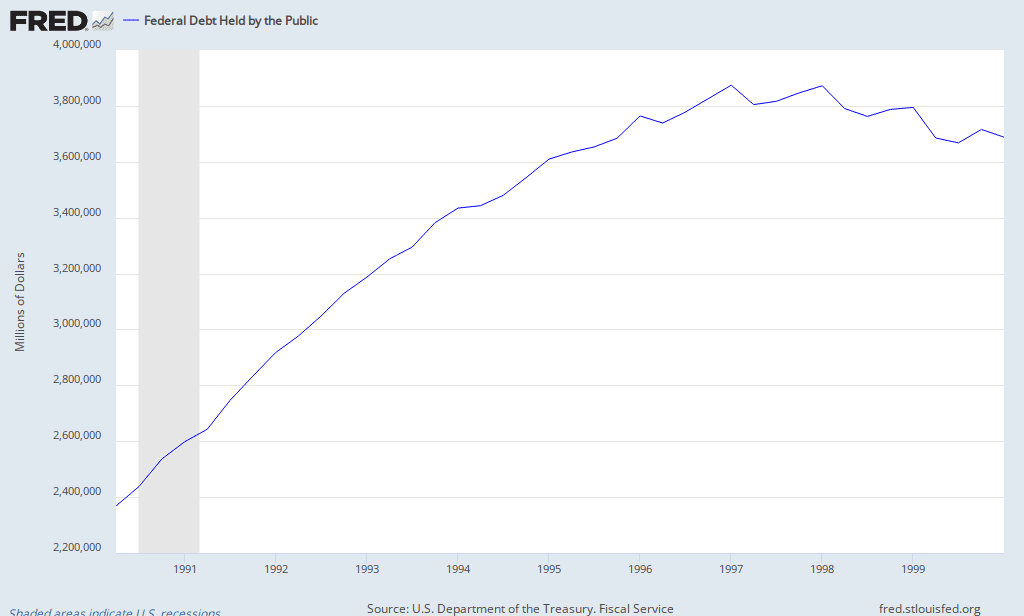


 But we didn't count loans as revenues. Instead, we had a surge in payroll taxes which were used to pay down the debt. If you want to say that we didn't have a surplus if you exclude the surpluses in the trusts, I would agree with you. But a surplus is defined as revenues exceeding expenditures, which is what happened in the 90s. And extrapolating a rise in the national debt and concluding we had a deficit is incorrect. That's why you don't have conservatives with financial knowledge making this argument.


