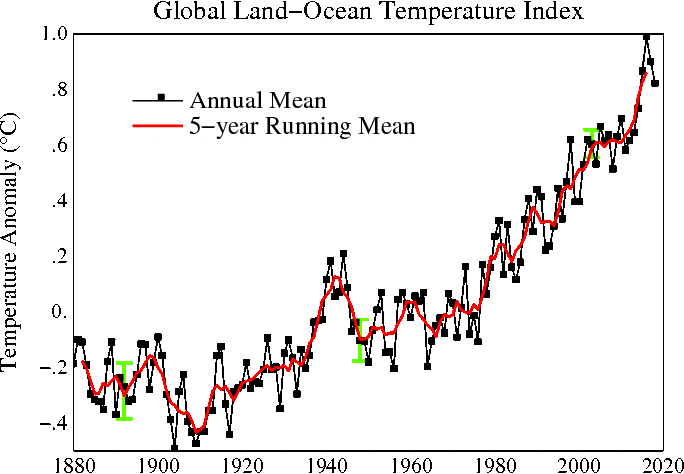
While the correlation between atmospheric increases in CO2 and earth's temperatures is poor (r2=0.44), it is much better for solar irradiance and solar activity (r2=>70 -- The higher the rs value the greater the correlation). It has long been known that solar irradiance by itself does not provide enough energy to cause the warming on earth experienced in the twentieth century. However, when combined with the type of solar irradiance that is emitted during high periods of solar activity every 11 and 22 years (the solar cycle), there is a poorly understood, but good correlation. Solar flares, coronal mass ejections and other solar activity reach a maximum during the peak of each solar cycle and somehow influence ocean temperatures and therefore climate. One of the leading theories on this interaction is the interaction between solar activity and incoming cosmic radiation on cloud formation.
You missed a decimal point in the r^2 for TSI.
The r^2 value is the pecentage of the dependent viable that is accounted for by the independent variable. There is no question that solar irradiance accounts for a larger percentage of the earths temperature. The PDO also has a marked effect on the the land ocean temperature.
Nobody has ever claimed that the earth temperature isn't substantially caused by then. You seem to be missing the point.
The correlation of TSI is not 100%. Nor does TSI and PDO account for all of it and none of the temperature rise.
The big problems with your r^2 values is
A) r, the coefficient of correlation, and the r^2 value are always between 0 and 1. An "r2=>70" is not possible.
B) When a multivariate regression is done, the sum of all the r^ values cannot add up to greater than 1. There more than 100% of something.
C). An r^ of 0.44 for CO2 would be that 44% of the variability in temperature is accounted for by CO2. 44% is, in no case, poor. 44% is damn near half.