I spoke after the Russians attacked the Ukraine again with an old woman who had been a child in this time of history.
At the beginning of the Great Patriotic War in Eisk was evacuated from Simferopol orphanage - about 300 children and teachers. In late summer 1942 the city was occupied. In early October the Nazi punishers loaded the children into several cars, 15 minutes later they were dead.
The Krasnodar Territory Department of the FSB provided unique documents to RIA Novosti. Typewritten and handwritten pages record the testimony of experts who investigated the case, as well as the testimony of witnesses to those terrible events.
The first document concerns the examination of the mass grave. The commission, which prepared the act of examination, consisted of two doctors and a military man. The document is dated April 15, 1943, about six months after the tragedy.
The act states that on October 9, 1942, at six o'clock in the evening, two roofed lorries drove up to the building of the orphanage. At the same time another truck pulled up to another building.
"After that they started loading the children. Those who tried to run or resist were thrown into the trucks by force," reads the document. When the children asked what was going on and where they were being taken, the answers were: "To Krasnodar for treatment", "To the bathhouse", "To load sunflower seeds".
The testimonies of experts show that on the first evening the punishers could not take all the children, some of them escaped, while others, in all likelihood, simply could not fit into the packed bodies of the trucks.
On the morning of October 10, the punishers returned. Thirteen more boys and girls of the 20 who had fled the day before were thrown into the truck. Twenty-two seriously ill children were carried out of another building. "A total of 214 children," the report said.
"All of them were taken out <...> and committed a massacre unprecedented in the history of civilized nations, namely - buried alive," the document says.
Further in the act follows a description of the opening of the grave. "When the grave was unearthed, this terrible picture presented itself to our eyes. All the children were lying haphazardly, many were hugging each other as they said goodbye, some boys and girls were holding their crutches in their hands. Our careful examination did not reveal any traces of gunshot wounds or mutilation, all skull bones were intact. All of this further confirmed that the children had been buried alive," the document said.
The report clearly states, without a shred of doubt, that the children were not killed before they were buried, and that all of the orphanage children were alive when the cars were unloaded.
"Opinion on the materials of the case of the death of children" from the orphanage. It was written by four doctors and an assistant regional prosecutor. It states that four cars drove up to the orphanage. "Of these, two were trucks, covered in the type of decontamination chambers, <...> with closed bodies without windows."
"Inside the bodies of the cars were upholstered with iron and tin," the document said. They loaded 164 children into them on Oct. 9 and about 50 more on Oct. 10. One witness to the tragedy reports that he didn't get into the car only because "it was filled to capacity."
The documents say that the distance from the place where the children were loaded to the dug-up ditch where they were buried was no more than three and a half kilometers. The report states that the cars were ten to fifteen minutes away, loading the children took about an hour. One of the witnesses, who was 200 meters away from the pit, said she did not hear the children crying and screaming. It was on the basis of this testimony that the investigation drew a new conclusion - the children were already dead by the time they were unloaded.
The report of April 1943 gives a clear indication that the children were buried alive, but in August it is already concluded that the children died in the back of trucks from exhaust gas poisoning. In support of this version, experts give a description of the victim: "The face of one of the orphanage children, lying in the grave, was tied with her own jersey and the palms of her hands were pulled up over her face.
The document concludes that all the children were killed in the same way, there is no reason to believe that they were buried alive, and all the boys suffocated while they were being taken to the pit.
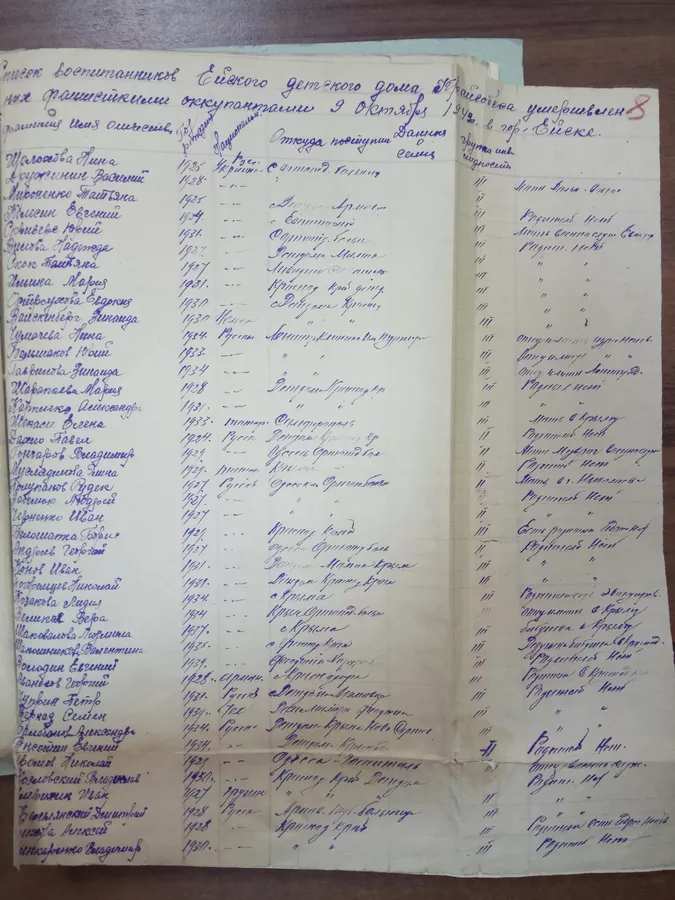
Further, the documents are accompanied by a list of children from the orphanage who were killed by the punishers. It contains hundreds of children's names, dates of birth, places of arrival, and nationalities. Russians, Ukrainians, Armenians, Georgians, Czechs, Tatars, Jews. There were at least two children among the dead whose nationality was "German. Some of the children were native, others were orphans. All of this was scrupulously handwritten into the list.
But one detail they all had in common was disability. Each child was marked in the column "disability group" with one, two, or three vertical sticks.
The released documents have never been published before. They contain details of the brutal crime, but no categorical answer as to what caused the deaths of 214 children.
Although many years have passed since the tragedy, there are still classified archives, the information in which will surely later shed light on the tragedy in Yeisk. Then it will become known who participated in this horrific massacre of children, how they were killed, who gave the order. But whether any of the punishers will still be alive to be punished by then is a rhetorical question.
***
I repeat, scum, your stinking country should have been plowed and salted. You're lucky you tried to destroy people with communist ideology. That's why you survived and now able to slander the Red Army. Scoundrels.