CUPCAKE
YOUR FIRST LINK
Yet Again, It Wasn't the Community Reinvestment Act...
Another attempt to blame the Community Reinvestment Act for the subprime crisis. Don't believe a word of it:
Economist's View: Yet Again, It Wasn't the Community Reinvestment Act...
AS FOR BLOOMBERGS BS, A WORLD WIDE CREDIT BUBBLE AND BUST WAS CONGRESS'S FAULT BUTTERCUP??? LOL
Let’s just be clear about what the CRA does and doesn’t do. It simply says that if you open a branch office in a low income neighborhood and collect deposits there, you are obligated to do a certain amount of lending in that neighborhood. In other words, you can’t open a branch office in Harlem and use deposits from there to only fund loans in high-end Tribeca. A bank must make credit available on the
same terms in both neighborhoods. In other words, a “red line” can’t be drawn around Harlem, a term that dates to when banks supposedly used colored pencils to draw no-loan zones on maps.
Showing that the CRA wasn’t the cause of the financial crisis is rather easy. As Warren Buffett pal Charlie Munger says, “Invert, always invert.” In this case, let’s assume Moore and Kudlow are correct, and the CRA
did require banks to lend to unqualified, low-income buyers. What would that world have looked like?
Here’s what we should have seen:
- Home sales and prices in urban, minority communities would have led the national home market higher, with gains in percentage terms surpassing national figures;
- CRA mandated loans would have defaulted at higher rates;
- Foreclosures in these distressed urban CRA neighborhoods should have far outpaced those in the suburbs;
- Local lenders making these mortgages should have failed at much higher rates;
- Portfolios of banks participating in the Troubled Asset Relief Program should have been filled with securities made up of toxic CRA loans;
- Investors looking to profit should have been buying up properties financed with defaulted CRA loans; and
- Congressional testimony of financial industry executives after the crisis should have spelled out how the CRA was a direct cause, with compelling evidence backing their claims.
Yet none of these things happened. And they should have, if the CRA was at fault. It’s no surprise that in congressional testimony, various experts were asked about the CRA -- from former
Federal Deposit Insurance Corp. Chairman Sheila Bair to the Federal Reserve’s
director of Consumer and Community Affairs -- and none blamed the crisis on the CRA.
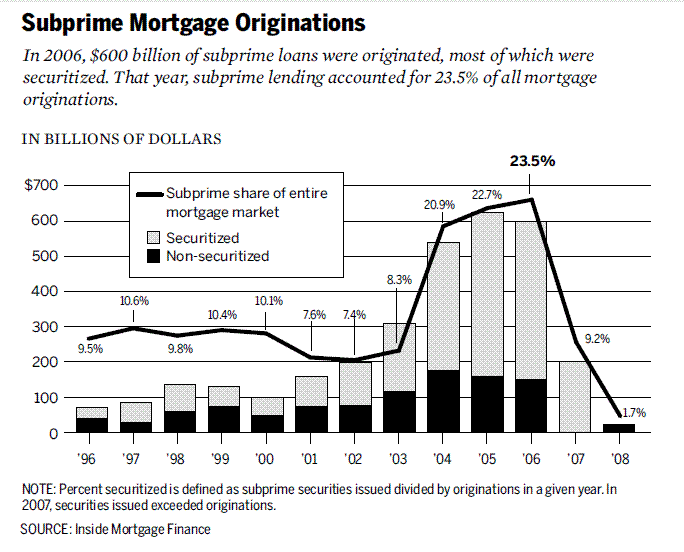
If that isn’t enough to dismiss the claim, consider this: Where did mortgages, especially subprime mortgages, default in large numbers?
It wasn’t Harlem, Philadelphia, Baltimore, Chicago, Detroit or any other poor, largely minority urban area covered by the CRA. No, the crisis was worst in Florida, Arizona, Nevada and California. Indeed, the vast majority of the housing collapse took place in the suburbs and exurbs, not the inner cities.
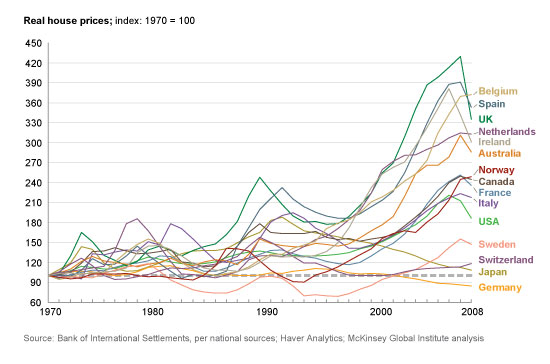
Now consider that much of the rest of the developed world also had a boom and bust in residential real estate that was worse than in the U.S. Oh, right -- those countries didn’t have the CRA.
What's more, many of the lenders that made the subprime loans that contributed so much to the collapse were private non-bank lenders that weren’t covered by the CRA. Almost 400 of these went bankrupt soon after housing began to wobble.
I have called the CRA blame meme “
the big lie” -- and with good reason. It’s an old trope, tinged with elements of dog-whistle politics, blaming low-income residents in the inner cities regardless of what the data show.
Lending to Poor People Didn't Cause the Financial Crisis
BANKSTERS DROPPED ALL UNDERWRITING STANDARDS CUPCAKE, YOU KNOW WHAT THOSE ARE? HINT GOV'T BACKED LOANS REQUIRED THEM
Did you miss the
government document siting the lowering of banks standards as a condition for bank mergers in allowing for more homeowners that previously failed through basic credit checks to be approved. Nothing you've stated had been able to discredit a government document source I provided which outlied the standards banks are to follow and used those standards as weight into bank mergers. You can keep challenging if you like, I've done the research with plenty more that I can provide. Trust me ... from what I've seen, you don't have enough knowledge on the subject. Keep your conspiracy theories, fruitcake, and let me know when you are old enough to have an honest discussion. You see, anyone who knows anything about the housing market KNOWS these changes that took effect happened well before the Bush Administration.
"You see, anyone who knows anything about the housing market KNOWS these changes that took effect happened well before the Bush Administration."
WEIRD CUPCAKE
From Bush's President's Working Group on Financial Markets March 2008
The Presidents Working Group's March policy statement
acknowledged that turmoil in financial markets clearly was triggered by a dramatic weakening of underwriting standards for U.S. subprime mortgages, beginning in late 2004 and extending into 2007.
Q Did the
Community Reinvestment Act under Carter
/Clinton caused it?
A "Since 1995 there has been essentially no change in the basic CRA rules or enforcement process that can be reasonably linked to the subprime lending activity.
This fact weakens the link between the CRA and the current crisis since the crisis is rooted in poor performance of mortgage loans made between 2004 and 2007. "
Did the CRA cause the mortgage market meltdown? | Federal Reserve Bank of Minneapolis
SOMETHING HAPPENED ABOUT 2003 CUPCAKE, CAN YOU FIGURE IT OUT?
FACTS on Dubya's great recession
Oh my little fruitcake, you really don't know anything about housing market or the recession that followed. This below is a matter of public record. Plenty more additional evidence to follow if you need any actual facts on the subject. If you want to continue down this path, you won't get very far
September 1999
With pressure from the Clinton Administration, Fannie Mae eased credit requirements on loans it would purchase from lenders, making it easier for banks to lend to borrowers unqualified for conventional loans. Raines explained that "there remain too many borrowers whose credit is just a notch below what our underwriting has required who have been relegated to paying significantly higher mortgage rates in the so-called subprime market," reported the New York Times.
With this action, Fannie Mae put itself at substantial risk in the event of an economic downturn. "From the perspective of many people, including me, this is another thrift industry growing up around us," warned Peter Wallison. "If they fail, the government will have to step up and bail them out the way it stepped up and bailed out the thrift industry." The danger was known.
March 2000
Rep. Richard Baker (R-Louisiana) proposed a bill to reform Fannie and Freddie's oversight in a House Subcommittee on Capital Markets.
Rep. Frank (D-Massachusetts) dismissed the idea, saying concerns about the two were "overblown" and that there was "no federal liability there whatsoever."
June 2000
Rep. Marge Roukema (R-New Jersey): "very few banks or S&Ls could, even in this day and age, even now, meet the stress-testing requirements which Fannie and Freddie are required to meet."
Rep. Carolyn Maloney (D-New York) regarding the Treasury Department line of credit: "It is really symbolic, it is obsolete, it has never been used." "Would you explain why it would be important to repeal something that seems to be of little use?"
Smith: "as long as the pipeline is there, it is like it is very expandable. . . . It is only $2 billion today. It could be $200 billion tomorrow."
Because of Democrat obfuscation, Smith's "tomorrow" arrived in 2008 when Treasury Secretary Henry Paulson put Fannie and Freddie into conservatorship.
February 2003
OFHEO reports that "although investors perceive an implicit Federal guarantee of [GSE] obligations . . . the government has provided no explicit legal backing for them," warning that unexpected problems at a GSE could immediately spread into financial sectors beyond the housing market, according to a White House release.
June 2003
Freddie Mac reported it had understated its profits by $6.9 billion. OFHEO director Armando Falcon Jr. requested that the White House audit Fannie Mae.
July 2003
Sens. Chuck Hagel (R-Nebraska), Elizabeth Dole (R-North Carolina) and John Sununu (R-New Hampshire) introduced legislation to address Regulation of Fannie Mae and Freddie Mac.
The bill was blocked by Democrats.
September 2003
In an interview with Ron Insana for CNN Money, Rep. Baker warned, "I have concerns that if appropriate resources aren't allocated for internal risk management, the consequences will be far more severe than just a real estate slowdown. The losses would fall quickly through the capital these companies have and down to shareholders and taxpayers. These companies have some of the lowest capital margins of any financial institution in the nation, yet, at the same time, they are two of the largest. The concern is that if something doesn't work out the way they predict, the American taxpayer could be called on to pay off the debt in some sort of bailout."
Rep. Barney Frank (D-Massachusetts): "These two entities - Fannie Mae and Freddie Mac - are not facing any kind of financial crisis. . . . The more people exaggerate these problems, the more pressure there is on these companies, the less we will see in terms of affordable housing."
October 2003
Fannie Mae discloses $1.2 billion accounting error.
November 2003
Council of the Economic Advisers Chairman Greg Mankiw warned, "The enormous size of the mortgage-backed securities market means that any problems at the GSEs matter for the financial system as a whole. This risk is a systemic issue also because the debt obligations of the housing GSEs are widely held by other financial institutions. The importance of GSE debt in the portfolios of other financial entities means that even a small mistake in GSE risk management could have ripple effects throughout the financial system," from a White House release.
February 2004
Mankiw cautions Congress to "not take [the financial market's] strength for granted." Again, the call from the Administration was to reduce this risk by "ensuring that the housing GSEs are overseen by an effective regulator," says a White House release.
OFHEO reported that Fannie Mae and
CEO Raines had manipulated its accounting to overstate its profits. Congress and the Bush administration sought strong new regulation and authority to put the GSEs under conservatorship if necessary. As the Washington Post reports,
Fannie Mae and Freddie Mac responded by orchestrating a major campaign "by traditional allies including real estate agents, home builders and mortgage lenders. Fannie Mae ran radio and television ads ahead of a key Senate committee meeting,
depicting a Latino couple who fretted that if the bill passed, mortgage rates would go up." Again, GSE pressure prevailed.
October 2004
In a subcommittee testimony,
Democrats vehemently reject regulation of Fannie Mae in the face of dire warning of a Fannie Mae oversight report. A few of them, Black Caucus members in particular, are very angry at the OFHEO Director as they attempt to defend Fannie Mae and protect their CRA extortion racket.
Rep. Maxine Waters (D-California): "Through nearly a dozen hearings where, frankly, we were trying to fix something that wasn't broke."
Rep. Maxine Waters (D-California): "Mr. Chairman, we do not have a crisis at Freddie Mac, and particularly at Fannie Mae, under the outstanding leadership of Mr. Frank Raines."
Rep. Ed Royce (R-California): "In addition to our important oversight role in this committee, I hope that we will move swiftly to create a new regulatory structure for Fannie Mae, for Freddie Mac, and the federal home loan banks."
Rep. Lacy Clay (D-Missouri): "This hearing is about the political lynching of Franklin Raines."
Rep. Ed Royce (R-California): "There is a very simple solution. Congress must create a new regulator with powers at least equal to those of other financial regulators, such as the OCC or Federal Reserve."
Rep. Barney Frank (D-Massachusetts): "Uh, I, this, you, you, you seem to me saying, Well, these are in areas which could raise safety and soundness problems.' I don't see anything in your report that raises safety and soundness problems."
Rep. Maxine Waters (D-California): "Under the outstanding leadership of Mr. Frank Raines, everything in the 1992 Act has worked just fine. In fact, the GSEs have exceeded their housing goals. What we need to do today is to focus on the regulator, and this must be done in a manner so as not to impede their affordable housing mission, a mission that has seen innovation flourish from desktop underwriting to 100% loans."
Rep. Don Manzullo (R-Illinois):
"Mr. Raines, 1.1 million bonus and a $526,000 salary. Jamie Gorelick, $779,000 bonus on a salary of 567,000. This is, what you state on page eleven is nothing less than staggering."
Rep. Don Manzullo (R-Illinois): "The 1998 earnings per share number turned out to be $3.23 and 9 mills, a result that Fannie Mae met the EPS maximum payout goal right down to the penny."
Rep. Don Manzullo (R-Illinois): "Fannie Mae understood the rules and simply chose not to follow them that if Fannie Mae had followed the practices, there wouldn't have been a bonus that year."
"The bill prohibited the GSEs from holding portfolios, and gave their regulator prudential authority (such as setting capital requirements) roughly equivalent to a bank regulator. In light of the current financial crisis, this bill was probably the most important piece of financial regulation before Congress in 2005 and 2006," reports the Wall Street Journal.
Greenspan testified that the size of GSE portfolios "poses a risk to the global financial system. It would be difficult, if not impossible, to bail out the lenders [GSEs] . . . should one get into financial trouble." He added, "If we fail to strengthen GSE regulation, we increase the possibility of insolvency and crisis . . . We put at risk our ability to preserve safe and sound financial markets in the United States, a key ingredient of support for homeownership."
Greenspan warned that if the GSEs "continue to grow, continue to have the low capital that they have, continue to engage in the dynamic hedging of their portfolios, which they need to do for interest rate risk aversion, they potentially create ever-growing potential systemic risk down the road . . . We are placing the total financial system of the future at a substantial risk."
Bloomberg writes, "If that bill had become law, then the world today would be different. . . .
But the bill didn't become law, for a simple reason: Democrats opposed it on a party-line vote in the committee, signaling that this would be a partisan issue. Republicans, tied in knots by the tight Democratic opposition, couldn't even get the Senate to vote on the matter. That such a reckless political stand could have been taken by the Democrats was obscene even then."
April 2007
In "A Nightmare Grows Darker," the New York Times writes that the "democratization of credit" is "turning the American dream of homeownership into a nightmare for many borrowers." The "newfangled mortgage loans" called "affordability loans" "represent 60 percent of foreclosures."
2007-2008
The housing bubble began to burst, bad mortgages began to default, and finally the Fannie Mae and Freddie Mac portfolios were revealed to be what they were, in collapse. And the testimony is evident as to why. As Wallison noted, "Fannie and Freddie were, I would say, the poster children for corporate welfare."
Archived-Articles: Why the Mortgage Crisis Happened