You do realize that notwithstanding the impact(s) of solar activity,
global warming could well trigger an ice age.
This is part of the problem with AGW theory in that it predicts all possible outcomes and is thus not capable of being tested; it is correct no matter what happens and is thus not really science.
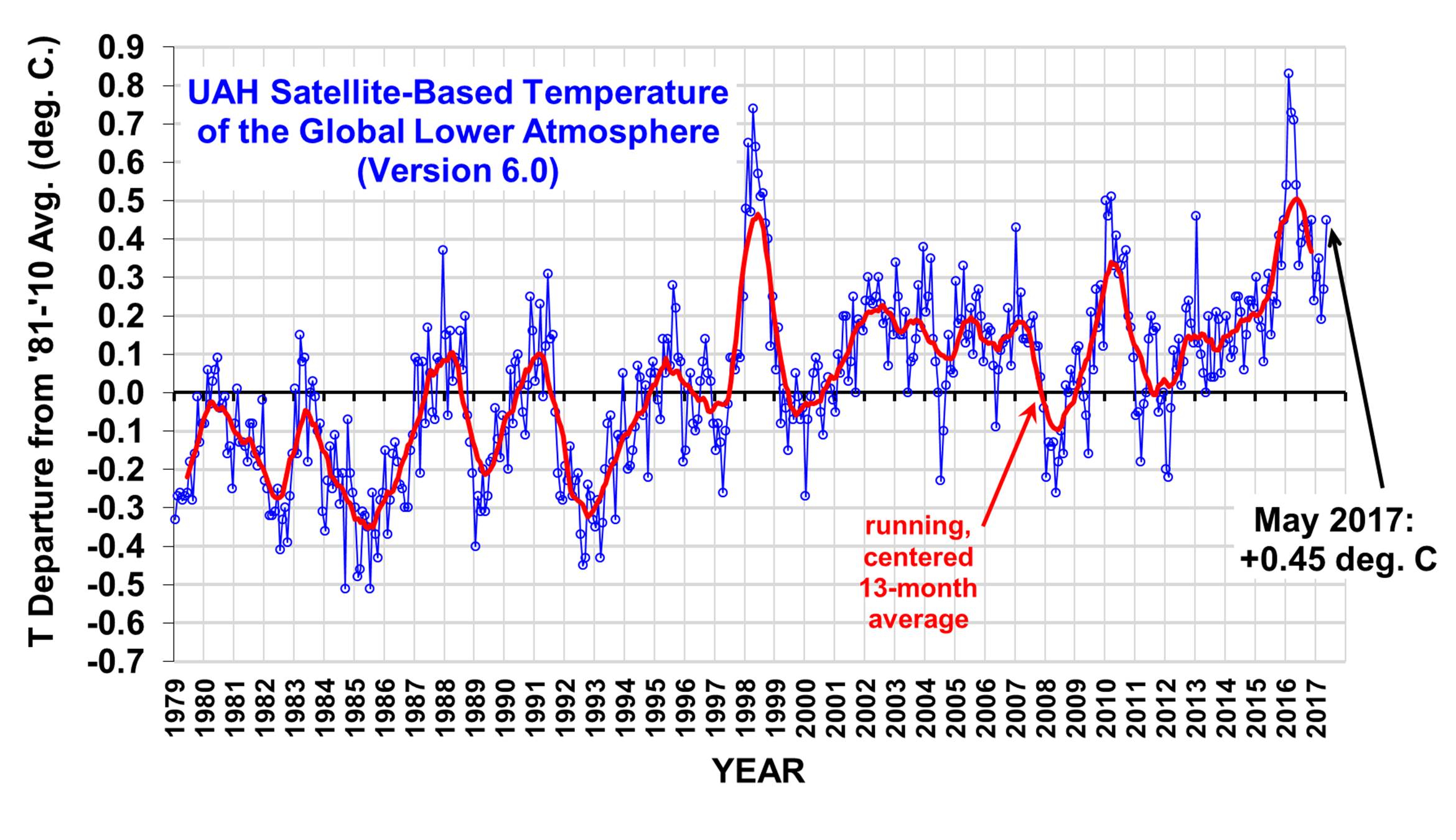
The heart of the global warming issue isn't that the Earth is warming. The crux is the rate at which it is doing so -- as contrasted with the rate in years long gone whence humanity had little to no material impact on the rate at which the Earth cyclically warmed and cooled and what might be done to attenuate humanity's impact on the rate of warming.
Our global temperature set only goes back a couple of centuries so there is no context for comparing rates of change.
We can say however that the rates of change have not been nearly as fast as almost any of the climate models that AGW advocates use to 'prove'
that AGW is real.
Additionally, given the frequency of the Sun's going from solar maximum to minimum and back again -- by the linked article's content, about eight to ten years -- I'm not convinced the solar cycle plays a controlling role on the periodic fluctuations in Earth's progression from ice age to warm period and back again, which we clearly observe has historically spanned millennia for each "peak and valley."
The solar change is based on larger cycles than the short ten to eleven year cycles. There are apparently larger cycles that stretch over decades and even centuries.
AGW theory in that it predicts all possible outcomes and is thus not capable of being tested
First of all, let's be clear. AGW is not a
scientific theory. AGW is an attestation of humanity's impact on natural processes (specifically climatological processes), not delineation of those processes and how they operate. Thus, AGW is not a scientific theory, which, by definition, is a set of statements, principles and laws that explains "how things work." For example, the Theory of Evolution describes not what causes evolution to happen as it does, but rather it explains how evolution happens and what one can expect to observe as a result of evolution "doing its thing."
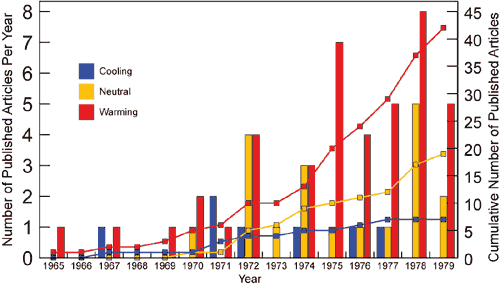
It is not at all so that AGW has not met the test of falsifiability. On the contrary, falsifiability sits at the heart of why so many climate and other scientists and rational thinkers accept the verity of AGW.
From "
The scientific consensus on climate change: How do we know we’re not wrong?"
- "In the early 20th century, Swedish chemist Svante Arrhenius predicted that increasing carbon dioxide from the burning of fossil fuels would lead to global warming, and by the mid century, a number of other scientists, including G.S. Callendar, Roger Revelle, and Han Suess, concluded that the effect might soon be quite noticeable, leading to see level rise and other global changes....[Indeed,] Svante Arrhenius and Guy Callendar predicted global warming before anyone ever built a global circulation model (or even had a digital computer)" (See also: CO2, the greenhouse effect and global warming: from the pioneering work of Arrhenius and Callendar to today's Earth System Models)
- In 1965, Revelle and his colleagues wrote, “By the year 2000, the increase in atmospheric CO2 …may be sufficient to produce measurable and perhaps marked change in climate, and will almost certainly cause significant changes in the temperature and other properties of the stratosphere.”
- "Should one believe that the correlation between increased CO2 and increased temperature is just a weird coincidence? If there were no theoretical reason to relate them, and if Arrhenius and Callendar and Suess and Revelle had not predicted that all this would all happen, then one might well conclude that rising CO2 and rising temperature were merely coincidental. But we have every reason to believe that there is a causal connection, and no good reason to believe that it is a coincidence. Indeed, the only reason we might think otherwise is wishful thinking: that this is just a natural cycle in which humans have played no role, and global warming will go away on its own in due course.
And that sums up the problem. Denying that global warming is real is precisely that: denial. It is denial that humans have become geological agents, changing the most basic physical processes of our Earth. For centuries, scientists thought that Earth processes were so large and powerful that nothing we could do would change them. This was a basic tenet of geological science: that human chronologies were insignificant in comparison with the vastness of geological time; that human activities were insignificant in comparison with the force of geological processes. And once, perhaps, they were. But no more. There are now so many of us cutting down so many trees and burning so many billions of tons of fossil fuels that we have, indeed, become geological agents. We have changed the chemistry of our atmosphere, causing sea level to rise, ice to melt, and the climate to change. There is no reason to think otherwise, except denial.
This is part of the problem with AGW theory in that it predicts all possible outcomes and is thus not capable of being tested; it is correct no matter what happens and is thus not really science.
In light of the great similarity between your remarks and those of
Betsy Gorisch, along with the apparent popularity of the website containing her thoughts among self-described "thoughtful" conservatives, I cannot help but think you've latched onto, perhaps even actively sought, commentary from one of the handful of climate science deniers who've availed themselves of the Internet to make their views known beyond the realm of people who happen to personally know them.
Interestingly, the woman states she is a professional geologist,
yet when I search for published works by her, I find none. Don't get me wrong, professionals don't publish nearly as much as do academic, public and private sector researchers; however, at some point early to midway through a distinguished career, they publish something of note -- one or two articles discussed at a professional symposium or conference, an editorial, a book, "something" -- that received enough critical notice, if not acclaim, that one could find. Doing so is part of what defines the difference between "having a distinguished career" and "merely having a career that adequately, perhaps more than adequately, paid the bills." I'm not deriding anyone for being the later type of professional, but being the former is what it takes for one to be among those whose points of view matter and are worth considering as being germane to the body of knowledge and understanding in a given discipline.