Hebron was an Arab city until a handful of Jewish families arrived from Spain and Portugal without incident.
Read the Hebrew Scriptures.
-----------------
Hebron has a long and rich Jewish history.
Numbers 13:22 states that (
Canaanite) Hebron was founded seven years before the Egyptian town of Zoan, i.e. around 1720 BCE, and the ancient (Canaanite and Israelite) city of Hebron was situated at Tel Rumeida. The city’s history has been inseparably linked with the
Cave of Machpelah, which the Patriarch
Abraham purchased from Ephron the
Hittite for 400 silver shekels (
Genesis 23) as a family tomb. This was the first parcel of land owned by the Jewish people in their
Promised Land. As recorded in Genesis, the Patriarchs
Abraham,
Isaac, and
Jacob, and the Matriarchs
Sarah,
Rebekah and
Leah, are buried there, and — according to a Jewish tradition —
Adam and
Eve are also buried there.
Hebron is mentioned 87 times in the Bible and is the world’s oldest Jewish community.
Joshua assigned Hebron to Caleb from the
tribe of
Judah (
Joshua 14:13-14), who subsequently led his tribe in conquering the city and its environs (
Judges 1:1-20). As Joshua 14:15 notes, “the former name of Hebron was Kiryat Arba...”
Following the death of
King Saul,
God instructed
David to go to Hebron, where he was anointed King of Judah (
II Samuel 2:1-4) and reigned in the city for seven years before being anointed King over all Israel (
II Samuel 5:1-3). One thousand years later, during the first
Jewish revolt against the
Romans, the city was the scene of extensive fighting. Jews lived in Hebron continuously throughout the
Byzantine,
Arab,
Mameluke and
Ottoman periods and it was only in 1929 that the city became temporarily “free” of Jews as a result of an Arab
pogrom in which 67 Jews were murdered and the remainder forced to flee. After the
1967 Six-Day War, the Jewish community of Hebron was re-established.
The city was part of the united kingdom and — later — the southern Kingdom of
Judah, until the latter fell to the
Babylonians in 586 BCE. Despite the loss of Jewish independence, Jews continued to live in Hebron (
Nehemiah 11:25), and the city was later incorporated into the (Jewish)
Hasmonean kingdom by
John Hyrcanus. King
Herod (reigned 37-4 BCE) built the base of the present structure — the 12 meter high wall — over the
Tomb the Patriarchs.
The city was the scene of extensive fighting during the
Jewish Revolt against the Romans (65-70, see
Josephus 4:529, 554), but Jews continued to live there after the Revolt, through the later
Bar Kochba Revolt (132-135 CE), and into the
Byzantineperiod. The remains of a
synagogue from the Byzantine period have been excavated in the city, and the Byzantines built a large church over the Tomb of the Patriarchs, incorporating the pre- existing Herodian structure.
Tel Hebron
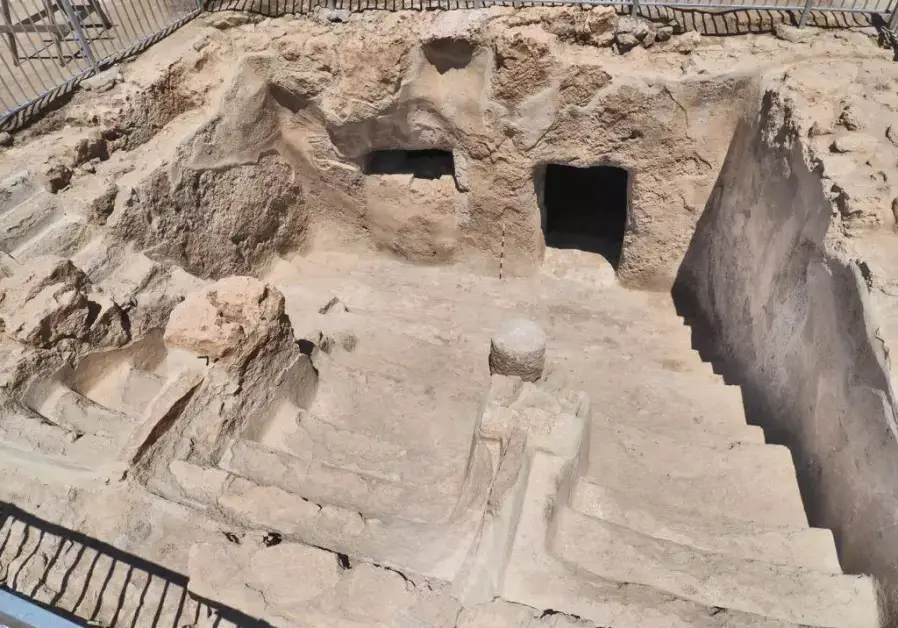
In October 2018, a new archaeological site opened at Tel Hebron where the walls of the city from the Early and Middle Bronze Age were excavated, as well as buildings from the Early Roman period, including pottery vessels, jewelry and coins. Workshops from the First Temple period, including wine and olive presses, pottery kilns and huge vessels to produce wine and oil were also discovered. Other findings include a four-chamber house, jars bearing ancient Hebrew inscriptions with words “to the king of Hebron” and a section of the city wall.
Jews continued to live in Hebron after the city’s conquest by the Arabs (in 638), whose generally tolerant rule was welcomed, especially after the often-harsh Byzantine rule. The Arabs converted the Byzantine church at the
Tomb the Patriarchs into a mosque.
Upon capturing the city in 1100, the
Crusaders expelled the Jewish community, and converted the mosque at the Tomb back into a church. The Jewish community was re-established following the
Mamelukes’ conquest of the city in 1260, and the Mamelukes reconverted the church at the Tomb of the Patriarchs back into a mosque. However, the restored Islamic (Mameluke) ascendancy was less tolerant than the pre-Crusader Islamic (Arab) regimes — a 1266 decree barred Jews (and Christians) from entering the Tomb of the Patriarchs, allowing them only to ascend to the fifth, later the seventh, step outside the eastern wall. The Jewish
cemetery — on a hill west of the Tomb — was first mentioned in a letter dated to 1290.
The
Ottoman Turks’ conquest of the city in 1517 was marked by a violent
pogrom which included many deaths, rapes, and the plundering of Jewish homes. The surviving Jews fled to Beirut and did not return until 1533. In 1540, Jewish exiles from
Spain acquired the site of the “Court of the Jews” and built the Avraham Avinu (“Abraham Our Father”)
synagogue. (One year — according to local legend — when the requisite quorum for prayer was lacking, the Patriarch
Abrahamhimself appeared to complete the quorum; hence, the name of the synagogue.)
Despite the events of 1517, its general poverty and a devastating plague in 1619, the Hebron Jewish community grew. Throughout the Turkish period (1517-1917), groups of Jews from other parts of the
Land of Israel, and the
Diaspora, moved to Hebron, joining the existing community, and the city became a rabbinic center of note.
In 1775, the Hebron Jewish community was rocked by a
blood libel, in which Jews were falsely accused of murdering the son of a local sheikh. The community — which was largely sustained by donations from abroad — was forced to pay a crushing fine, which further worsened its already shaky economic situation.
Despite its poverty, the community managed, in 1807, to purchase a 5-dunam plot — upon which the city’s wholesale market stands today — and after several years the sale was recognized by the Hebron Waqf. In 1811, 800 dunams of land were acquired to expand the cemetery. In 1817, the Jewish community numbered approximately 500 and, by 1838, it had grown to 700, despite a pogrom which took place in 1834, during Mohammed Ali’s rebellion against the Ottomans (1831-1840).
In 1870, a wealthy Turkish Jew, Haim Yisrael Romano, moved to Hebron and purchased a plot of land upon which his family built a large residence and guest house, which came to be called Beit Romano. The building later housed a synagogue and served as a yeshiva, before it was seized by the Turks. During the
Mandatory period, the building served the British administration as a police station, remand center, and court house.
In 1893, the building later known as
Beit Hadassah was built by the Hebron Jewish community as a clinic, and a second floor was added in 1909. The
Hadassah organization contributed the salaries of the clinic’s medical staff, who served both the city’s Jewish and Arab populations.
During World War I, before the British occupation, the Jewish community suffered greatly under the wartime Turkish administration. Young men were forcibly conscripted into the Turkish army, overseas financial assistance was cut off, and the community was threatened by hunger and disease. However, with the establishment of the British administration in 1918, the community, reduced to 430 people, began to recover. In 1925, Rabbi Mordechai Epstein established a new yeshiva, and by 1929, the population had risen to 700 again.
The history of the city of Hebron and the Jewish connection to the city and present Jewish settlements there.

www.jewishvirtuallibrary.org