The Madman Theory
A certain amount of unpredictability is a virtue in foreign policy. When one’s adversaries—and perhaps one’s allies—don’t know precisely what a country will do, it gives that country a little extra power in the relationship. Like all virtues, it turns into a vice when used in excess. Donald Trump,
Fred Kaplan recently argued, offers an extreme test of Richard Nixon’s “madman theory,” the Vietnam-era approach of letting enemies think Nixon might really be insane and do anything.
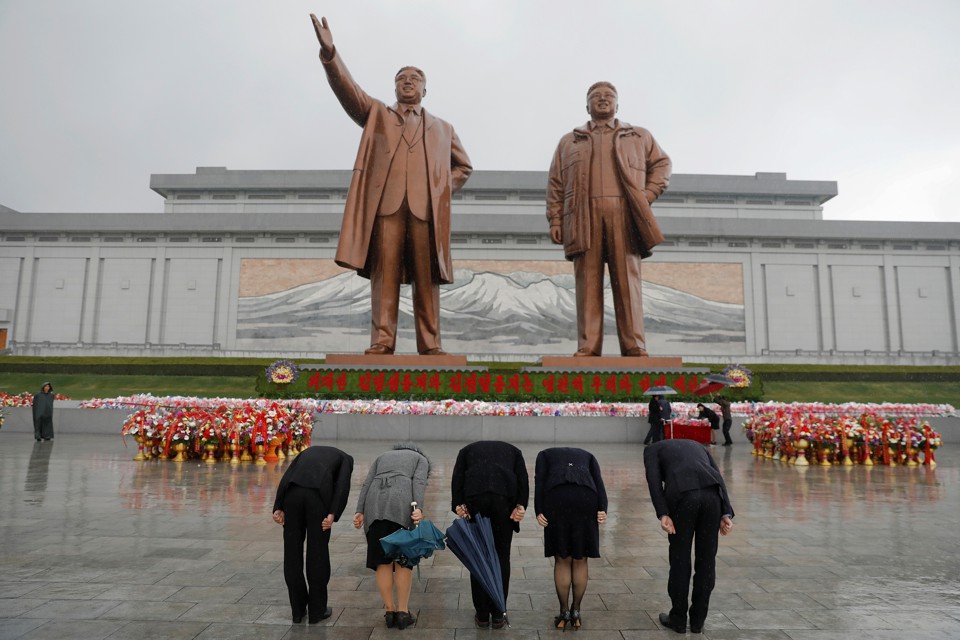
North Korea and the Risks of Miscalculation
As my colleague Kathy Gilsinan wrote last week, the hazards of this approach are on display in the latest American standoff with North Korea—a contest between two leaders who delight in bellicose rhetoric and erratic action. “When two leaders each habitually bluster and exaggerate, there’s a higher likelihood of making a catastrophic mistake based on a bad guess,” she wrote, including the threat of nuclear war. Even for those who espouse unpredictability, the presumption is that at least the putative madman has some sense what’s going on, even if no one else does. The point is the appearance of unpredictability, not true chaos.
That brings us to a baffling news item on Tuesday.
On April 9, as tension between the U.S. and North Korea over missile tests rose, the U.S. announced it was dispatching the USS
Carl Vinson, an aircraft carrier, and its retinue, toward the Korean peninsula. “U.S. Pacific Command ordered the
Carl Vinson Strike Group north as a prudent measure to maintain readiness and presence in the Western Pacific,”
a Navy spokesman said at the time.
There was one flaw in the plan,
as The New York Times reports:
The problem was, the carrier, the
Carl Vinson, and the four other warships in its strike force were at that very moment sailing in the opposite direction, to take part in joint exercises with the Australian Navy in the Indian Ocean, 3,500 miles southwest of the Korean Peninsula.
The result is the sort of thing that would comical if it didn’t involve nuclear brinkmanship. The announcement of the Vinson’s movement jacked up the tension between Washington and Pyongyang, which called the travel “reckless” and thundered,
in a statement to CNN, “We will make the U.S. fully accountable for the catastrophic consequences that may be brought about by its high-handed and outrageous acts.” Had the North Korean government, unsure how to interpret Trump’s tough rhetoric, actually started a hot war, the Vinson would have been 3,500 miles away, rather than ready to act.
How did this happen? Was it Trump’s vaunted unpredictability? Nah:
White House officials said on Tuesday they were relying on guidance from the Defense Department. Officials there described a glitch-ridden sequence of events, from a premature announcement of the deployment by the military’s Pacific Command to an erroneous explanation by Defense Secretary Jim Mattis—all of which perpetuated the false narrative that an American armada was racing toward the waters off North Korea.
The confusion might never have become public if not for another miscue: The Navy posted a picture of the Vinson steaming through the Sunda Strait in Indonesia, far from where the White House had placed it—a case of the government failing to take simple steps to cover its own tracks.
The boat blunder is only the latest example of how failure to communicate between units is undermining the Trump administration’s ability to articulate and execute a policy. In this case, the White House blames the Pentagon for providing misleading information and a premature press release, though a fuller story will probably emerge over time. (It’s important to remember that Mattis, a decorated and respected Marine general, was supposed to be one of the more competent figures in an administration full of thin government resumes.)
On Monday, it was the White House and the State Department that were odds. Even as State was expressing concerns about the apparently tainted referendum process that handed Turkish President Recep Tayyip Erdogan sweeping new powers,
Trump was calling Erdogan and offering what appeared, from the White House’s official statement, to be full-throated congratulations on the result, devoid of any concern for electoral legitimacy or worries about Erdogan’s increasingly repressive governance.


