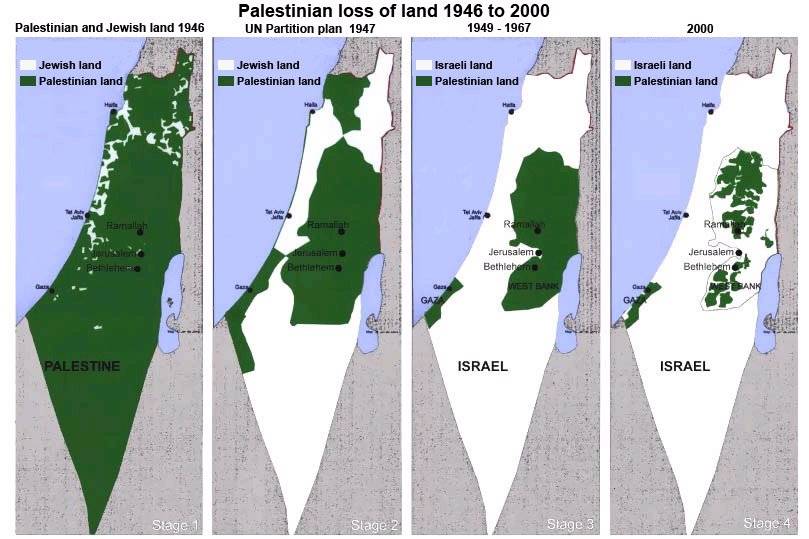
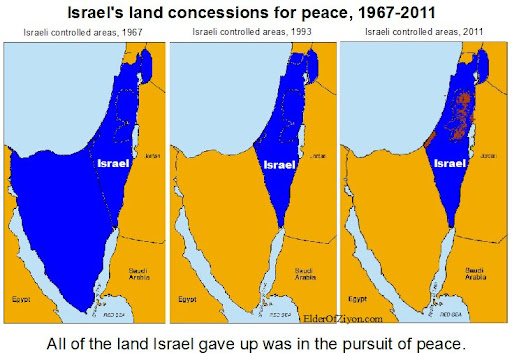
They gave up the west bank, the Sinai, Gaza.
They didn't have to give up any of it.
I think I am getting my threads mixed up here, there are several on this, anyway, yes they sure did.
In 04 sharon and bush exchanged formal letters as heads of state.
Its pretty clear what was expected from the palast. as Sharon enacted an Israeli retreat, pulled settlers ( physically uprooting them in some cases ) and troops from Gaza. in effect they did same way back ala Camp David. Sadat had proven his point as Egypt had regained their honor and he was in a position to keep the peace, Israel surrendered territory taken by conquest.
What was the Palestinian reaction after the Gaza pull out......*shrugs*
Anyone who was watching including several on the left realized back in 2009 that obamas request that Israel halt all settlements before the paalis started negotiations was not wise, it was in effect giving up something for exactly nothing, they were proven correct as that then became the rule, Abbas made it a pre-condition that they stop settlements before any negotiations on other points.
Abbas no longer trusts Obama this speech was framed to gain his confidence again, we'll see how that works out.
here-
The Wrath of Abbas
Fed up with the stalled peace talks, the Palestinian leader defies Israel and vents about Obama.
Palestinian Leader Mahmoud Abbas's Frustration with Obama - Newsweek
and, an excellent in depth view, oh and American Interest is left of center publication and Meade, well his reputation speaks for itself, hes an avowed democrat;
Baruch, this speaks to your comment earleir here or in another thread ala Right of Return...
May 14, 2011
White House Down in Middle East
Walter Russell Mead
This doesn’t mean that the US should give up on the peace process. But it means that to succeed we have to accept that peace is still far away. There will be no peace in the Middle East until a workable solution is found for the human problems of the Palestinian people. Part of this involves an independent Palestinian state including the West Bank and Gaza; part of it includes compensation for Palestinian refugees (and for Jews forced out of their homes throughout the Arab world by mob violence and government decree after 1948); part of it includes the resettlement of Gazans and stateless Palestinian refugees from countries like Lebanon, Syria and beyond where even today Palestinians lack passports and full legal rights. Part of it will involve the increasing isolation and marginalization of the shrinking minority of Palestinians who reject terms that the rest of the world (including more and more Muslims) recognizes as reasonably just. Part of it will come from pressure on governments (Syria and Iran for example) who consciously try to block peace: too many foreign powers and political groups feed on Palestinian misery and anger.
None of this means turning on Israel. The refugee problem in the Middle East is not solely or even primarily Israel’s fault, and Israel can’t solve it. No amount of pressure on Israel can solve the Palestinian refugee problem; Israel cannot and will not take them back and this has been clear for sixty years.
If anybody is to blame for the refugee mess, it is the United Nations and the ‘world community’. When the British gave up their League of Nations mandate over Palestine and returned it to UN jurisdiction, the UN failed in its duty to protect both Arabs and Jews. The war that broke out between Palestinians and Israelis and that created the refugee problem was a consequence of the UN’s failure to ensure an orderly implementation of the partition plan it approved. Had the Arabs won the war there would have been a massive Jewish refugee problem as desperate Jews fled from or were expelled by advancing Arab armies; when the Israelis won the war it was the Arabs who fled and/or were expelled.
We cannot have peace in the Middle East without a solution to the Palestinian refugee problem. It may be that the refugees (and their descendants: it has been more than 60 years since the Palestinians fled or were driven from their homes) will not accept any settlement that the world is willing or able to make. If they don’t, however, the conflict will not come to an end.
White House Down in Middle East | Via Meadia