Mr Natural
Diamond Member
- Aug 23, 2009
- 25,547
- 13,263
- 1,415
Why haven’t we?Why wouldn't we?
Follow along with the video below to see how to install our site as a web app on your home screen.
Note: This feature may not be available in some browsers.
Why haven’t we?Why wouldn't we?
Reasons. But I think we could. I think we should.Why haven’t we?

You are planned obsolescenceHey Robert, there is no need for me to watch that video nor no need for you to continually ask poster if they watched the video.
No need for humans to go to Mars.
Maybe in millions of years from now.
If I can reach the author of the video, I will; ask him.Why wouldn't we?
 Reason To Watch:If you think going to Mars is difficult, wait until you understand the physics of coming back. This video exposes the rarely discussed return problem using real rocket science, orbital mechanics, and energy calculations. You’ll discover why fuel mass multiplies exponentially, why radiation weakens astronauts, and why timing launch windows is brutally unforgiving. Inspired by Richard Feynman’s scientific skepticism, we analyze whether optimism is ignoring physical limits. This isn’t science fiction—it’s applied physics. By the end, you’ll see Mars missions differently and understand why “planting a flag” is easier than coming home alive.
 Keywords:Mars return mission, Richard Feynman physics, Mars mission failure, space travel physics, escape velocity Mars, rocket equation problem, interplanetary travel limits, why Mars is dangerous, Mars fuel problem, orbital mechanics explained, radiation in space, Mars mission engineering, space science documentary, physics of rockets, rocket mass equation, Elon Musk Mars plan, NASA Mars mission, human Mars return, deep space travel, Feynman warning, physics reality check, space exploration truth, Mars survival problem, science explained
 Timestamps:0:00 – The Mars Return Problem4:30 – Feynman’s Philosophy on Reality9:10 – The Rocket Equation Trap15:40 – Fuel Mass Explosion22:15 – Radiation & Human Limits30:50 – Launch Windows & Orbital Timing40:20 – Engineering vs Physics52:00 – Can Technology Solve It?1:05:30 – The Harsh Conclusion1
 45 – What This Means for Humanity1:34:50 – Final Thoughts
Fuel is why. No returning from Mars fuel is there. Our best rockets take 9 months to get there. Those rockets never return. IT is a one way trip for anything we have. Who understands this? If you need more persuading, here it is.

Well, that can actually be mitigated without a significant weight penalty.Once you get into space, it will not take much energy to propel you. Of more concern to me is surviving all the radiation you would be exposed to on the voyage.

 sciencesensei.com

That is much harder to solve than inhabiting Mars is.
Radiation exposure on trip to Mars:
We Know How Much Radiation Astronauts Will Receive, But We Don't Know How to Prevent it
www.universetoday.com
Radiation exposure on Mars:
How Bad Really Is the Radiation on Mars?
Mars is a world of breathtaking landscapes—and hidden dangers. Unlike Earth, Mars lacks a protective...

Fuel is why. No returning from Mars fuel is there. Our best rockets take 9 months to get there. Those rockets never return. IT is a one way trip for anything we have. Who understands this? If you need more persuading, here it is.
Can Tunnels be dug on Mars? I believe they can. Can machines get to Mars? Without crashing? Some will make it. Suppose a tunnel machine is put on Mars and needs its engine. And its engine is in a different rocket and son of a gun, it crashes. Still can the Tunnel machine return to Earth? Very profound question.If some multi Billionaire wants to take a stab at it with his own money, I wouldnt be opposed.
FAr from it being humans though at first. AI and robotics would have to lead the way. Probably putting some orbiting space station in place, from which long range craft could dock without landing on the surface. Those longer range craft could also possibly drop of supplies such as fuel.
Musk alrady has innovated tunnel boring by the way. His boring machines are designed to fit inside his rockets.

We can't return. Did you watch the video?

Fuel is why. No returning from Mars fuel is there. Our best rockets take 9 months to get there. Those rockets never return. IT is a one way trip for anything we have. Who understands this? If you need more persuading, here it is.


most of the fuel in rockets is spent escaping Earth's gravity .. so having a fuel base on the moon may indeed allow people to go to Mars and return .. of course the first manned trip would probably be an orbit of Mars .. just like they did with the moon before Armstrong set foot on it ..Moon 180k miles away
Mars about 35 million at its closest point to Earth
180000
35000000
minor difference...

Fuel is why. No returning from Mars fuel is there. Our best rockets take 9 months to get there. Those rockets never return. IT is a one way trip for anything we have. Who understands this? If you need more persuading, here it is.

No human will ever return from Mars, or get there
AI OverviewTechnology is always improving. It will eventually happen.
What is happening today is some of us want to forecast the future much like Columbus would have when he sailed and had he predicted nuclear submarines and aircraft carriers.Excellent video. I've studied the Mars problem for decades and Feynman mostly gets it right but that is an old video and some things have changed, and he didn't even go into many other problems the trip faces.
It is doable to get to Mars but it'll be super hard.
What does this add up to?
- First we need to build a Moon base, not a little one but a big one like in 2001, where people live semi-permanently and regularly commute back and force to Earth.
- We need to assemble and launch from the Moon. This greatly saves weight as escape velocity off the Moon is much less than Earth.
- Sending a refining plant to Mars to make fuel there is a possibility. Another possibility is sending several tanks of fuel ready to go robotically to Mars so that when we get there, the fuel we need to return home is already there.
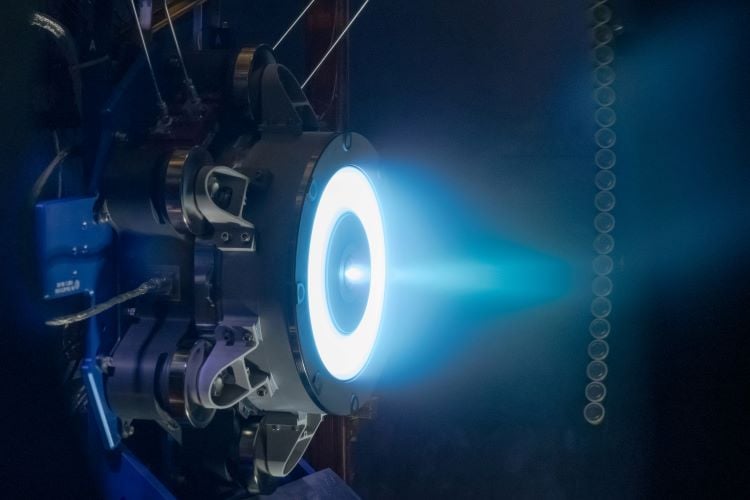
- A big problem is rocket propulsion. Rockets really are a bad solution. We need something much lighter capable of generating more thrust. There are several ideas on the drawing board.
- But the other problem is that once there, you need to build underground bases to live sheltered from radiation, then many more years adding to it to create a complete self-sustaining environment.
- Plus you still need to bring people home. No one can just stay forever on Mars, I figure at best maybe a three year stint on Mars and you are done.
So, figure on another two centuries before travel to Mars and living there is a distinct possibility; with the usual setbacks, funding, technological issues, 300 years. Put another way, late in the 24th century when Star Trek has us flying at Warp 5 in starships.
- Figure on another 100 years to get the Moon base built.
- Another 50 years to assemble your rocket and supplies.
- At least another 50 years of repeated missions to Mars both robotic and manned to get all your ducks in order before a permanent Mars colony is even viable.
That is the reality unless there is some profound advancement in our science. Total cost: probably around a quadrillion dollars, so at least, a planetary not national project. By why? Because we must get off the Earth or sooner or later face extermination by the next 6-9 mile wide impactor.
Upside: we will eventually terraform Mars and make it much more habitable like the Earth.