There was no international law in the OP.
But here's some for you:
International Humanitarian Law - Customary Law
Let's see which ones Hamas is violating, shall we?
Rule 1. The parties to the conflict must at all times distinguish between civilians and combatants. Attacks may only be directed against combatants. Attacks must not be directed against civilians. [IAC/NIAC]
Rule 2. Acts or threats of violence the primary purpose of which is to spread terror among the civilian population are prohibited. [IAC/NIAC]
Rule 6. Civilians are protected against attack, unless and for such time as they take a direct part in hostilities. [IAC/NIAC]
Rule 7. The parties to the conflict must at all times distinguish between civilian objects and military objectives. Attacks may only be directed against military objectives. Attacks must not be directed against civilian objects. [IAC/NIAC]
Rule 8. In so far as objects are concerned, military objectives are limited to those objects which by their nature, location, purpose or use make an effective contribution to military action and whose partial or total destruction, capture or neutralisation, in the circumstances ruling at the time, offers a definite military advantage. [IAC/NIAC]
Rule 9. Civilian objects are all objects that are not military objectives. [IAC/NIAC]
Rule 10. Civilian objects are protected against attack, unless and for such time as they are military objectives. [IAC/NIAC]
Rule 11. Indiscriminate attacks are prohibited. [IAC/NIAC]
Rule 12. Indiscriminate attacks are those:
(a) which are not directed at a specific military objective;
(b) which employ a method or means of combat which cannot be directed at a specific military objective; or
(c) which employ a method or means of combat the effects of which cannot be limited as required by international humanitarian law;
and consequently, in each such case, are of a nature to strike military objectives and civilians or civilian objects without distinction. [IAC/NIAC]
Rule 13. Attacks by bombardment by any method or means which treats as a single military objective a number of clearly separated and distinct military objectives located in a city, town, village or other area containing a similar concentration of civilians or civilian objects are prohibited. [IAC/NIAC]
Rule 14. Launching an attack which may be expected to cause incidental loss of civilian life, injury to civilians, damage to civilian objects, or a combination thereof, which would be excessive in relation to the concrete and direct military advantage anticipated, is prohibited. [IAC/NIAC]
Rule 15. In the conduct of military operations, constant care must be taken to spare the civilian population, civilians and civilian objects. All feasible precautions must be taken to avoid, and in any event to minimise, incidental loss of civilian life, injury to civilians and damage to civilian objects. [IAC/NIAC]
Rule 16. Each party to the conflict must do everything feasible to verify that targets are military objectives. [IAC/NIAC]
Rule 17. Each party to the conflict must take all feasible precautions in the choice of means and methods of warfare with a view to avoiding, and in any event to minimising, incidental loss of civilian life, injury to civilians and damage to civilian objects. [IAC/NIAC]
Rule 18. Each party to the conflict must do everything feasible to assess whether the attack may be expected to cause incidental loss of civilian life, injury to civilians, damage to civilian objects, or a combination thereof, which would be excessive in relation to the concrete and direct military advantage anticipated. [IAC/NIAC]
Rule 19. Each party to the conflict must do everything feasible to cancel or suspend an attack if it becomes apparent that the target is not a military objective or that the attack may be expected to cause incidental loss of civilian life, injury to civilians, damage to civilian objects, or a combination thereof, which would be excessive in relation to the concrete and direct military advantage anticipated. [IAC/NIAC]
Rule 20. Each party to the conflict must give effective advance warning of attacks which may affect the civilian population, unless circumstances do not permit. [IAC/NIAC]
Rule 21. When a choice is possible between several military objectives for obtaining a similar military advantage, the objective to be selected must be that the attack on which may be expected to cause the least danger to civilian lives and to civilian objects. [IAC/arguably NIAC]
Rule 22. The parties to the conflict must take all feasible precautions to protect the civilian population and civilian objects under their control against the effects of attacks. [IAC/NIAC]
Rule 23. Each party to the conflict must, to the extent feasible, avoid locating military objectives within or near densely populated areas. [IAC/arguably NIAC]
Rule 24. Each party to the conflict must, to the extent feasible, remove civilian persons and objects under its control from the vicinity of military objectives. [IAC/arguably NIAC]
Rule 71. The use of weapons which are by nature indiscriminate is prohibited. [IAC/NIAC]
Rule 87. Civilians and persons hors de combat must be treated humanely. [IAC/NIAC]
Rule 90. Torture, cruel or inhuman treatment and outrages upon personal dignity, in particular humiliating and degrading treatment, are prohibited. [IAC/NIAC]
Rule 91. Corporal punishment is prohibited. [IAC/NIAC]
Rule 92. Mutilation, medical or scientific experiments or any other medical procedure not indicated by the state of health of the person concerned and not consistent with generally accepted medical standards are prohibited. [IAC/NIAC]
Rule 97. The use of human shields is prohibited. [IAC/NIAC]
Rule 106. Combatants must distinguish themselves from the civilian population while they are engaged in an attack or in a military operation preparatory to an attack. If they fail to do so, they do not have the right to prisoner-of-war status. [IAC]
Rule 113. Each party to the conflict must take all possible measures to prevent the dead from being despoiled. Mutilation of dead bodies is prohibited. [IAC/NIAC]
Rule 136. Children must not be recruited into armed forces or armed groups. [IAC/NIAC]
Rule 137. Children must not be allowed to take part in hostilities. [IAC/NIAC]
Or does this law only apply to Jews?


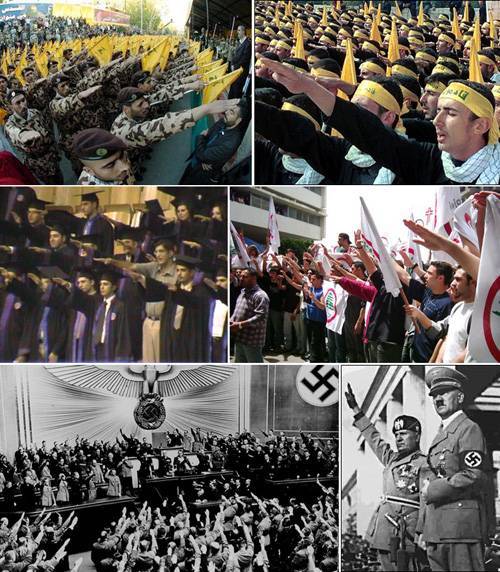
 , Adolf Hitler's 900-page autobiography outlining his political views, has been translated into Arabic a number of times since the early 1930s.